
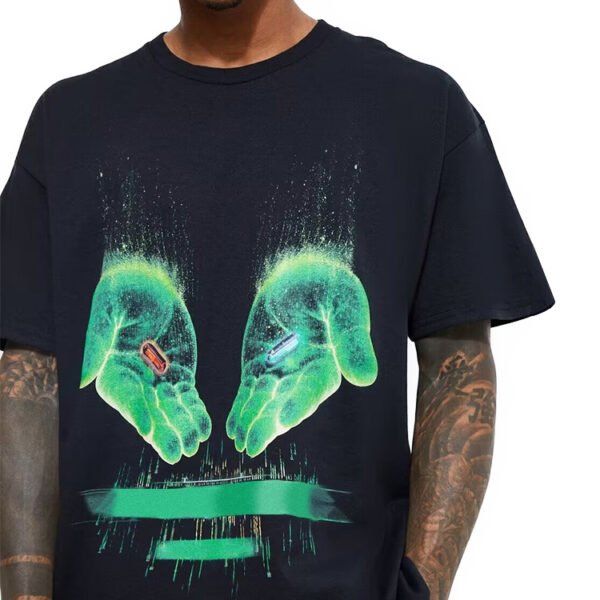
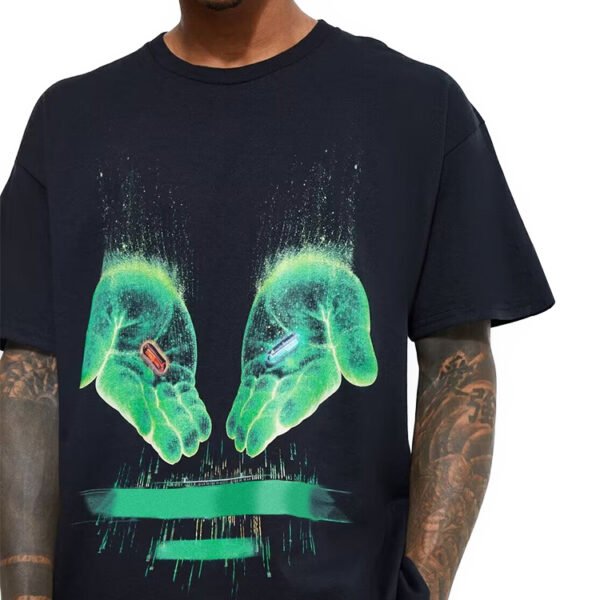
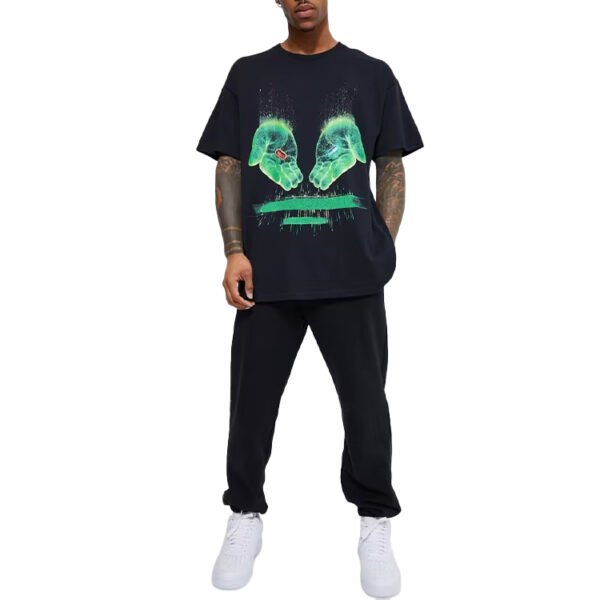
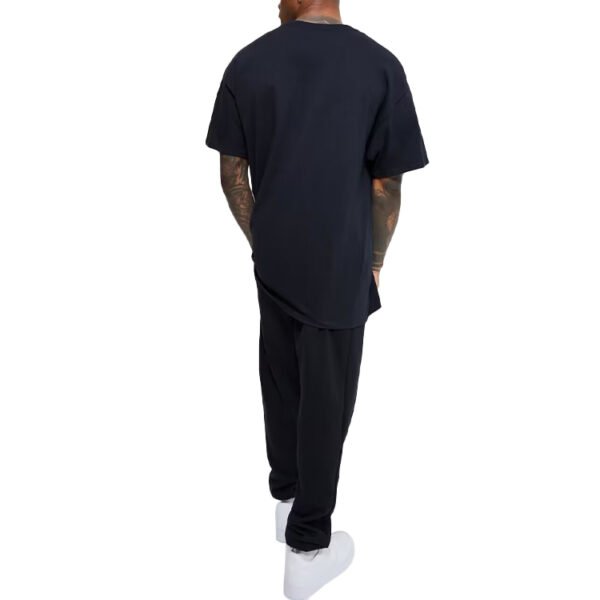
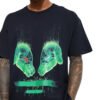
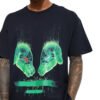
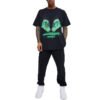
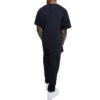
A custom oversized graphic tee is only commercially dependable when its relaxed proportions remain balanced after laundering. The supplied image shows a long body, dropped shoulders, and a dominant centered graphic, making dimensional stability and torque control more important than decoration alone for repeatable production.
Why Dimensional Stability Leads This Development
An oversized tee has more visual exposure than a close-fitting style, so small length or width changes alter the intended proportion. The image's extended body and broad sleeves require a controlled measurement plan before artwork placement and size grading are finalized.
Torque is equally important because side seams can rotate when fabric relaxes unevenly during washing or finishing. With a large front graphic, even modest twisting becomes conspicuous: the print no longer sits squarely with the wearer's chest, center front, and hem.
Reading the Supplied Product Evidence
The main image presents a dark, smooth-looking jersey surface, a rounded crew neck, short sleeves, and a long relaxed body. Those visible elements support a T-shirt development brief, but they do not verify fiber content, GSM, stitch density, or laundering performance.
The chest artwork uses bright green imagery against the dark ground, creating a strong alignment reference for production inspection. Buyers should treat the artwork edges, neckline center, shoulder balance, and hem line as visual checkpoints when reviewing fit samples and decorated panels.
Construction Controls for an Oversized Body
The pattern should establish finished body length, chest width, shoulder drop, sleeve opening, and side-seam position as separate toleranced measurements. Oversizing should come from deliberate pattern geometry rather than uncontrolled grading, especially where the front graphic needs stable placement across sizes.
Neckline recovery and shoulder-seam behavior also deserve attention because relaxed proportions can make weak stabilization visible. VeeWen's development team can compare prewash and postwash measurements, then adjust pattern allowances, seam construction, or handling instructions before approving the production-ready specification.
Print Placement and Shape Retention
A broad front graphic increases the buyer's need for dimensional consistency because its composition depends on a stable panel. The supplied artwork sits centrally across the upper torso, so placement should be checked from the true center front rather than estimated from side seams.
The trade-off is that stronger dimensional controls may limit certain wash effects or require additional sampling before approval. A buyer seeking a deliberately relaxed look should define acceptable postwash change clearly, while still rejecting visible twisting, neckline distortion, or artwork misalignment.
VeeWen Workflow Checkpoint
Within VeeWen's product-development workflow, this style should begin with a measurement-led tech pack that records the oversized block, artwork coordinates, wash condition, and inspection points. The first sample should be reviewed before decoration approval, because print decisions depend on the stabilized body shape.
The next checkpoint is a comparison of original and laundered samples by size, focusing on length, chest width, hem balance, and side-seam rotation. Once the buyer accepts the measured tolerance and visual result, VeeWen can lock the construction and decoration instructions for MOQ: 100 pieces per style.
Buyer Approval and Commercial Trade-Offs
The commercial advantage is a recognizable oversized silhouette that keeps its graphic presentation consistent across wearers and repeat orders. The limitation is that dimensional control may reduce tolerance for casual pattern variation, and the final hand feel, shrinkage, and recovery remain dependent on confirmed fabric and finishing.
Approval should therefore be based on a laundered size-set sample, not an unwashed prototype alone. Confirm the composition, finished measurements, artwork scale, neckline recovery, seam alignment, and acceptable change after care before releasing the style for production.
Buyer Questions
Is the shirt confirmed to be 100% cotton?
No. The source wording mentions cotton, but supplied evidence does not verify composition; VeeWen should confirm the fabric specification, blend, weight, and recovery.
Why test torque on an oversized T-shirt?
Because side-seam rotation can disturb the long body's balance and make the centered chest artwork appear slanted, especially after laundering or finishing.
What should the first approval sample include?
Request the intended fabric, complete oversized measurements, artwork placement, neckline construction, care process, and a laundered comparison showing dimensional change by size.
What is the minimum commercial quantity?
The commercial minimum is MOQ: 100 pieces per style, with production proceeding against approved measurements, materials, decoration details, and final technical specifications.
Approve the Wash-Stable Oversized Block
Send VeeWen the artwork, target measurements, fabric direction, and care expectations. We will organize the dimensional-control checkpoints needed to approve a balanced oversized tee before MOQ: 100 pieces per style production.


Reviews
There are no reviews yet.