


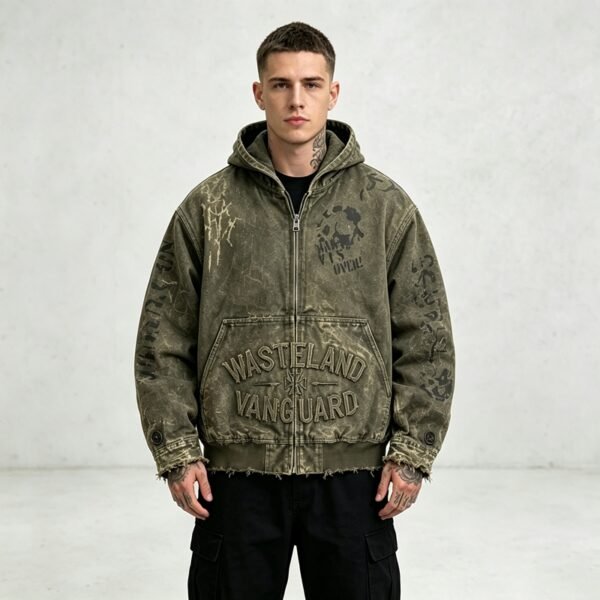
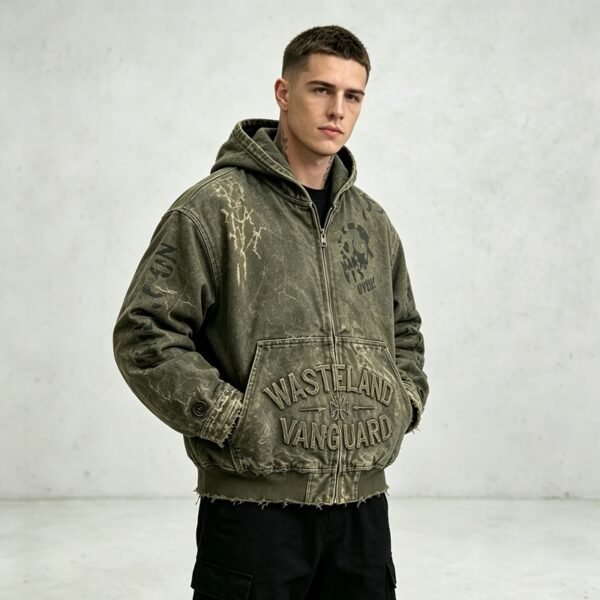
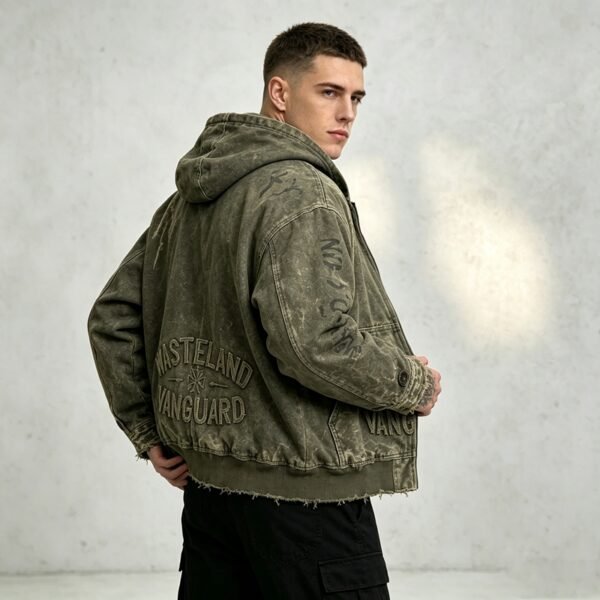




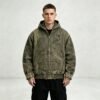
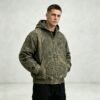

This jacket should be developed around disciplined raw-edge containment. The canvas reference and distressed surface invite visible irregularity, but the hood, artwork, embroidery, and frayed hem still need defined boundaries so the finished garment looks intentionally worn rather than structurally unstable.
Make Fraying a Defined Construction Zone
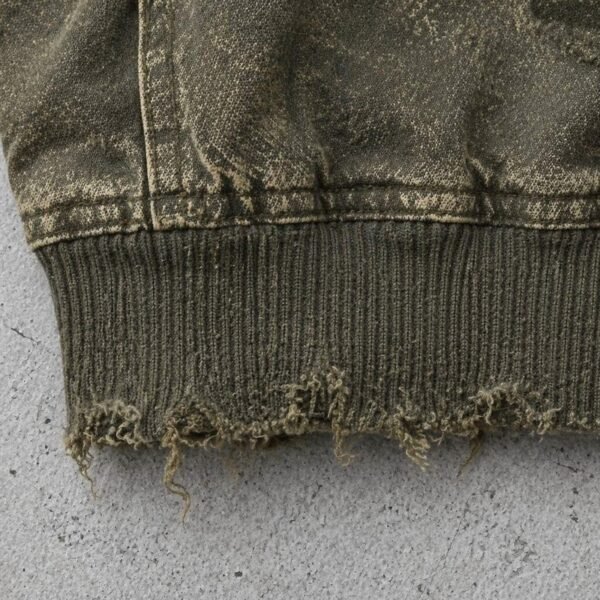
Raw fraying becomes a product feature only when its location, depth, and stopping points are controlled. The source wording identifies a frayed hem, so the development pack should distinguish intended exposed yarns from protected seams and stress-bearing areas.
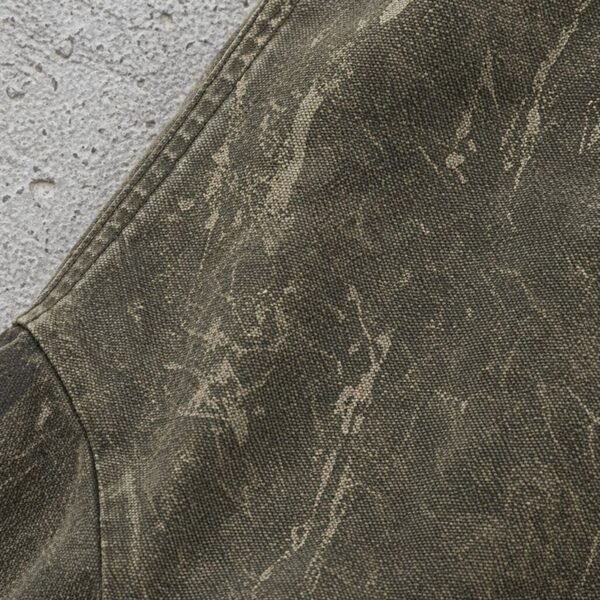
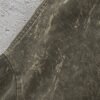
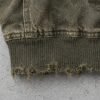
The close-up image shows dense canvas structure with irregular tonal wear, but it does not prove how far fraying extends. VeeWen should map the hem treatment separately from the body fabric, specifying edge allowance, seam security, and acceptable visual variation.
Protect Seams Beneath a Distressed Surface
A distressed finish can weaken edge stability if abrasion reaches seam allowances, pocket corners, hood joins, or cuff attachments. The jacket therefore needs a containment plan that keeps the worn appearance visible while preserving load paths through the underlying construction.
During VeeWen's development review, inspect raw-edge zones after handling and sample finishing. Check whether loose yarns migrate into stitching, whether seam lines remain straight, and whether the visual treatment creates weak points around openings or attachment areas.
Separate Decorative Processes by Their Stress
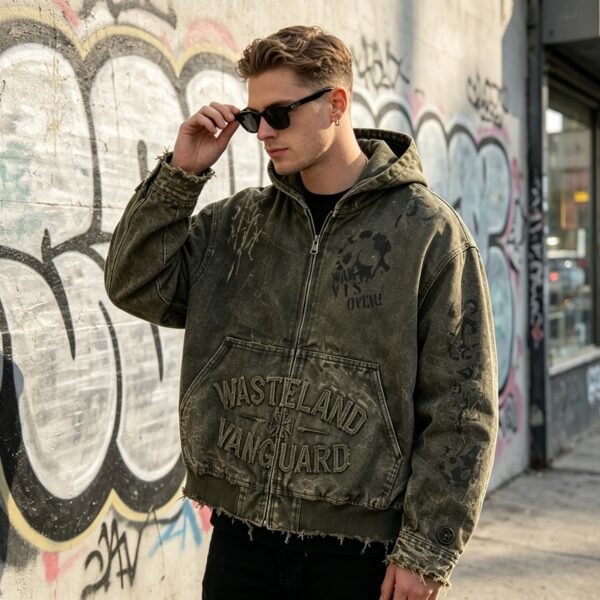
Towel-style embroidery and direct-to-garment print impose different requirements. Embroidery adds localized mass and needle penetration, while printing depends on a stable surface and controlled artwork boundary. They should be developed as distinct operations within one coordinated placement map.
The source title names both decoration types, but supplied evidence does not verify scale, artwork, thread density, ink system, or curing. VeeWen should confirm each process on the selected canvas before approving their position near distressed or frayed areas.
Use Canvas Structure to Frame the Finish
The close-up visibly shows a compact woven texture and muted olive-brown appearance. That structure can support a rugged outerwear direction, yet its hand, weight, and shrinkage behavior will affect how the hood, body panels, and raw hem settle after finishing.
The workflow should compare fabric swatches with the intended abrasion and decoration sequence. Confirm whether the canvas remains receptive to print, whether embroidery puckers the panel, and whether finishing changes edge behavior before the final pattern and artwork package are released.
Grade Fray and Artwork With the Garment
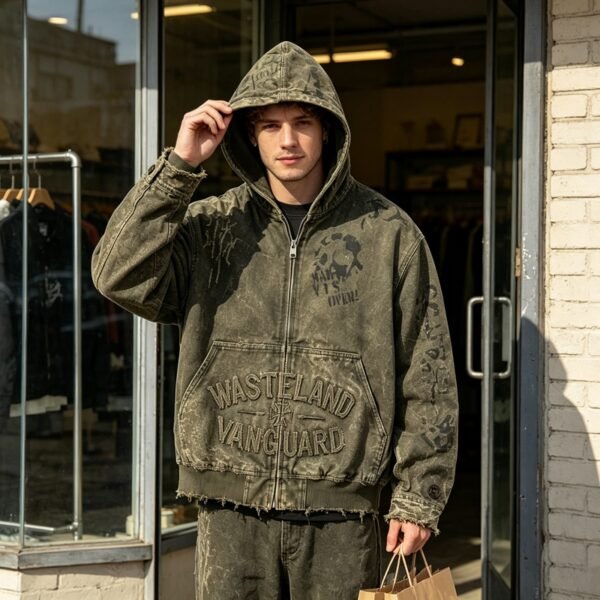
Size grading affects more than body measurements on a decorated jacket. Hem exposure, artwork placement, embroidery scale, hood proportion, and sleeve balance must remain intentional across labels, or the distressed composition may appear crowded in smaller sizes and underdeveloped in larger ones.
VeeWen's technical review should overlay the graded pattern with decoration and treatment zones. This reveals whether artwork crosses seams, whether embroidery approaches the hood or pocket, and whether the raw hem maintains a consistent visual rhythm across the range.
Set the Durability Approval Checkpoint
The buyer's decision is whether the jacket can carry controlled imperfection without uncontrolled failure. Approve only after reviewing the raw hem, seam junctions, hood opening, cuffs, embroidery backing, print edges, and surface abrasion as one finished system.
For the stated MOQ: 100 pieces per style, record the approved treatment envelope in the production file. Define acceptable fray length, tonal variation, placement tolerance, and repair limits so operators can reproduce the intended character consistently.
Buyer Questions
Does the image verify the canvas composition?
No. The image supports a canvas-like woven surface, while exact fiber content, GSM, finishing chemistry, and performance characteristics require source or laboratory confirmation.
Can frayed hems be reproduced consistently?
Yes, through a defined treatment zone, edge allowance, containment method, and acceptable variation range documented in the technical specification and approved sample.
Should embroidery and printing be tested together?
Yes. Their combined placement should be reviewed on the selected canvas because needle penetration, surface stability, artwork edges, and finishing sequence can interact.
What is the exact commercial minimum?
The exact commercial minimum is MOQ: 100 pieces per style. Final production remains subject to approved materials, treatment standards, decoration details, and confirmation.
Approve the Controlled Distress Standard
Share your target jacket measurements, artwork, and desired fray character with VeeWen. Development begins by approving the canvas treatment envelope and decoration map before production specifications are finalized.



Reviews
There are no reviews yet.