
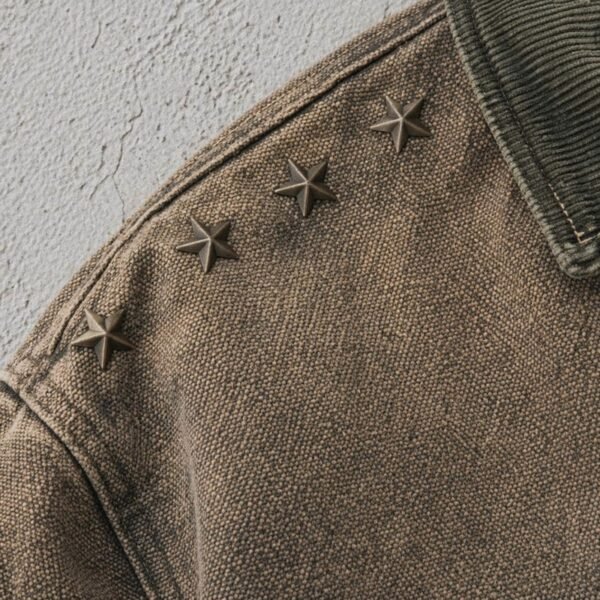
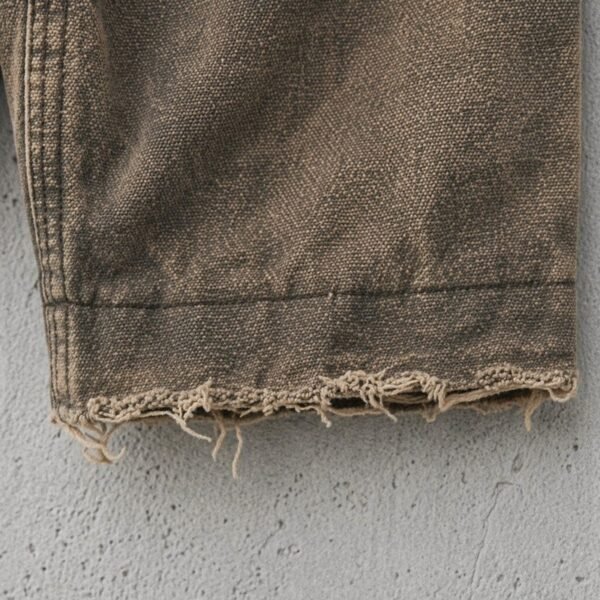
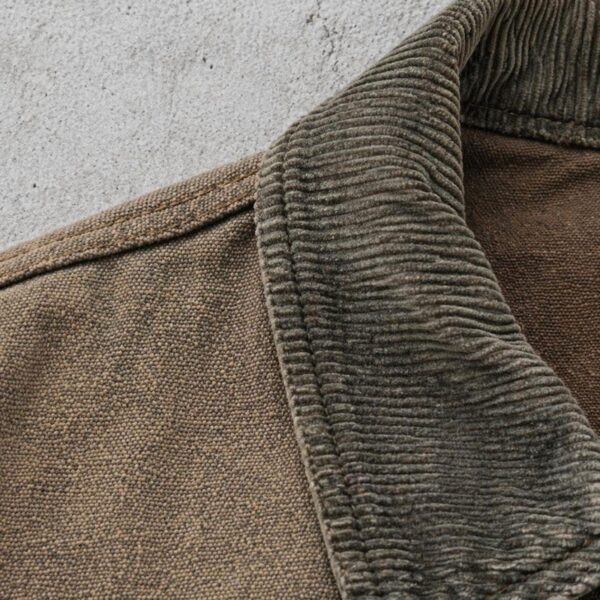



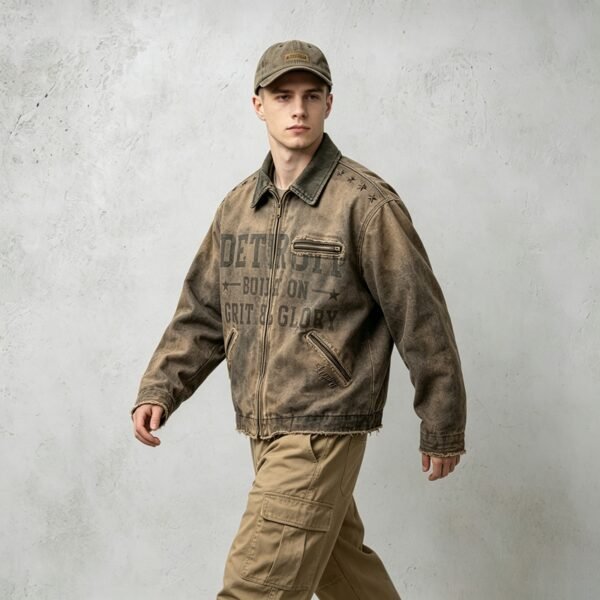





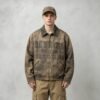



This full-zip canvas jacket is developed around neckline pull without a hood: the collar, zipper endpoint, and front facing determine how the garment closes against the neck. The image shows corduroy contrast, shoulder rivets, and textured washed canvas, so closure engineering must protect both structure and comfort.
The Collar Replaces Hood Volume
Because this jacket has no hood, the neckline's visual authority comes from the collar and upper front edges. The supplied close-up shows a ribbed corduroy collar against textured canvas, making collar height and roll behavior more important than drawcord adjustment.
A taller collar can frame the neck and reinforce a protective outerwear impression, while a lower collar improves openness and layering. The pattern must balance stand height, seam allowance, and fold line so the neckline does not collapse when the zipper is partly open.
Zipper Pull Determines Neckline Tension
The source wording identifies a full-zip jacket, so the zipper endpoint becomes the practical control for neckline pull. When closed, the slider and top stop concentrate tension at the collar base; when open, the facing must remain orderly rather than spreading unpredictably.
Prototype reviews should compare fully closed, half-open, and fully open positions across the size range. Check whether the zipper can reach the intended endpoint smoothly, whether the collar edges meet evenly, and whether the neck feels compressed over a light base layer.
Corduroy Contrast Adds a Hinge Effect
The visible collar uses a ribbed texture distinct from the canvas body, creating a clear transition at the neckline. That contrast can help define the closure, but different materials may fold, recover, and absorb wash effects differently at the same seam.
Treat the collar-body join as a hinge requiring controlled turn-of-cloth and stitch placement. Too much rigidity can make the collar stand away from the neck; too little support can erase the contrast. Approval should prioritize the intended profile after washing and pressing.
Rivets Increase Shoulder Constraint
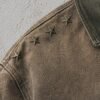
Several raised star rivets appear near the shoulder area, where the jacket naturally flexes during arm movement. Their placement adds visual emphasis beside the collar, but hardware can increase localized weight and affect how the upper panel folds toward the neckline.
Map rivet positions against shoulder seams, collar joins, and armhole movement zones before finalizing artwork. The buyer should review whether the decoration remains visually balanced when the zipper is closed and whether the shoulder still moves comfortably during reach and layering tests.
Washed Canvas Exposes Construction Decisions
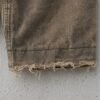
The image shows a pronounced canvas weave and uneven brown tonal variation associated with a washed appearance. Such surface variation can highlight seam ridges, collar edges, and the raw hem, meaning construction choices will remain visible rather than disappearing into a smooth finish.
Approve the wash reference alongside collar and zipper samples, because processing can change hand feel and edge definition. The review should examine the collar fold, zipper tape visibility, rivet surroundings, and frayed hem character as one finished visual system.
VeeWen Workflow Locks Closure Before Decoration
VeeWen's workflow should begin this jacket's technical review with collar pattern geometry, zipper length, top-stop position, facing width, and seam support. Those decisions establish the neckline behavior before rivet mapping, DTG artwork, wash development, and raw hem finishing are treated as final.
At the buyer checkpoint, VeeWen can consolidate the approved closure block into the graded pattern and decoration package. Sign off only after the collar profile, zipper pull, shoulder mobility, and washed appearance remain coherent across the intended size range.
Buyer Questions
Does this jacket include a hood?
No hood is visible in the supplied image or identified in the source wording. The development focus is the collar, zipper endpoint, and hoodless neckline.
What controls the neckline when zipped?
The collar stand, zipper endpoint, top stop, and front facing jointly control closure tension, comfort, and the final profile around the wearer's neck.
Are the star rivets confirmed as hardware?
The supplied image visibly shows raised star-shaped accents, while the source wording identifies star rivets. Final hardware material, attachment, and testing require confirmation.
What is the minimum order quantity?
The commercial minimum is MOQ: 100 pieces per style. Final quantity planning should account for approved sizes, colors, hardware, decoration, and packaging requirements.
Approve the Collar and Zip
Share your target size range, zipper preference, decoration map, and wash direction so VeeWen can review neckline ease, collar profile, hardware placement, and hem character.


Reviews
There are no reviews yet.