
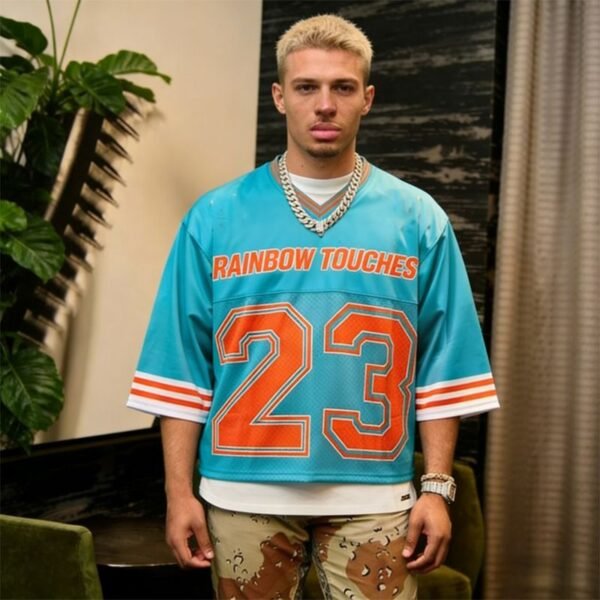
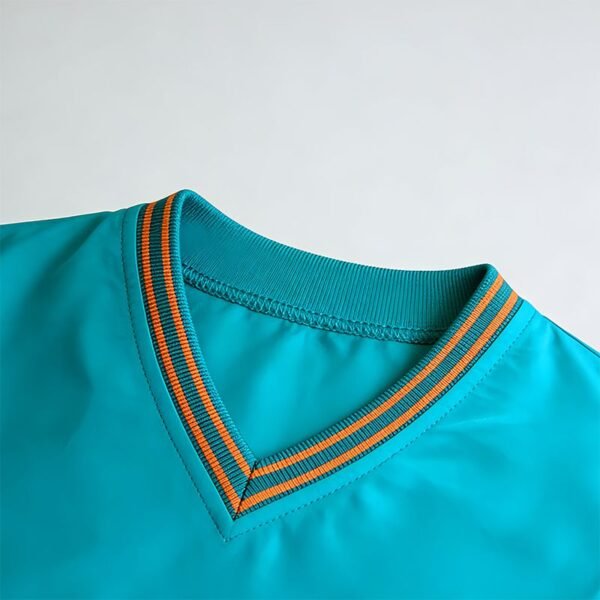
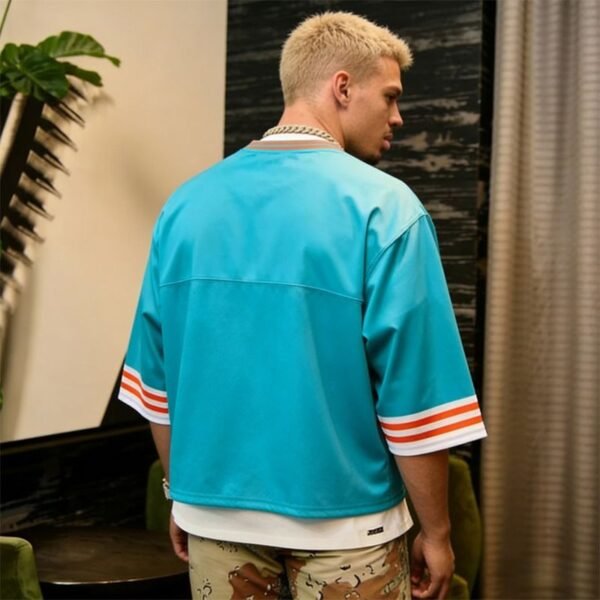

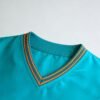
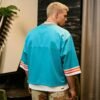

This jersey requires a stress map that follows movement, not a random reinforcement grid. The supplied image shows a broad outlined torso number, striped sleeves, and a flexible mesh body, making bartack location central to durability, comfort, and graphic cleanliness.
Why Bartacks Need a Stress Map
A jersey moves across the shoulder, underarm, side seam, sleeve opening, and lower hem. Each junction experiences a different combination of pulling and recovery. Bartacks are most useful when they connect reinforcement to those actual force paths rather than being placed uniformly.
The broad front number adds another consideration: stitching or applique handling can stiffen the torso locally. Reinforcement should support nearby seams without creating hard points that interrupt drape, rub against the wearer, or compete with the graphic treatment.
Number Applique and Load Transfer
The outlined number visibly spans a large section of the front, so its perimeter may influence how the mesh stretches during reaching and bending. If the applique edge resists movement, adjacent mesh can carry more force. A coordinated reinforcement plan can moderate that transfer.
The buyer should review corners, outline intersections, and lower number edges for lifting or distortion. Bartacks should reinforce genuine stress locations while staying visually quiet. Their spacing and orientation should follow seam direction and expected pulling, not simply mirror the printed artwork.
Sleeve Stripe Junctions
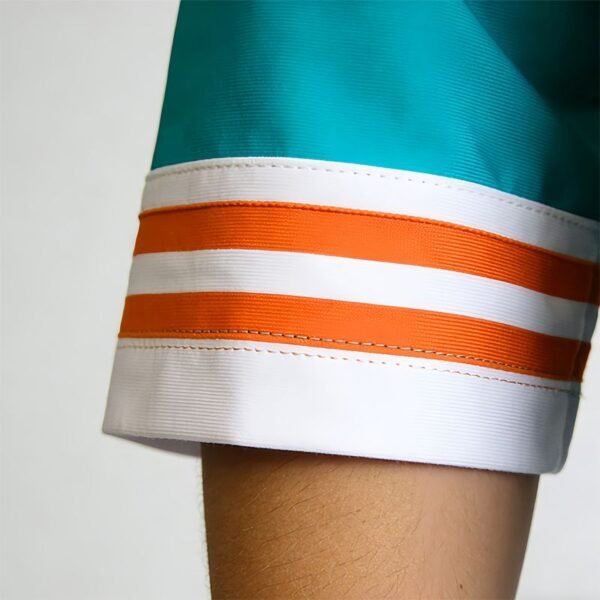
The image shows multiple orange and white sleeve stripes near the lower sleeve. Stripe changes add seam and decoration decisions in a region that moves frequently. Bartacks placed near the sleeve opening or stripe joins must avoid bunching the mesh or interrupting the clean horizontal rhythm.
A reinforcement that is too dense may create a rigid cuff-like feel, while too little support can allow opening seams to spread. The first sample should compare reinforcement positions beside the stripe layout, including how the sleeve hangs when the arm is relaxed.
Mesh Behavior and Comfort
Mesh is flexible by appearance, but the supplied image alone cannot establish its fiber content, openness, weight, or stretch performance. Those variables affect how a bartack penetrates the fabric and whether reinforcement remains comfortable. The construction decision therefore depends on the approved material.
VeeWen should assess needle entry, thread concentration, and backing or stabilizer requirements on the selected mesh. Any support layer must preserve the intended hand and airflow characteristics. The goal is localized strength that does not turn a breathable-looking body into a stiff patchwork.
VeeWen Development Checkpoint
VeeWen's workflow should translate the artwork and pattern into a stress map before final sample approval. Mark the shoulder, underarm, side seam, sleeve opening, hem, and number perimeter, then identify where bartacks can distribute force without crossing prominent graphic boundaries.
The sample record should capture bartack length, direction, thread appearance, placement tolerance, and interaction with the twill number. This product-specific map gives cutting, sewing, and decoration teams one shared reference while leaving unverified performance values open for confirmation.
Approval Through Movement Testing
Review the jersey on a moving wearer or form with arms raised, extended, and relaxed. Observe the number perimeter, sleeve stripes, side seams, and hem while the body stretches. Look for mesh distortion, seam opening, applique lift, or reinforcement that becomes visually dominant.
Approve production only after deciding the acceptable balance between reinforcement and mobility. The buyer should confirm the stress locations, bartack visibility, number attachment, and mesh reference together, because changing one element can alter force distribution across the finished jersey.
Buyer Questions
Are the bartack locations visible in the image?
No. The supplied image supports the stress-map rationale but does not prove bartack placement. Confirm locations, dimensions, thread, and tolerances through the development sample.
Why does the large number affect reinforcement?
A broad twill applique can resist local mesh movement, shifting force toward its perimeter and nearby seams. Review corners and edges for lifting, rippling, or distortion during movement.
Does mesh automatically provide athletic performance?
No. Mesh appearance does not verify fiber content, breathability, moisture behavior, stretch, or durability. Those characteristics require confirmation from the selected fabric reference and sample.
What is the commercial minimum?
The exact commercial minimum for this VeeWen style is MOQ: 100 pieces per style. Final artwork, mesh, reinforcement, sizing, and attachment details require development approval.
Approve the Stress Map
Share the jersey artwork, mesh reference, and movement priorities with VeeWen for a sample review covering bartack placement, number attachment, stripe junctions, and reinforcement visibility.



Reviews
There are no reviews yet.