
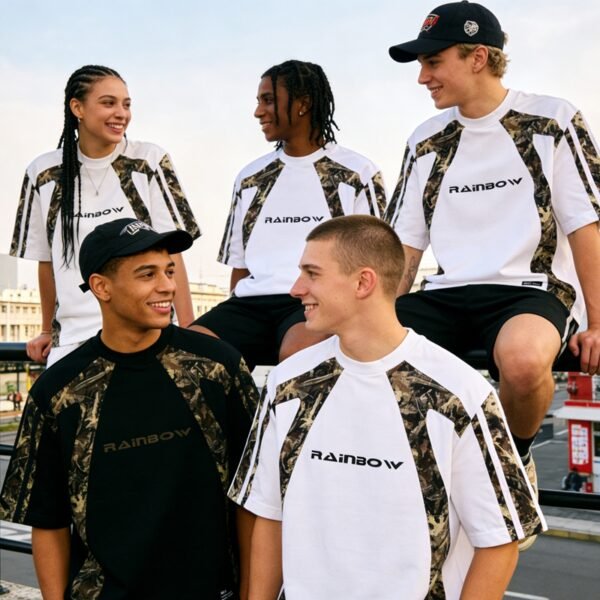
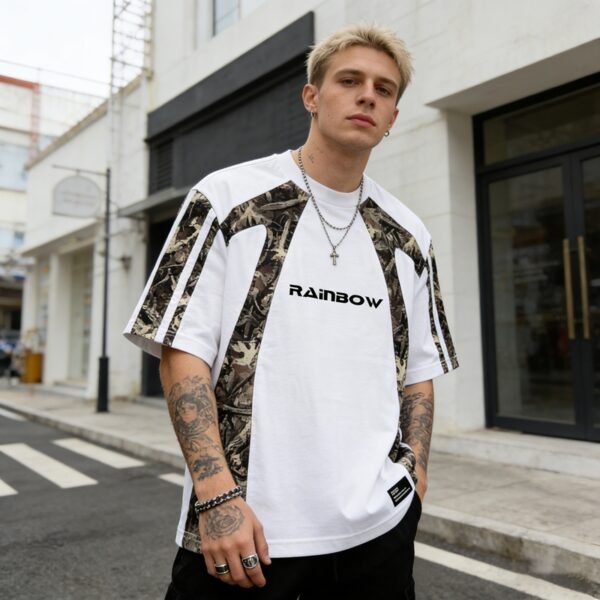
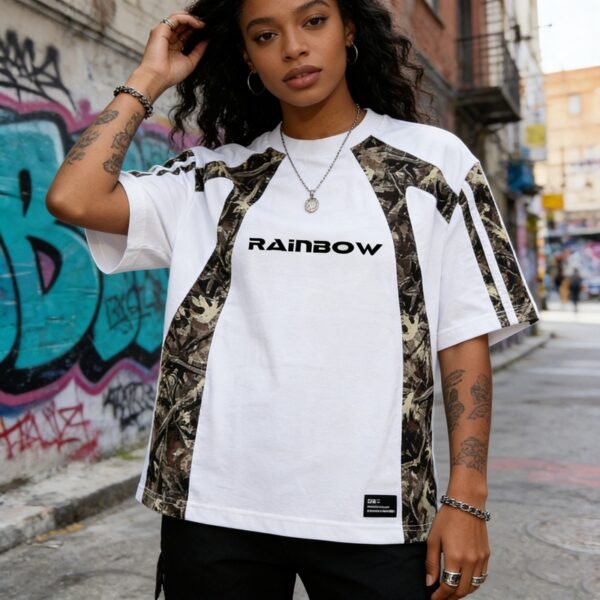
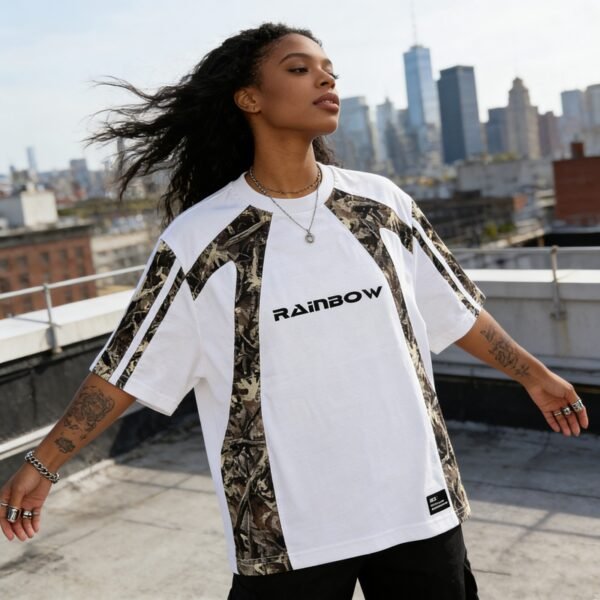
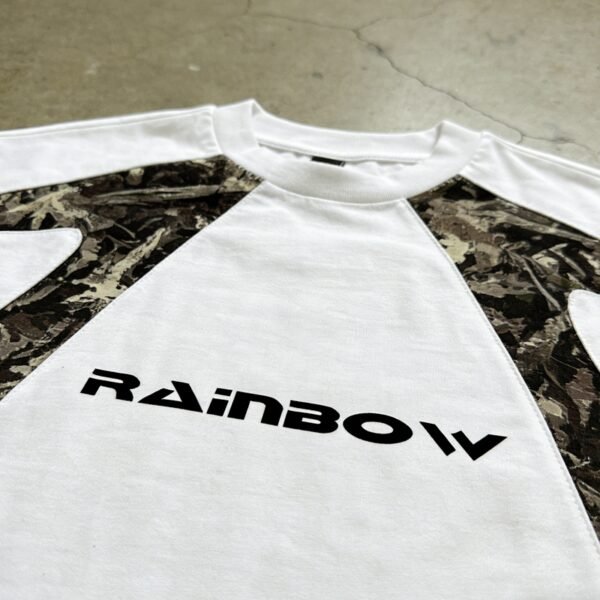
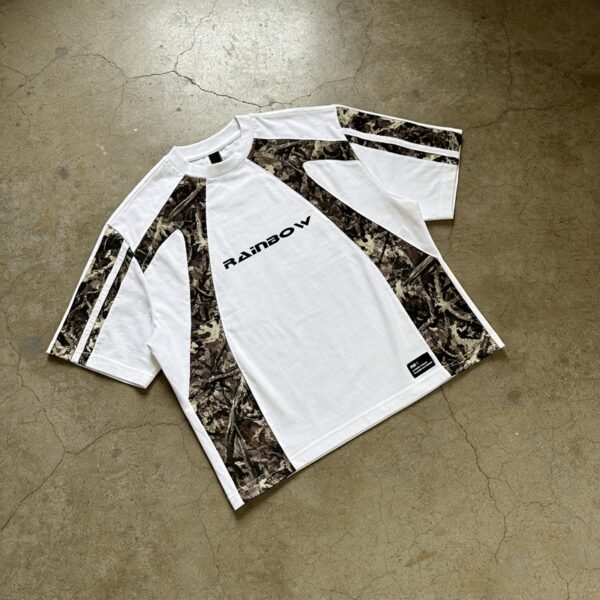
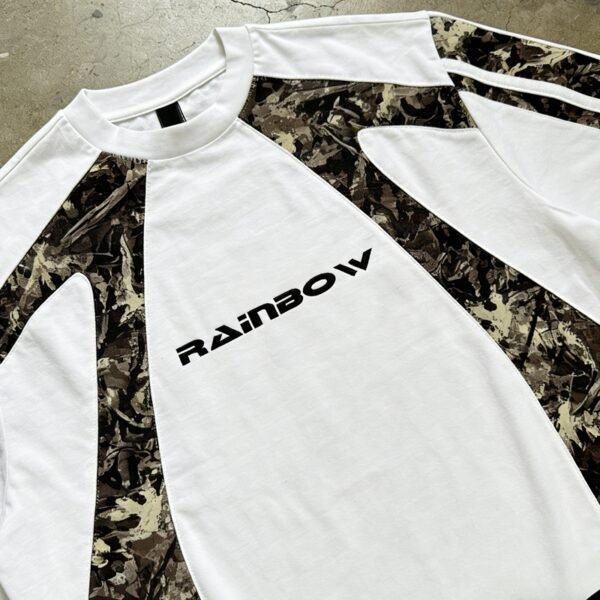
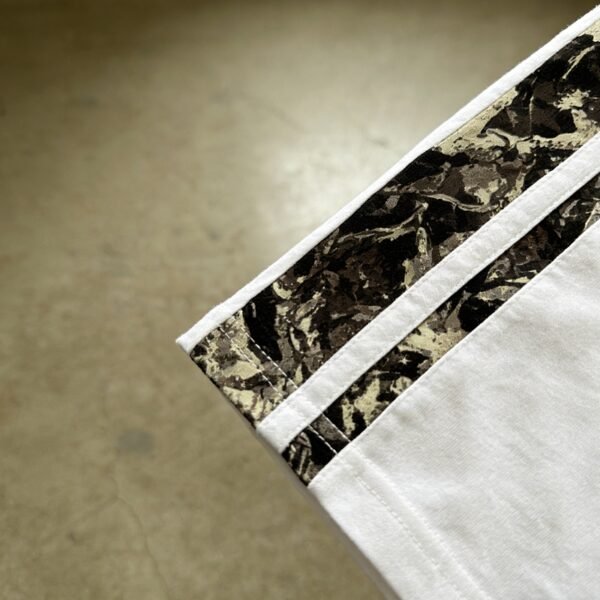
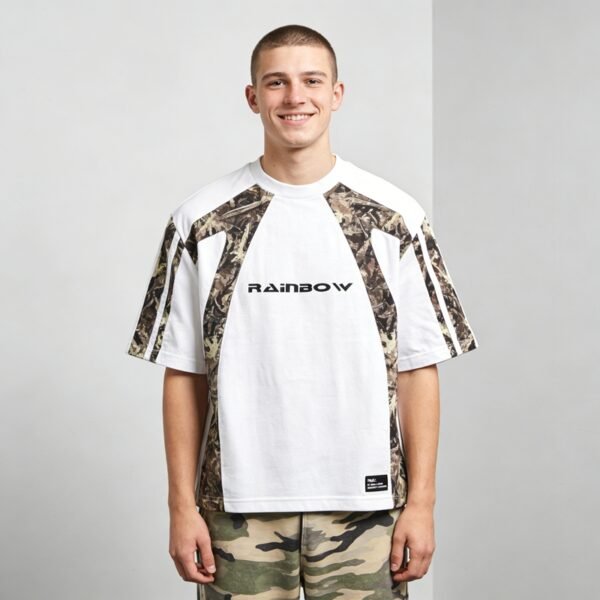




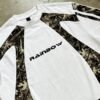
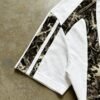
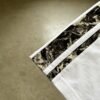
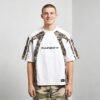
This custom oversized T-shirt uses angular camouflage panels to organize the entire silhouette. Its development challenge is marker direction: broad body pieces, extended sleeves, and visibly oriented inserts compete for cutting yield. VeeWen aligns print flow, panel symmetry, and material consumption before final costing and approval.
Define Direction Before Building the Marker.
Camouflage is visually irregular, yet it is not automatically nondirectional. Branches, shadows, and elongated forms can establish a clear upward or lateral flow, making randomly rotated pieces appear inconsistent even when every component comes from the same printed material.
VeeWen should classify each camouflage component as one-way, paired, or freely rotated before marker creation. That decision governs whether left and right sleeves may be nested oppositely, whether shoulder inserts require mirroring, and how much usable width remains around oversized body pieces.
Account for the Oversized Pattern Footprint.
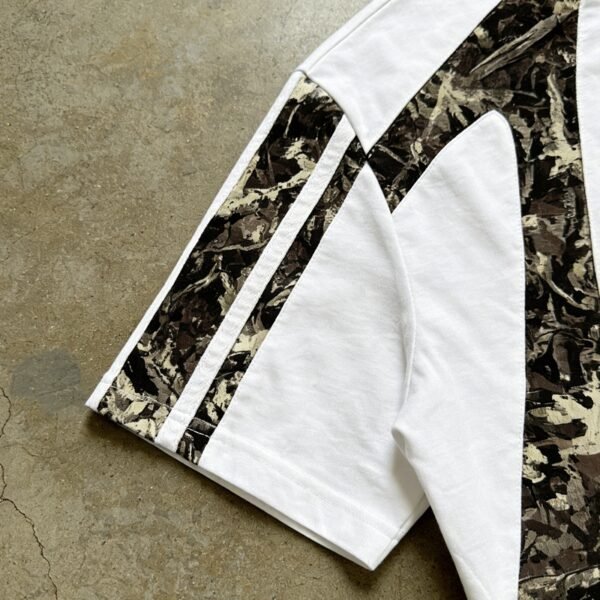
The photographed fit combines broad torsos, dropped shoulders, and sleeves extending near the elbow. Those proportions enlarge the marker footprint and reduce opportunities to place small pieces between major panels, especially when print direction prevents rotation or when fabric width limits nesting choices.
Costing should use the approved oversized pattern rather than a standard T-shirt consumption assumption. Body length, chest width, sleeve extension, size range, fabric width, shrinkage allowance, and directional restrictions must enter the marker calculation before VeeWen confirms the production material requirement.
Control the Shoulder-to-Sleeve Print Flow.
The camouflage treatment travels across the upper shoulder and down the sleeve, making discontinuity highly visible. Although exact motif matching may be unnecessary, conflicting directions or dramatically different print densities can interrupt the intended athletic panel line and make paired sleeves look unrelated.
The buyer should select an approval standard for visual flow: directional alignment, balanced density, or exact motif positioning. Each level carries different cutting implications, so VeeWen should document acceptable left-right variation with annotated sample photographs instead of relying on subjective instructions during production.
Coordinate White and Black Body Variants.
The main image shows the same panel concept against both white and black bodies. Camouflage contrast reads differently on each base: white emphasizes every insert edge, while black reduces some boundaries and increases the importance of consistent panel shape and graphic visibility.
If both colorways enter one program, VeeWen should preserve common pattern geometry while reviewing artwork color, thread choice, and panel distribution separately. Shared markers may be inappropriate when base materials, shrinkage behavior, or order quantities differ, even though the silhouette appears visually related.
Use Cutting Rules to Protect Assembly.
Angular inserts create pointed seam entries and multiple alignment landmarks. A marker optimized only for yield can still create assembly problems if pieces lose clear notches, mirrored components are mixed, or print direction changes unnoticed between bundles intended for opposite garment sides.
VeeWen's workflow should connect marker approval to bundle identification and sewing references. Directional arrows, left-right labels, panel codes, and notch checks should follow pieces from cutting through assembly, ensuring the approved camouflage logic survives beyond the marker software and cutting table.
Approve Consumption with a Marker Review.
Material consumption becomes a design decision when buyers request controlled motif placement. Stricter matching creates unusable spaces around pieces and may require shifting components within the repeat, while relaxed variation improves yield but allows more visible differences among garments and paired panels.
Before purchase planning, VeeWen should present the marker assumptions alongside a representative sample. The buyer's checkpoint is to approve orientation, matching tolerance, colorway rules, size coverage, and acceptable variation, then confirm that the resulting consumption basis reflects the intended commercial product.
Buyer Questions
Why must camouflage direction be approved?
Irregular motifs can still carry recognizable flow. Approval prevents opposing sleeves, inverted branches, or inconsistent panel density from weakening the intended design while establishing realistic rotation restrictions for marker planning.
Does exact camouflage matching reduce material yield?
Usually, stricter motif positioning limits where pattern pieces can sit within the print repeat, creating additional unused space. Actual consumption depends on approved patterns, fabric width, repeat dimensions, and matching tolerance.
Can VeeWen develop both pictured base-color directions?
Yes. White and black body directions can share design geometry, but each requires separate confirmation of material, thread, graphic color, camouflage contrast, shrinkage behavior, marker assumptions, and approved visual standards.
What is the commercial minimum for this T-shirt?
MOQ: 100 pieces per style. Final production should follow approval of measurements, material details, camouflage artwork, panel direction, matching tolerance, marker assumptions, labeling, packaging requirements, and the signed reference sample.
Set the Print Direction Before Confirming Consumption.
Send VeeWen your oversized measurements, camouflage artwork, colorways, and matching expectations. We will develop the pattern and marker logic for approval, with MOQ: 100 pieces per style for confirmed custom manufacturing.


Reviews
There are no reviews yet.