
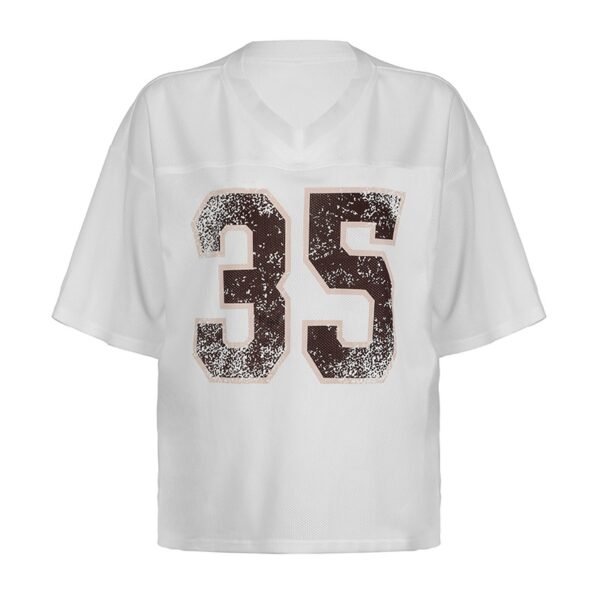





This jersey concept depends on a small but decisive interface: how the V-neck rolls, stands, and settles against lightweight mesh. The image shows a shallow opening, bound edge, oversized body, and prominent numbered graphic. VeeWen should develop those relationships together, because collar control determines whether volume reads deliberate or unstable.
Why Collar Geometry Governs the Oversized Shape
An oversized jersey carries substantial visual width through its shoulders, sleeves, and torso. A controlled V-neck introduces a directional break near the face, while sufficient stand height prevents the neckline from disappearing into the body. The image supports this balance through a shallow, clearly framed opening.
If the collar rolls too far outward, the garment can appear loose rather than designed; if it stands too high, lightweight mesh may look stiff. The development target is a measured transition: enough edge definition to frame the V, with flexibility that preserves the relaxed jersey attitude.
Reading the Supplied Image as Construction Evidence
The front image shows a white mesh-like surface, broad sleeves, a shallow V opening, and a centered distressed number graphic. These details indicate that the neckline is a primary visual control point, because the relatively clean upper chest leaves little competing construction around it.
The visible collar boundary appears smooth and continuous around the opening, while the V center creates a sharper directional point. Additional views should confirm whether the binding is self-fabric, separate tape, or another treatment, since that choice changes roll, bulk, and recovery.
Development Variables to Lock Before Sampling
VeeWen should convert the visual target into measurable checkpoints: neckline opening width, V depth, collar finished height, seam allowance behavior, and edge recovery after laundering. These controls should be recorded beside the base size and graded across the size range, rather than judged only from a single.
The mesh-like fabric also requires an agreed handling method at the neckline. Stabilization, stitch density, and pressing can alter the stand height substantially. The buyer should identify the preferred softness and edge definition first, then approve a collar sample before committing the complete garment.
Graphic Placement Must Respect the Neckline
The large number graphic begins below the V-neck and occupies the central torso, leaving the collar visually unobstructed. That spacing helps the neckline function as a frame rather than becoming lost inside the artwork. Placement should therefore be graded with the body, not simply enlarged proportionally.
A distressed graphic may contain irregular edges that compete with any collar distortion. VeeWen's artwork review should check the relationship between the V point, graphic top edge, and chest width at each size. The buyer should approve a placement diagram alongside the neckline measurements.
VeeWen Workflow for Collar Approval
VeeWen's product-development workflow should begin with a collar-focused pattern block, using the supplied image as a proportion reference and the buyer's measurements as the technical authority. The first review should isolate the neckline on the intended fabric, allowing roll and stand height to be judged independently.
After the collar is approved, the complete jersey can be evaluated for sleeve width, body balance, and graphic placement. Any change to mesh weight, binding width, or neckline depth should trigger a focused recheck, because those variables can shift the collar's visual behavior without changing the nominal.
Buyer Checkpoint for Bulk Readiness
The approval decision is not simply whether the shirt looks oversized. The buyer should inspect the V opening on a hanger and on a fit model, checking whether the edge remains centered, the stand height stays consistent, and the collar neither collapses nor dominates the graphic.
A production-ready specification should state the neckline measurements, tolerance, binding construction, fabric reference, artwork position, and wash review requirement. Once those points are approved, the 100-piece-per-style minimum can be evaluated against the finalized technical package and colorway plan.
Buyer Questions
What collar feature should be sampled first?
Sample the V opening, collar finished height, binding width, and center point first, because these variables determine roll, stand, softness, and visual stability.
Is the fabric composition confirmed?
No. The supplied image shows a mesh-like jersey surface, but fiber content, GSM, stretch, recovery, and performance require confirmation from the selected fabric source.
How should the number graphic be approved?
Approve artwork scale, distressed edge treatment, chest placement, color references, and size grading together, ensuring the graphic remains balanced beneath the controlled neckline.
What is the commercial minimum?
The commercial minimum is MOQ: 100 pieces per style. Final quantities should follow approval of fabric, measurements, artwork, colorway, and production specifications.
Approve the Collar Direction
Send the preferred mesh reference, size chart, neckline measurements, and artwork file so VeeWen can prepare a collar-focused development review and confirm the next sample checkpoint.


Reviews
There are no reviews yet.