


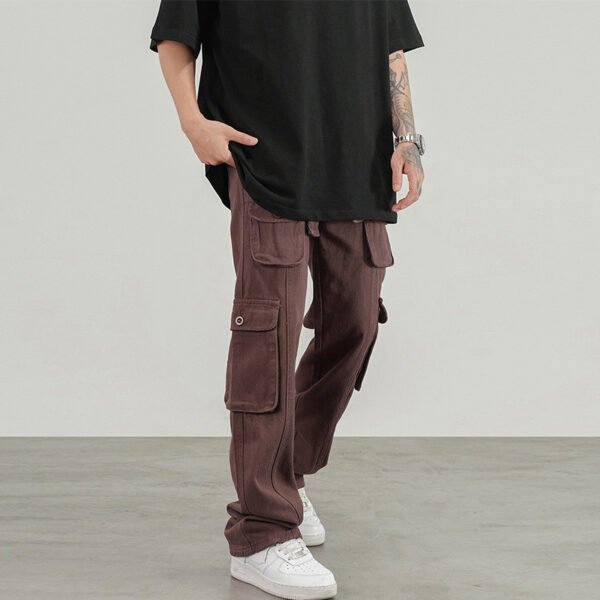

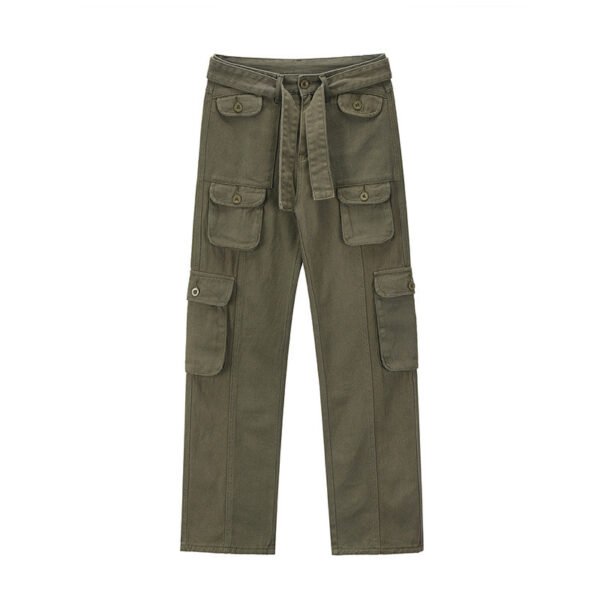

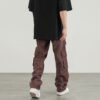

This cargo trouser is built around utility communicated through layered pockets, a loose straight leg, and a muted olive surface. Its critical development question is whether pocket trims and hardware retain definition after the chosen wash process.
Utility Is Carried by Pocket Definition
The reference image shows an olive trouser whose identity comes from several raised cargo pockets, not from a printed graphic or decorative surface alone. Their overlapping proportions create a functional visual hierarchy that needs crisp edges, stable flaps, and controlled attachment points.
The upper and lower pockets appear deliberately varied in size and position, giving the leg depth while preserving a straight profile. Development should record pocket dimensions, placement from seams, flap extension, and closure location so the utility language remains coherent across sizes.
Trim Finish Must Survive the Wash
Pocket flaps, folded edges, bartacks, snaps, and surrounding topstitching can all change appearance during garment finishing. Abrasion may soften corners, while heat, moisture, or mechanical action may alter hardware brightness and the perceived contrast between trim and olive cloth.
A wash trial should inspect every closure and exposed edge rather than judging only the overall color. The desired result is a softened utility surface with readable pocket architecture, not a finish that makes flaps curl, hardware distract, or topstitching disappear.
Hardware Needs a Compatibility Decision
The image visibly includes small metallic closure details on pocket panels, making hardware part of the product argument. Their scale is restrained, but even modest brightness can become prominent against a muted olive base after washing or repeated handling.
Confirm the selected hardware finish, attachment method, and wash compatibility before approving bulk components. A darker or less reflective option may integrate more quietly, while a brighter finish can sharpen the utility impression but increase contrast and visual risk.
The Loose Leg Balances Added Bulk
Multiple pockets add thickness and weight at the outer leg, especially where panels overlap or carry flap construction. The straight loose silhouette shown in the image provides room for that build, preventing the cargo arrangement from pulling the trouser immediately toward a tapered outline.
Pattern review should assess pocket fullness while the wearer walks, sits, and bends. If the pocket bags or flaps project too far, the trouser may feel cumbersome; if reduced too much, the garment loses the dimensional utility that distinguishes it.
VeeWen Workflow Aligns Trim and Finishing
For VeeWen development, the useful working document is a trim-and-wash matrix linked to the pocket specification. It should identify each closure, edge treatment, reinforcement point, and wash exposure, then connect those choices to the sample sequence and inspection points.
This product-specific workflow lets the development team compare an unwashed construction sample with a finished sample panel by panel. The buyer can then approve not only the silhouette, but also whether the trim hierarchy remains commercially clear after finishing.
Approval Centers on Function After Appearance
The central trade-off is between authentic softened character and dependable pocket operation. More aggressive finishing may deepen the retro utility impression, but it can also weaken edge definition, affect closure alignment, or create inconsistent hardware appearance across production.
Approve the style when the washed sample keeps every pocket legible, closes securely, and maintains an even straight-leg hang. Confirm composition, colorfastness, hardware performance, and care instructions separately, since those details are not verified in the supplied evidence.
Buyer Questions
What is the first cargo approval checkpoint?
Approve the trim-and-wash sample first, checking flap edges, closure operation, hardware appearance, and pocket placement after finishing rather than evaluating color alone.
Can the pocket layout be customized?
Yes, pocket dimensions, spacing, flap proportions, closures, and reinforcement details can be developed as a coordinated package around the intended fit and utility level.
Is the olive color production-standard?
No. The image provides a visual reference only; final olive shade, tonal variation, and wash compatibility require fabric-specific lab or sample approval.
What is the commercial minimum?
The exact commercial minimum is MOQ: 100 pieces per style. Labeling, grading, packaging, and final trim selections should be confirmed during development.
Approve the Trim-and-Wash Package
Share your target olive shade, pocket specification, hardware preference, and finishing direction for VeeWen review, with MOQ: 100 pieces per style.


Reviews
There are no reviews yet.