


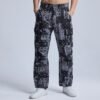


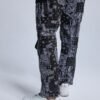

This cargo trouser concept treats pocket density as an engineering problem. The supplied image shows layered thigh pockets, flaps, and a straight leg in a high-contrast print, so seam stacking must be controlled to preserve movement, alignment, and a clean utility silhouette during development.
Why Pocket Density Changes the Wearing Experience
Each added pocket introduces fabric layers, seam allowances, turn-under edges, and reinforcement points. When those elements overlap, the thigh can become stiff or project outward, changing drape and making a straight leg feel narrower during walking, sitting, or climbing.
The reference image concentrates pockets across both thighs rather than distributing them sparsely. That arrangement creates a clear approval risk: the garment may look balanced frontally while hidden pocket layers create pressure, ridges, or inconsistent fall at the side seams.
Reading the Supplied Image as a Construction Brief
The visible garment uses a black-and-white all-over motif that crosses pockets, flaps, and leg panels. Because the contrast is strong, seam distortion and misaligned pocket edges will be conspicuous, making print continuity and topstitch control part of the technical review.
The straight lower leg and full-length pocket arrangement suggest a utility silhouette that depends on uninterrupted vertical balance. Pocket placement should therefore be checked against grain direction, inseam position, knee clearance, and the visual centerline before approval.
Bulk-Control Methods for Layered Pockets
VeeWen can develop the pocket package by separating bulky junctions, grading seam allowances, and selecting attachment sequences that avoid unnecessary accumulation. The precise solution depends on fabric thickness, pocket-bag structure, edge treatment, and whether the flaps are self-lined or folded.
At high-layer intersections, reinforcement must support stress without creating a hard knot of fabric. Development should compare bartack length, stitch density, seam direction, and edge finishing through hand-feel checks and movement trials on the actual shell reference.
Print Placement and Pocket Alignment
A repeating paisley layout can conceal minor distortion in open panels, but pocket boundaries interrupt the pattern and reveal placement errors. The reference image shows motifs continuing across several utility zones, so pattern matching should be evaluated before final cutting instructions are released.
The buyer should define which areas require visual continuity and which may use engineered interruption. That decision affects marker efficiency, cutting complexity, pocket templates, and inspection criteria, especially where lower cargo pockets overlap printed leg sections.
VeeWen Development Workflow for This Axis
VeeWen's workflow should begin with a pocket intersection map rather than a finished silhouette alone. The team can identify every three-layer or four-layer junction, assign seam directions, and mark where bulk-control decisions must be recorded in the technical package.
A development sample should then be reviewed from both the outside and inside, with attention to ridges, pocket opening behavior, and leg balance. The buyer's approval checkpoint is a signed construction map tied to the approved sample and production measurements.
Trade-Offs and Buyer Approval Checkpoint
Reducing seam layers can improve flexibility and appearance, but it may change pocket capacity, edge stability, or the visual fullness expected from cargo styling. Conversely, heavier reinforcement may improve stress control while making the garment feel less fluid through the thigh.
Before commercialization, approve the pocket hierarchy, seam allowance treatment, print placement tolerance, and movement result together. A visually attractive prototype is not sufficient if the densest intersections remain rigid, uncomfortable, or inconsistent between left and right legs.
Buyer Questions
What should be checked first on this cargo pant?
Review the densest pocket intersections first, because localized seam bulk can affect comfort, drape, side balance, and sewing sequence before other details are finalized.
Does the image verify the fabric composition?
No. The image supports a woven printed appearance, but fiber content, GSM, stretch, recovery, and laundering behavior require source confirmation or physical material testing.
Can the pocket layout be changed during development?
Yes, the pocket map can be adjusted, but every change should be rechecked for seam accumulation, print alignment, capacity, movement clearance, and production practicality.
What is VeeWen's minimum order?
VeeWen's exact commercial minimum is MOQ: 100 pieces per style. Final development decisions should still confirm materials, measurements, packaging, and approved construction details.
Approve the Cargo Pocket Engineering Brief
Send your target measurements, fabric reference, label requirements, and pocket priorities to VeeWen for a construction-led review of seam bulk and print alignment.


Reviews
There are no reviews yet.