










This custom garment-washed printed T-shirt is developed around registration control, keeping the centered graphic visually balanced as cut panels, neckline boundaries, garment washing, and graded sizes influence the finished appearance.
The Graphic Establishes a Registration Standard
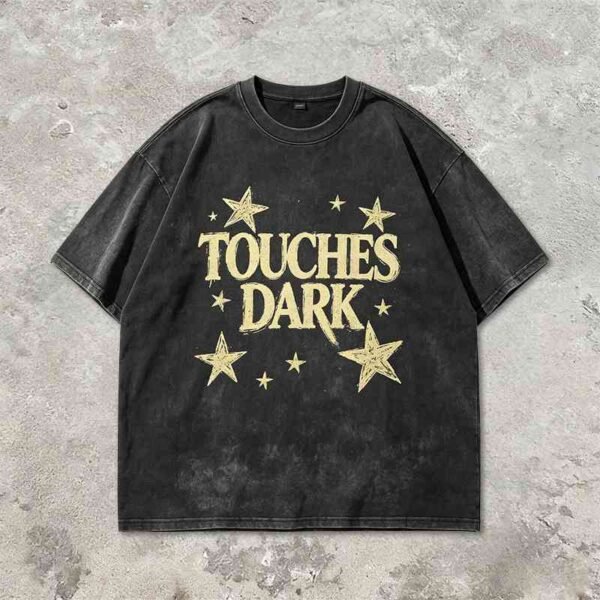
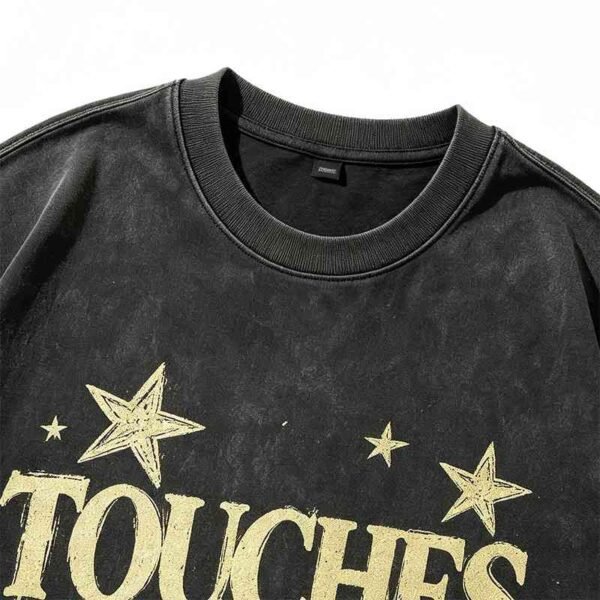
The supplied image shows a centered pale graphic on washed black fabric, surrounded by stars and bounded by the crew neckline, side seams, and hem. These relationships create a measurable visual frame for evaluating placement after cutting, printing, washing, and grading.
Although the visible reference uses a front composition, the assigned registration axis should govern any artwork extending across multiple panels. Every repeat, edge, or secondary placement needs coordinates tied to pattern pieces, not only a flat artwork file.
Registration Depends on Panel and Process Sequence
Panel registration means controlling artwork position relative to cut edges, seams, and neighboring printed areas. If panels are printed separately, small shifts can accumulate; if printing occurs after assembly, seam thickness and garment handling can affect pressure, coverage, and alignment.
The washed appearance adds another variable because tonal change can make edges appear to move even when coordinates remain fixed. Development should therefore distinguish true registration error from acceptable wash variation, using the graphic frame and seam distances as reference points.
Wash Variation Changes the Approval Evidence
The photographed surface contains lighter and darker tonal variation across the body, while the graphic remains the dominant focal point. That contrast suggests the approval sample must be evaluated after the planned wash sequence, because pre-wash alignment alone cannot represent the finished visual balance.
Artwork scale, ink coverage, and clearance from the neckline should be reviewed together. A graphic positioned too close to ribbing may appear crowded after washing, while excessive seam clearance can weaken the centered composition and reduce the intended streetwear proportion.
VeeWen's Workflow Makes Coordinates Production-Ready
VeeWen should translate the artwork into panel-specific placement marks, recording centerlines, top offsets, side-seam clearances, and repeat relationships in the technical package. The first sample should include decoration before the approved wash treatment, allowing construction and registration to be reviewed together.
For graded sizes, the team can define which dimensions remain fixed and which scale with the body panel. Buyer comments should identify measurable movement, artwork distortion, or wash-related tonal change, converting visual feedback into instructions the production pattern can follow.
Trade-Offs in Coverage, Flexibility, and Tolerance
A larger graphic creates stronger visual impact but increases sensitivity to panel distortion, seam proximity, and wash movement. Smaller artwork offers more tolerance yet may lose the dense focal presence shown in the reference. Registration limits should reflect the selected scale and print method.
Extending artwork across multiple panels can create a more integrated effect, but it introduces more alignment risk than a single-panel front print. The buyer should decide whether the commercial priority is uninterrupted composition, simplified repeatability, or a controlled compromise between both.
Approve the Washed and Decorated Sample
The key approval checkpoint is a finished sample carrying the intended artwork, construction, and wash appearance. Measure the graphic against neckline, side seams, hem, and any adjacent panels, then separate coordinate errors from acceptable tonal variation before comments are issued.
Release should include artwork dimensions, placement tolerances, wash order, panel references, and grading rules. This record protects consistency when quantities expand, because the approved visual standard remains tied to physical landmarks instead of relying on an unannotated image.
Buyer Questions
Does the image prove an all-over print construction?
No. The visible image shows a front-centered graphic. All-over panel registration remains a development requirement to confirm through artwork files, pattern pieces, decoration method, and finished samples.
Why must registration be checked after washing?
Washing can alter panel appearance, dimensions, and tonal contrast. Post-wash review shows whether artwork remains balanced against seams, neckline, hem, and neighboring printed areas.
Is the fabric composition confirmed?
The source wording states 95% cotton and 5% spandex, but fabric weight, knit structure, recovery, and final laboratory or supplier documentation remain To Confirm.
What is the commercial minimum for this program?
The commercial minimum is MOQ: 100 pieces per style. Final artwork versions, colorways, size ratios, and production details should be confirmed during quotation and development.
Approve the Registration and Wash Standard
Share your artwork, panel patterns, target measurements, wash direction, and label requirements. VeeWen can map registration points, prepare the decorated sample, and document measurable approval tolerances.


Reviews
There are no reviews yet.