
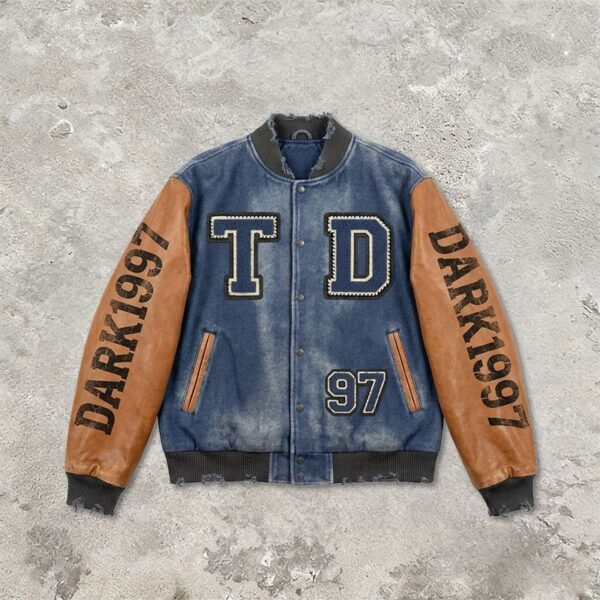
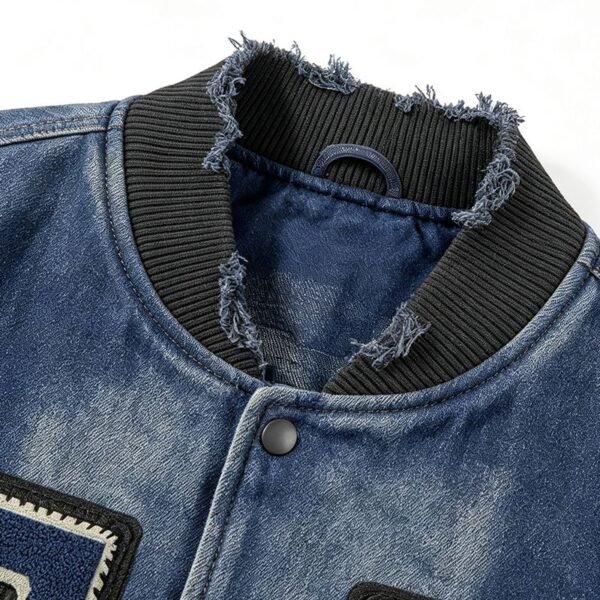





This varsity jacket is developed around bartack placement and stress distribution, treating each pocket, snap, rib junction, and decoration zone as a connected load path. The visual evidence shows a multi-panel garment whose vintage character depends on reinforcement remaining discreet while daily movement repeatedly loads the same points.
Stress Begins at the Pocket Opening
The angled lower pockets are practical load points because hands, phones, and repeated entry place tension along their openings. In the supplied image, each pocket sits within a contrasting sleeve-and-body composition, so reinforcement must support the seam without making the pocket mouth visibly stiff.
VeeWen's sample review should inspect pocket opening length, corner geometry, and bartack orientation under loaded and unloaded conditions. A short bartack may secure the seam edge, while a misplaced or oversized one can distort the vintage surface and compete with the contrasting trim.
Snaps Create Repeated Front Loads
A snap-front closure concentrates force at each fastening point, especially when the wearer pulls the jacket open or layers it over thicker garments. The visible central snap line divides decorated front panels, making reinforcement placement important for both load control and consistent front alignment.
The product-development workflow should mark snap positions, placket support, and nearby patch exclusion zones in the technical pack. The buyer should approve the closure sample after repeated opening and closing, checking that the front remains aligned without transferring stress into the applique edges.
Panel Junctions Need Balanced Reinforcement
The blue body and tan sleeves meet at prominent shoulder and armhole junctions, where movement transfers force across different panel behaviors. Even when the materials look compatible, their stretch, thickness, and seam recovery may differ. Reinforcement must distribute that difference instead of concentrating it at one stitch.
VeeWen can review the armhole and shoulder as a load map, identifying where bartacks, seam reinforcement, or stitch adjustments are appropriate. The approval question is whether the junction retains a clean silhouette after arm movement, not simply whether the seam looks secure when flat.
Rib Openings Change the Load Path
The dark rib collar, cuffs, and hem frame the jacket and introduce flexible edges beside more structured panels. Cuffs experience pulling during dressing, while the hem can be stressed when the wearer sits or reaches. Bartacks should stabilize transitions without flattening the rib's intended recovery.
During development, VeeWen should inspect rib attachment, seam allowance control, and reinforcement spacing at each opening. The buyer should compare the garment on-body and flat, confirming that security measures remain hidden while the collar, cuffs, and hem retain their visual rhythm.
Decoration Adds Localized Weight
Large chest letters, lower numerals, and vertical sleeve graphics create localized weight and stiffness across the jacket. Their edges may also become snag points during handling. Reinforcement should therefore be coordinated with decoration boundaries, avoiding a bartack that cuts through an applique or magnifies an already rigid.
The technical pack should show decoration footprints alongside stress points, with clear no-interference zones around seams, snaps, and pockets. VeeWen's workflow can then evaluate construction and decoration on the same sample, allowing the buyer to approve a coherent surface rather than isolated operations.
Buyer Approval Checkpoint
The buyer should approve this jacket only after examining the points most likely to receive repeated force: pocket mouths, snap attachments, cuff joins, armhole seams, and hem transitions. The supplied image makes these areas visually prominent, so functional reinforcement must preserve the deliberately worn-in appearance.
Record bartack count, position, orientation, stitch density, and distance from visible decoration in the approved specification. Then confirm the graded sample behaves consistently across sizes. The commercial decision is approval of a controlled stress map, not acceptance of generic reinforcement language.
Buyer Questions
Where should bartacks be considered first?
Prioritize pocket openings, snap-support areas, cuff joins, armhole junctions, and hem transitions, then confirm exact placement through loaded sample review and technical measurement approval.
Are the listed composition abbreviations verified?
No. The source title includes abbreviated composition references, but the final shell, sleeve, trim, and lining materials require written confirmation before production.
How can reinforcement preserve the vintage look?
Coordinate bartack size, orientation, thread appearance, and placement with panel seams and decoration boundaries so reinforcement secures load points without becoming a dominant visual feature.
What is the minimum order quantity?
MOQ: 100 pieces per style. This applies after approval of the jacket block, material specification, decoration method, reinforcement plan, and graded production sample.
Approve the Stress Map
Share the target size chart, material plan, decoration files, and preferred vintage appearance with VeeWen. The next checkpoint should confirm reinforcement placement across every loaded junction before grading and production.



Reviews
There are no reviews yet.