
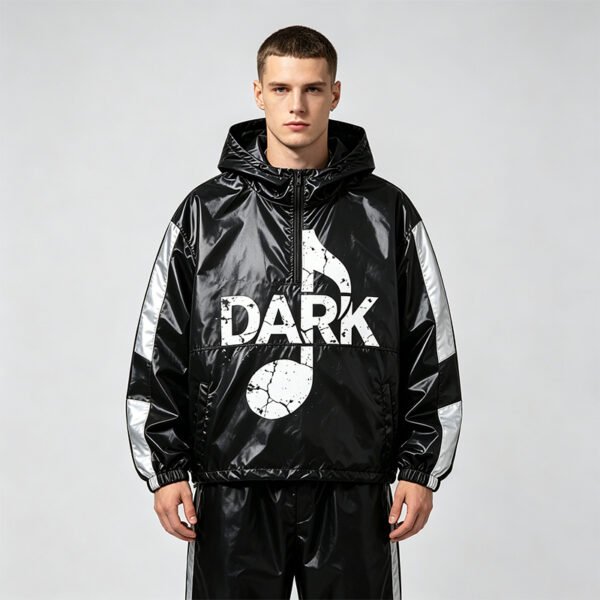
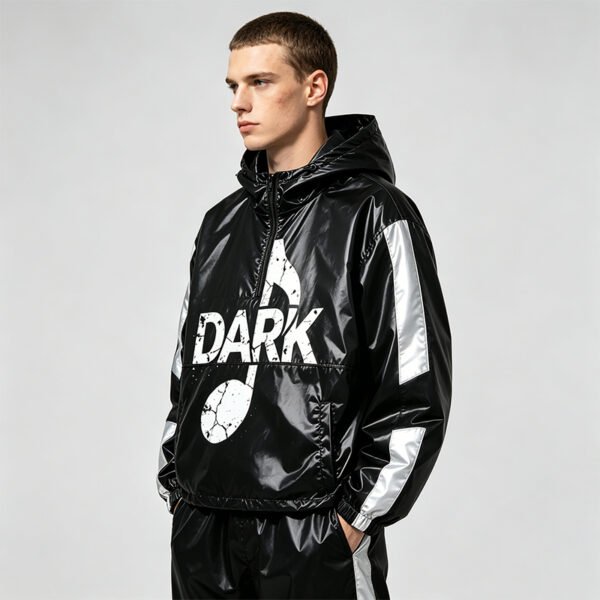
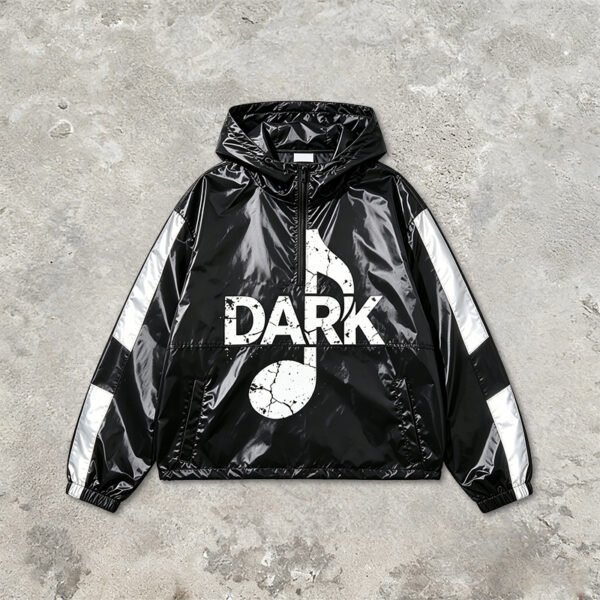




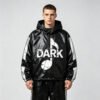
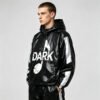
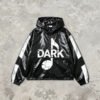
This custom hooded jacket is developed around movement control rather than decoration alone. Its relaxed body, directional sleeve seaming, elastic openings, and uninterrupted back graphic create a wearable outer layer that supports active styling while keeping the artwork visually dominant during motion.
Movement Begins with Sleeve Geometry
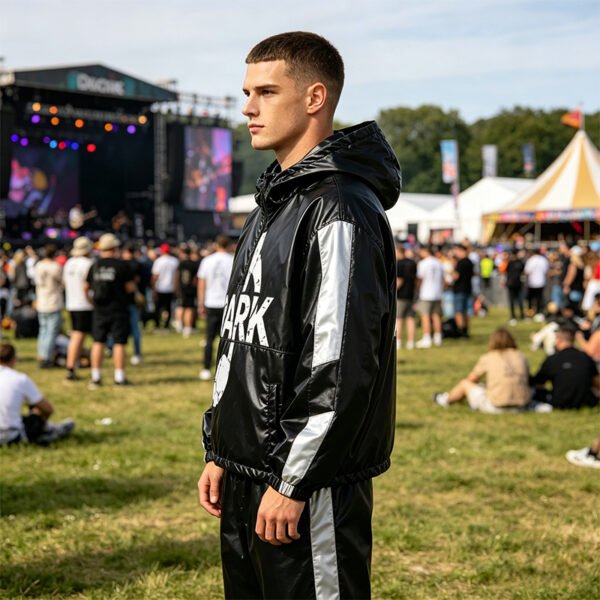
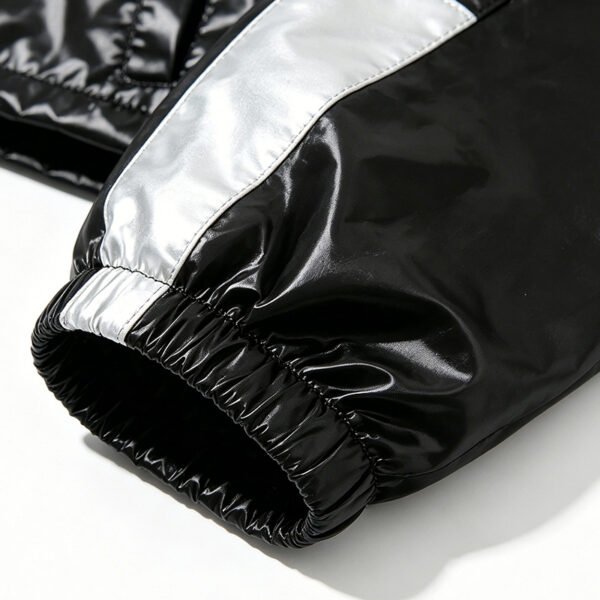
The visible sleeve seams are more than decorative lines: they divide the arm area into controlled panels that can be adjusted for reach. VeeWen can test seam angle, sleeve pitch, and elbow shaping so movement is distributed instead of pulling directly across the back.
The relaxed shoulder and hood connection provide upper-body clearance, but extra volume can become visually bulky or catch air. A development sample should compare arm lift, forward reach, and natural resting posture before the final block is approved.
Elastic Openings Contain Active Volume
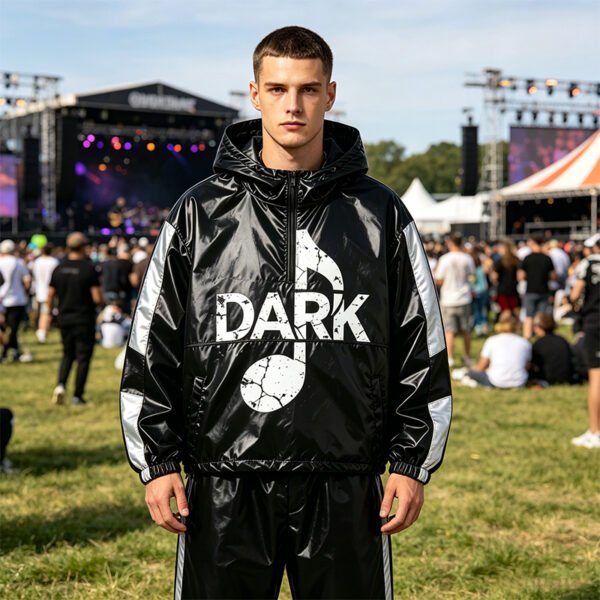
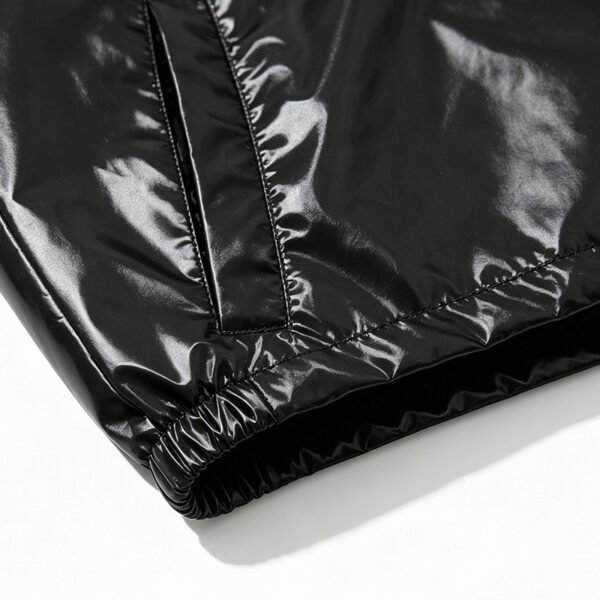
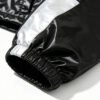
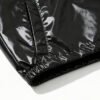
Elasticated cuffs visibly gather the sleeve ends, helping prevent excess fabric from falling over the hands during movement. The hem uses similar containment, keeping the body from spreading excessively while preserving a casual, layered silhouette around the waist.
Tighter elastic improves control but can reduce comfort or create pressure when worn over heavier layers. VeeWen should set recovery targets through fitting trials, then confirm cuff and hem tension against the intended size range and styling layer.
Half-Zip Access Changes the Front Balance
The source wording identifies a half-zip front, which creates a partial opening rather than a full center-front break. That construction can preserve a cleaner shell appearance, but the zipper length and facing must accommodate head entry and neckline comfort.
A short opening may limit ventilation compared with a full zip, especially in a coated-looking shell. VeeWen's sample review should confirm zipper travel, hood overlap, neckline stand, and ease when the garment is worn over a sweatshirt.
Back Artwork Needs a Stable Print Field
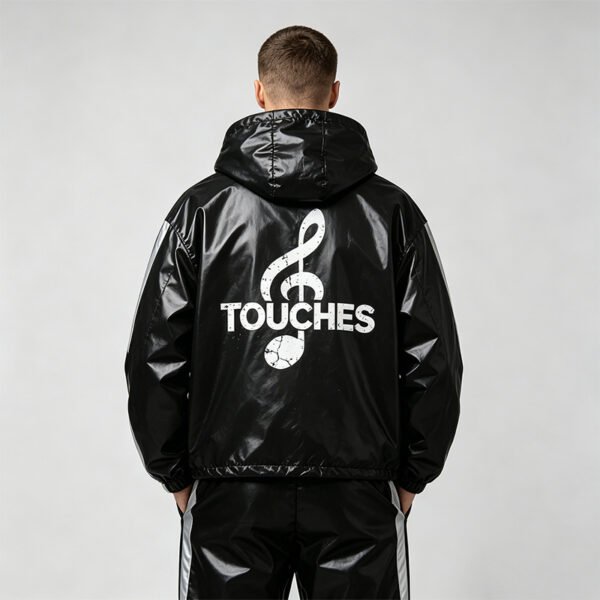
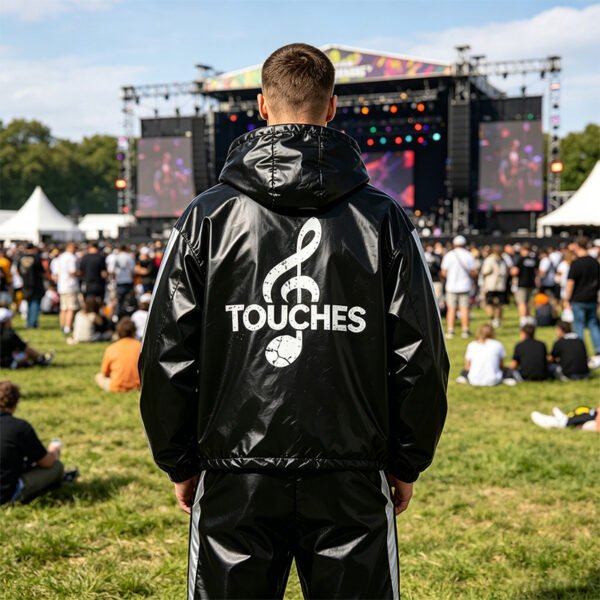
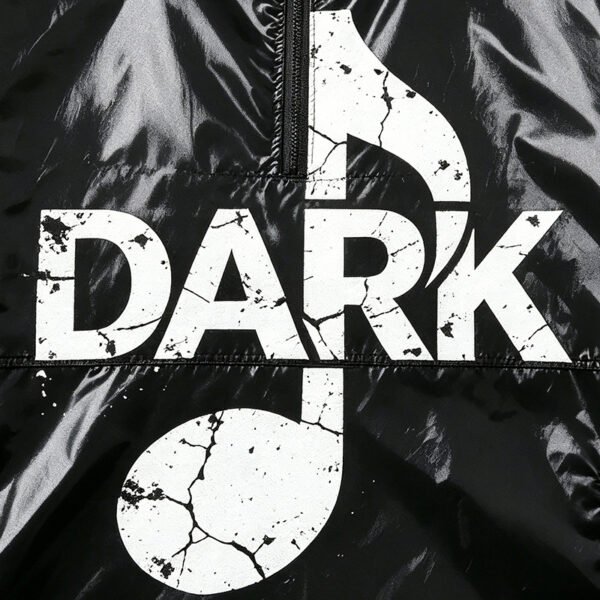
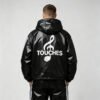
The supplied back view shows a large white musical graphic centered on a broad black panel, with no obvious seam crossing the artwork. This gives the print a strong visual anchor and makes panel stability a core development requirement.
Oversized graphics can expose distortion when the wearer bends or the shell wrinkles. The artwork should therefore be checked at actual placement dimensions, with print adhesion, cracking, and wash-care behavior treated as approval questions rather than assumed performance.
Glossy Shell Appearance Requires Trade-Off Control
The surface appears smooth and reflective, giving the jacket a sharper visual identity than a matte woven layer. Gloss can amplify folds, seam ridges, and print contrast, so pattern lines and pressing quality become highly visible in finished photographs.
A reflective finish may show scuffs or handling marks more readily than a dull surface. VeeWen should align the approved shade, sheen level, hand feel, and abrasion expectations before bulk material booking, because visual uniformity and ruggedness may compete.
VeeWen Workflow: Approve Motion Before Artwork Lock
VeeWen can begin with a mobility-focused pattern review, mapping sleeve seams, cuff recovery, hem containment, hood volume, and half-zip access. The first sample should be assessed on-body through reach and layering checks before the graphic position is treated as final.
Once the block moves correctly, the development team can lock the back-panel print scale and placement against the approved seam map. The buyer's checkpoint is a signed movement sample with confirmed artwork clearance, shell appearance, and opening tension.
Buyer Questions
Is the shell composition confirmed?
No. The image suggests a coated-looking synthetic shell, but exact fiber content, coating chemistry, and performance characteristics require source or laboratory confirmation.
What mobility feature should buyers prioritize?
Prioritize sleeve seam direction, elbow shaping, cuff recovery, and shoulder ease, because these elements determine whether the relaxed silhouette moves comfortably without uncontrolled excess volume.
Can the back graphic be changed?
Yes. Artwork scale, color, placement, and print method can be developed around the approved seam map, subject to strike-off, adhesion, wash-care, and distortion review.
What is the commercial minimum?
The exact commercial minimum is MOQ: 100 pieces per style. Final quantities, size ratios, materials, trims, and packaging should be confirmed during development.
Approve the Mobility Sample
Send your target measurements, artwork, and shell references to VeeWen for a movement-led review. Confirm sleeve geometry, opening tension, surface appearance, and print clearance before approving the production specification.

Reviews
There are no reviews yet.