
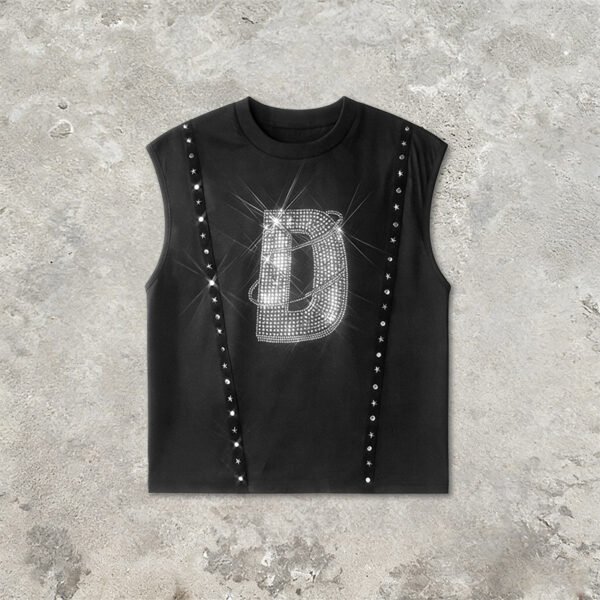
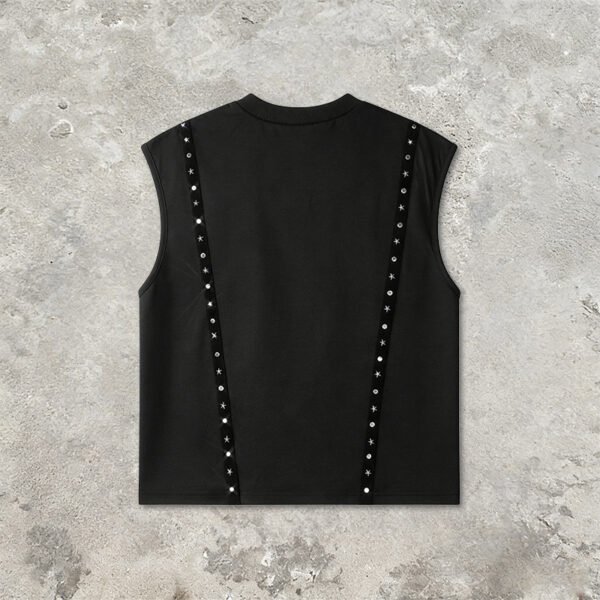


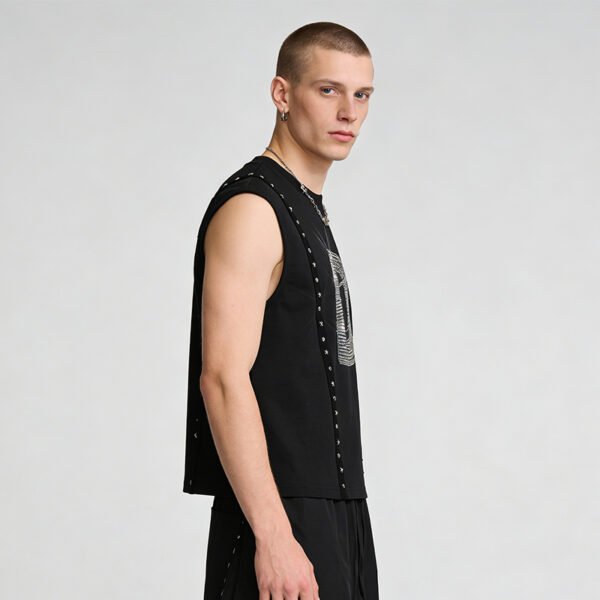

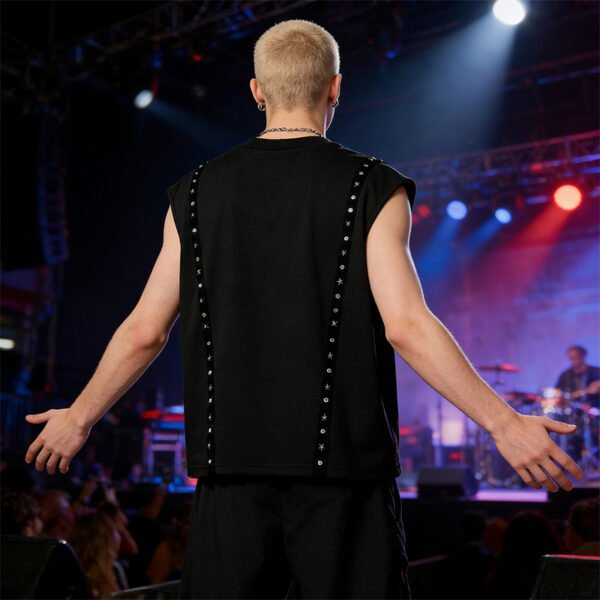



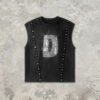

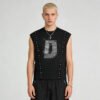





This vest is governed by alignment under dimensional change. The centered rhinestone graphic and paired vertical webbing create a visual grid, so material shrinkage, side-to-side movement, and finishing tension must be reviewed together before approval.
The Vertical Webbing Creates a Measurement Grid
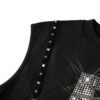
The supplied image shows two long embellishment strips descending near the front sides of a centered rhinestone graphic. Their repeated stud pattern turns ordinary dimensional movement into a visible defect because even small convergence or divergence changes the garment's symmetry.
Set the strips from fixed shoulder and hem references, not from visual judgment alone. Measure their inner and outer edges at several heights, then compare the finished sample against the approved center graphic and neckline before accepting the alignment system.
Shrinkage Control Applies Beyond Denim
The assigned development axis references denim shrinkage and leg-twist control, but the underlying concern is dimensional stability after wet or heat-related finishing. For this vest, that principle protects the parallel webbing and centered graphic even though denim construction is not visually confirmed.
The material route remains a trade-off. A denser base may stabilize embellishment but increase stiffness, while a softer knit may improve comfort yet magnify distortion. Confirm the fabric category, recovery, shrinkage behavior, and finishing process before specifying tolerances.
Rhinestones Intensify Distortion Risk
The central rhinestone graphic is broad, bright, and positioned on the visual centerline. That reflective concentration makes any skew, bubbling, or uneven spacing easy to notice, especially where the graphic is framed by the darker uninterrupted body and parallel webbing.
Development should test the graphic on the actual approved base rather than treating artwork as a flat decoration. Review adhesion or attachment security, surface flexibility, wash response, and edge clarity, while ensuring the graphic does not pull the front panel out of shape.
Studded Webbing Needs Tension Discipline
The paired strips appear to combine narrow webbing with regularly spaced metallic studs and star-like accents. Their construction introduces localized weight and stiffness, so tension during attachment can pull the armhole, shoulder, or hem toward the embellishment line.
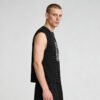
The buyer should compare relaxed and worn-on-body samples, checking whether the strips remain straight when the vest is suspended, laid flat, and fitted. Approve the attachment sequence only after confirming that pressing, handling, and finishing do not introduce twist.
Workflow Converts Alignment into Tolerances
VeeWen's development workflow should map the centerline, neckline, armholes, webbing edges, stud repeat, and rhinestone boundaries in one front-panel drawing. This creates a shared control document for patternmaking, embellishment placement, sewing, and final inspection.
The first sample should establish dimensional measurements before and after the nominated finishing route. The pre-production checkpoint then compares shrinkage, graphic centering, webbing parallelism, and neckline recovery against the approved standard, allowing material or sequence adjustments before bulk cutting.
Approve the Finished Grid, Not Just the Artwork
The approval question is whether the vest still reads as a centered, parallel composition after the complete manufacturing route. Attractive artwork alone cannot compensate for twisted webbing, shifted studs, or a neckline that changes the apparent vertical axis.
Release the style only when the base material, embellishment method, finishing route, and dimensional tolerances are documented together. If the reference material changes, repeat the alignment review because shrinkage and twist behavior may change with it.
Buyer Questions
Why is denim shrinkage mentioned for this vest?
It is the assigned manufacturing axis, applied here as a dimensional-stability principle; the supplied image does not verify denim construction or denim fiber content.
What should the first sample measure?
Measure centerline position, webbing edge distances, stud spacing, neckline width, body length, and post-finish change before approving the construction sequence.
Can the webbing be moved closer to the graphic?
Yes, but revise the full front-panel map and test tension, clearance, embellishment balance, and armhole behavior before accepting the revised placement.
What is the minimum order quantity?
The exact commercial minimum is MOQ: 100 pieces per style, with final colorways and specifications subject to the approved development package.
Approve the Embellished Alignment System
Share the intended material, finishing route, size range, and artwork files with VeeWen so shrinkage and webbing-parallelism tolerances can be tested together.


Reviews
There are no reviews yet.