














This T-shirt should be developed as a surface-compatibility study: the washed black ground establishes atmosphere, while the rhinestone field must retain controlled brightness, adhesion, and placement after treatment.
Why Treatment and Hardware Must Be Developed Together
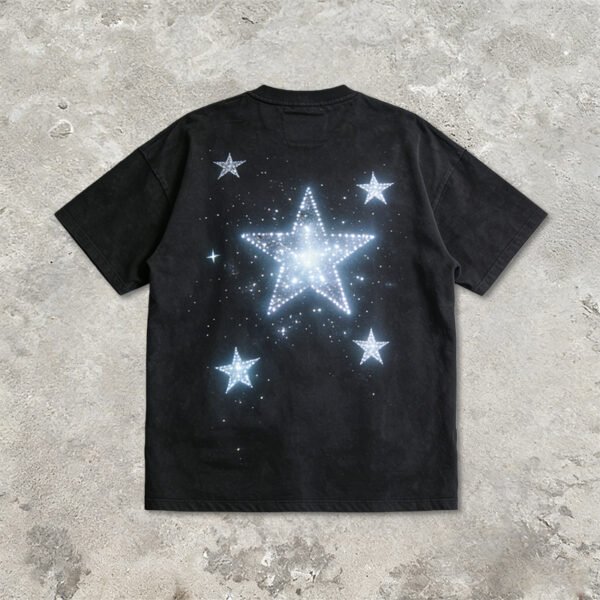
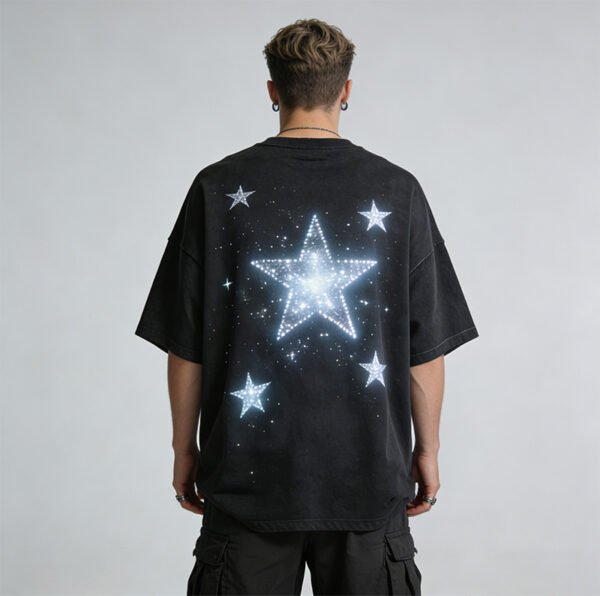
The supplied image shows a dark shirt with a visibly uneven washed surface and highly reflective stars. Those effects rely on contrast: if washing lightens the ground too much, the stars lose separation; if treatment is too mild, the garment may not achieve the intended aged depth.
Rhinestones introduce a separate material system onto the textile. Heat, moisture, abrasion, and chemical exposure can affect their coating, bonding, or reflectivity. The correct development question is therefore not whether each finish works alone, but whether they remain compatible in sequence.
Reading the Star Field as a Placement Map
The large central star anchors the back graphic, while four smaller stars and scattered points create a surrounding field. This hierarchy should become a placement map with reference coordinates, not an informal decoration instruction interpreted differently by each operator.
The central motif also establishes visual weight across the back. Review its distance from neckline, side seams, and hem, then document the smaller-star offsets. Consistent registration matters because even small shifts are obvious when reflective points catch light against a plain dark ground.
Plating Versus Washed Contrast
A brighter plated surface creates sharper highlights, but may look too polished against a subdued washed base. A softer finish can integrate more naturally, yet may reduce the visual impact expected from the star arrangement. This is a deliberate commercial trade-off requiring buyer direction.
The image provides evidence of strong light reflection from the star shapes, but it does not verify the hardware substrate, plating system, or wash recipe. Those variables should be treated as open development inputs until the buyer approves physical standards.
Protecting the Garment Base
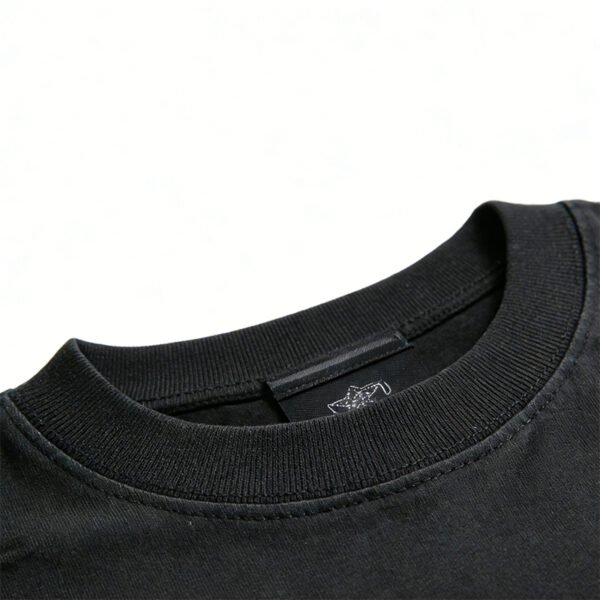
The neckline, sleeve hems, and lower body appear relatively clean compared with the embellished back. That separation suggests the wash character should enrich the base without making every area equally distressed or visually noisy.
Pattern and process planning should protect high-stress zones while maintaining the intended tonal variation. Confirm whether embellishment follows washing, or whether a controlled post-wash application is required; the sequence changes handling risk, appearance, and inspection criteria.
VeeWen Development Checkpoint
VeeWen can structure this product around paired lab approvals: establish a washed-black fabric and garment-treatment standard, then approve a rhinestone plating and adhesion standard against that same ground.
The workflow should compare decorated samples after the planned handling sequence, using the central star and smaller surrounding motifs as inspection landmarks. Bulk approval follows only when brightness, placement, surface tone, and attachment behavior meet the signed reference.
Trade-Offs Before Bulk Approval
More aggressive washing may create richer tonal variation but can increase abrasion around attached stones. Heavier embellishment can strengthen shelf impact, while adding weight, handling complexity, and more inspection points. A quieter finish may improve consistency but reduce the graphic's immediate visibility.
The buyer should define the priority order among wash character, reflective intensity, stone security, and placement precision. That decision lets VeeWen balance process choices against the product's commercial purpose instead of treating every visual variable as equally fixed.
Buyer Questions
Should washing happen before or after rhinestone application?
The sequence requires testing because washing first can protect hardware, while applying afterward may alter registration; the approved method should balance appearance, adhesion, and handling risk.
How should the star placement be controlled?
Create a placement map using neckline, side seams, hem, and central star coordinates, then document smaller-star offsets and acceptable registration tolerances for production inspection.
What does the source confirm about fabric composition?
The source wording identifies a cotton blend, but it does not provide percentages, fabric weight, shrinkage, or finishing response, so those details remain to confirm.
What is the minimum order quantity?
The commercial minimum is MOQ: 100 pieces per style, with production beginning after embellishment, treatment, specification, and finished-sample approvals are confirmed.
Align the Surface Treatment
Share your target wash depth, reflective standard, and placement artwork with VeeWen for coordinated hardware and garment-treatment development before bulk commitment.


Reviews
There are no reviews yet.