





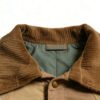


This cropped utility jacket is an operational hardware study as much as a patchwork statement. The supplied rear image shows segmented tan panels, a ribbed collar, broad sleeves, and a clean center-back field, while the source wording adds cargo and frayed-print intent that must coexist with usable zipper clearance.
Why Puller Scale Controls Utility Performance
A utility jacket can look technical yet fail operationally if its puller is too small to locate, too large for the collar zone, or obstructed by seam allowances. Here, the cropped body and segmented panels leave limited visual space for hardware without disturbing proportion.
The correct puller is therefore defined by movement, not decoration alone. Its grip should support deliberate opening and closing, while its length, thickness, and attachment angle preserve collar comfort, zipper travel, and the clean center-back geometry visible in the supplied image.
Reading the Supplied Construction Evidence
The rear view shows a broad upper back panel, a horizontal lower section, divided sleeves, and tonal shoulder inserts. These boundaries create a measured grid, so any zipper tape, puller projection, or added tab must align with the existing panel rhythm.
The ribbed collar is especially important because it establishes the upper limit for hardware. Source wording also identifies cargo, patchwork, frayed-print, and technicalwear directions, indicating that operational details must be resolved alongside the deliberately irregular surface character.
Clearance Trade-Offs in a Cropped Jacket
A larger puller improves visibility and grip, especially when the jacket is worn over layers, but it can catch on straps, strike the collar, or overpower the tonal patchwork. A smaller puller looks quieter yet may become difficult to operate under pressure.
The buyer should choose whether the hardware communicates rugged utility, restrained refinement, or a balanced middle. That decision affects puller mass, cord or tab length, zipper gauge, stopper position, and the amount of free space preserved around the neckline.
VeeWen Development Checkpoint
VeeWen's product-development workflow should convert the visual evidence into a hardware clearance map showing collar edge, zipper centerline, seam intersections, puller parked position, and maximum travel. This makes the operational requirement inspectable before the style reaches a finalized production package.
The sample review should test the jacket open and closed, flat and worn, with bare and covered hands. Record whether the puller can be found, grasped, and moved without catching patchwork seams or colliding with the ribbed collar.
Patchwork Requires Hardware Discipline
Tonal patchwork creates visual complexity through color, seam direction, and surface variation rather than bright contrast. Oversized hardware can interrupt that language, while undersized hardware may disappear into the construction and weaken the intended utility signal.
Panel transitions should therefore guide zipper placement and puller finishing. Check whether the puller sits over a stable substrate, whether nearby frayed-print treatment interferes with movement, and whether the center-back panel remains visually quiet when the jacket is worn.
Buyer Approval Before Production
Approve the hardware package when the puller is easy to operate, remains clear of the collar and seams, and looks proportionate against the cropped body. Confirm that zipper travel reaches its intended endpoints without twisting tape or distorting the surrounding panels.
The final decision should lock puller dimensions, attachment method, finish, zipper specification, and tolerance notes in the technical file. Once approved, VeeWen can proceed toward MOQ: 100 pieces per style with the operational clearance standard documented.
Buyer Questions
Why does puller size matter on this jacket?
Puller size affects grip, visibility, collar interference, seam clearance, zipper travel, and the visual balance of a compact cropped utility silhouette during wear.
Is the 95% cotton reference fully verified?
No. The percentage appears in the source wording only and remains a source reference until fabric composition, GSM, and supporting swatches are confirmed.
Can the patchwork layout be adapted for private label?
Yes, panel colors, artwork, labels, surface treatments, and hardware can be adapted, with each revision requiring renewed clearance and proportion review.
What is the commercial minimum?
The exact commercial minimum is MOQ: 100 pieces per style, subject to the approved hardware, panel map, material specification, and production documentation.
Approve the Hardware Clearance Sample
Provide target measurements, fabric swatches, zipper preferences, artwork, and intended layering use so VeeWen can validate puller operation and panel clearance before MOQ: 100 pieces per style.

Reviews
There are no reviews yet.