


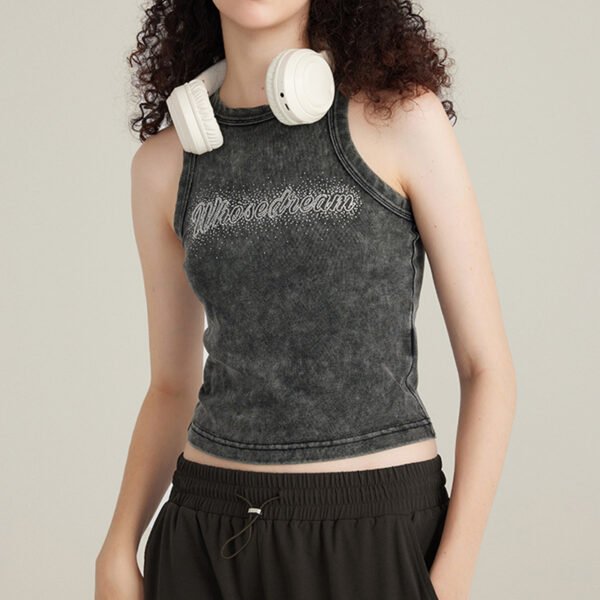
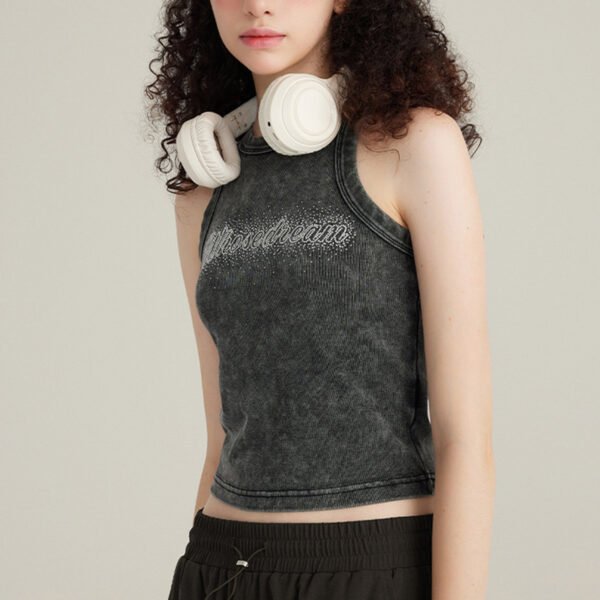








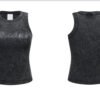
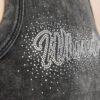


This tank top development centers on artwork scale as a production control. The supplied image shows a fitted charcoal washed silhouette carrying a compact rhinestone chest wordmark, so legibility depends on spacing, stone density, and placement discipline through washing, grading, and repeat orders.
Scale Controls Chest Legibility
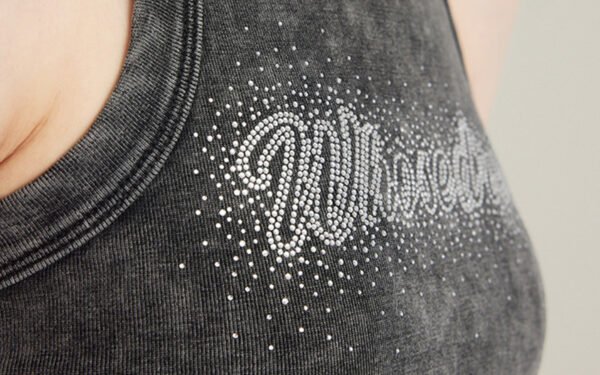
The image presents a narrow rhinestone wordmark spanning the upper chest, not a full-front decoration. That proportion preserves the washed ground as part of the design, while requiring calibrated stone size and spacing so letters remain readable without creating an overly rigid panel.
For a close-fitting tank, artwork width also interacts with bust curvature, armhole proximity, and stretch recovery. VeeWen development should establish a placement map using the base size, then define proportional rules for larger and smaller sizes before approving the graded artwork.
Rhinestone Density Affects Repeatability
Small reflective units create a refined surface rhythm, but every additional stone increases application points, alignment sensitivity, and potential handling variation. The reference therefore supports a controlled-density approach, where the wordmark remains recognizable while avoiding unnecessary concentration at letter joins and narrow counters.
The production sample should record stone diameter, spacing, adhesive or heat-fix method, and acceptable missing-unit tolerance. These parameters turn an attractive chest graphic into a repeatable specification that operators and inspectors can evaluate consistently across the MOQ of 100 pieces per style.
Washed Grounds Require Registration Planning
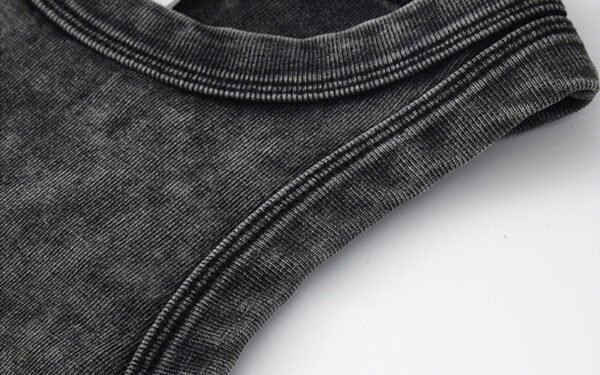
The charcoal wash visibly varies across the tank, especially around seams and curved body areas. That variation can strengthen a vintage effect, yet it may change contrast beneath reflective decoration. Artwork approval should therefore consider the darkest and lightest expected ground, not one perfectly uniform sample.
A practical workflow is to validate the decoration after the intended wash sequence, because applying stones before or after washing changes registration, surface hand, and attachment risk. VeeWen can use wash panels and decorated body trials to isolate the most stable order of operations.
Placement Must Survive Size Grading
On a fitted sleeveless body, moving the graphic only a few millimeters can alter the visual relationship with the neckline, bust, or side seams. The supplied image places the wordmark centrally and high enough to read clearly, making vertical and horizontal tolerances important approval points.
Size grading should scale the garment while preserving optical balance rather than mechanically enlarging every artwork dimension. VeeWen should compare graded print or transfer maps on physical patterns, confirming chest clearance, seam avoidance, and consistent perceived scale across the approved size range.
Mechanism Within VeeWen Workflow
This argument enters VeeWen's workflow at artwork engineering, where the graphic is converted into measurable width, height, stone count, spacing, and placement tolerances. Those controls are checked against the fitted pattern before decoration sampling, so visual intent and manufacturability develop together.
The next checkpoint combines washed fabric, decorated panels, and a completed tank sample. Review should cover contrast, stretch response, attachment security, and post-wash appearance, then lock a reference standard that production teams can use for the MOQ of 100 pieces per style.
Buyer Approval Checkpoint
The buyer should approve the artwork at actual garment scale, viewing both the clean sample and the washed finished sample under normal retail lighting. The key decision is whether the compact wordmark remains legible and premium without overwhelming the close-fitting silhouette.
Before bulk release, confirm composition, wash recipe, stone specification, attachment method, care labeling, graded placement, and acceptable appearance variation. If any item remains open, hold the production record at sample approval rather than treating the visual reference as a finished specification.
Buyer Questions
Can the chest artwork be resized for different collections?
Yes, artwork width and stone density can be engineered separately, but each version requires placement, legibility, stretch, and wash validation before approval.
Does the reference confirm 315 GSM fabric?
No. The source wording mentions 315 GSM, but supplied evidence does not independently verify composition, measured weight, or finished-body weight.
What is the minimum order quantity?
The commercial minimum is MOQ: 100 pieces per style. Final planning still depends on approved colors, sizes, decoration specifications, and production documentation.
What should be approved first?
Approve the artwork map, decorated wash sample, base pattern balance, and tolerance standard together before grading, care labeling, and bulk production release.
Approve the Artwork Control Set
Send the target artwork, size range, wash direction, and preferred decoration details. VeeWen can develop the scale map and sample checkpoints needed to confirm repeatability before bulk approval.


Reviews
There are no reviews yet.