
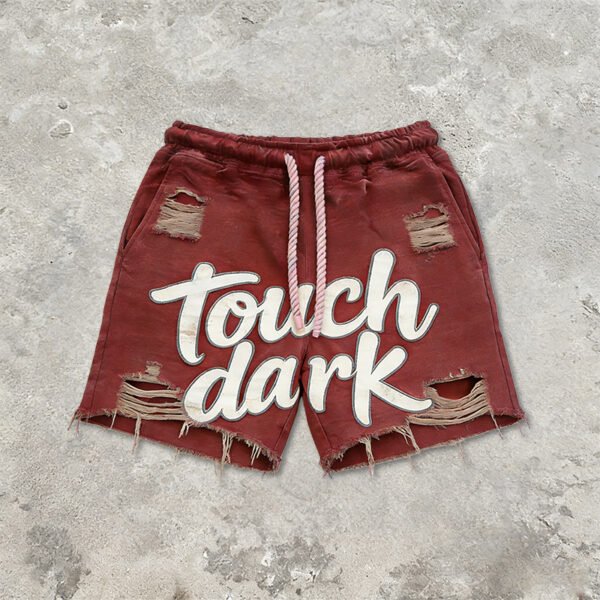
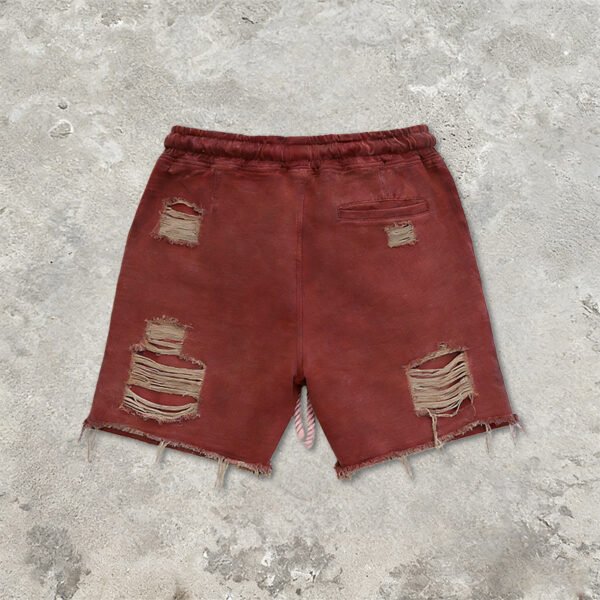


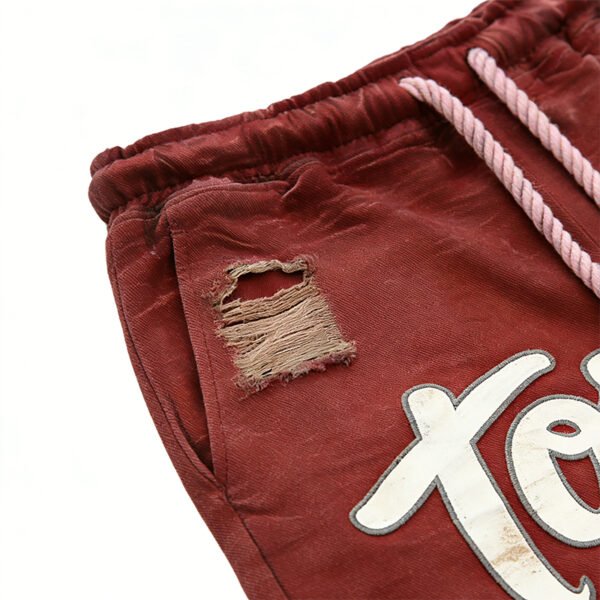
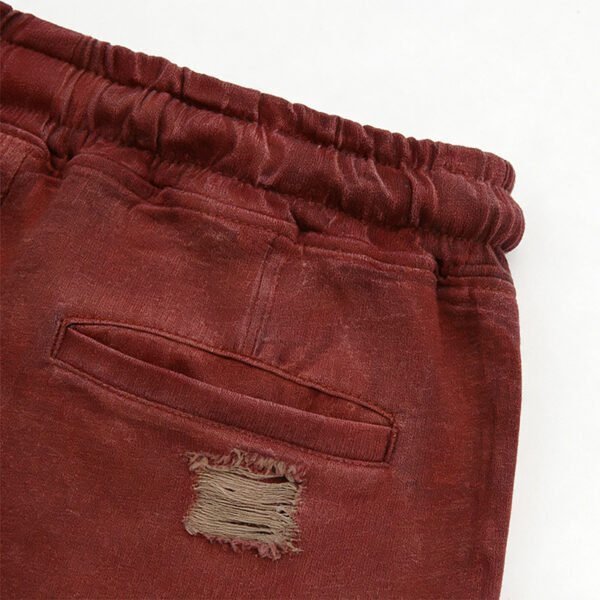

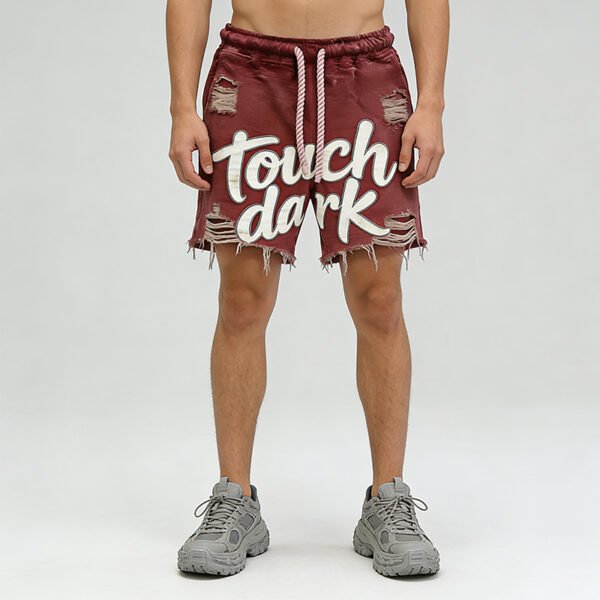
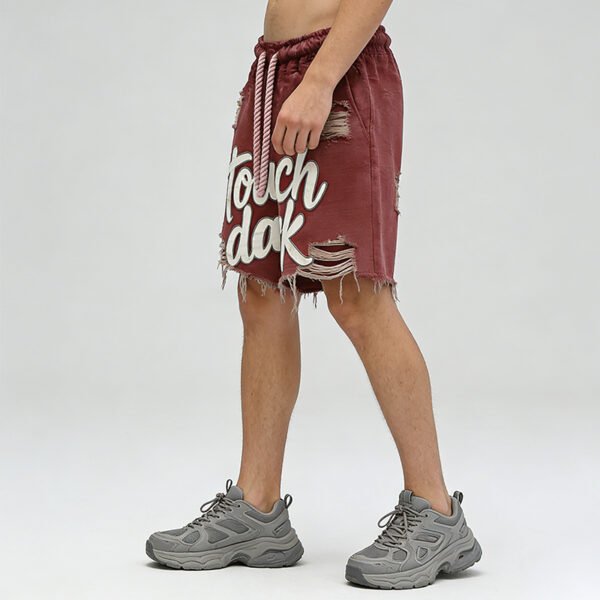






This short is developed around a controlled tension: expressive abrasion must remain visibly intentional while embroidery stays legible, anchored, and contained. The supplied image shows a washed burgundy pull-on silhouette, large contrasting lower-front artwork, pocket-area distressing, and raw hems that require coordinated placement planning.
Map the artwork before distressing
The dominant light artwork sits across the lower front, spanning both leg panels and approaching the hem. That position makes panel alignment, seam allowance, and leg opening symmetry more important than simply enlarging a supplied graphic for production.
Upper pocket-area tears and lower-leg openings create competing points of attention around the central artwork. VeeWen's development review should therefore lock artwork scale, vertical position, and safe distances from pocket, inseam, side seam, and finished hem before wash trials begin.
Contain stitches around fragile edges
Distressed openings remove support from the surrounding fabric, while embroidery introduces needle penetrations, thread tension, and localized weight. If stitching crosses weakened fibers or frayed edges, the artwork may deform, shed, or lose its intended outline during handling.
The technical approval should identify a stable embroidery field and define where reinforcement, underlay, or a clean patch boundary is permitted. This keeps the visual effect expressive without allowing stitch paths to consume abrasion zones or destabilize the short's lower front.
Sequence wash and abrasion deliberately
The image presents a maroon-burgundy surface with softened color variation rather than a flat, untouched body. Because wash changes hand, shade, and dimensional stability, the intended embroidery and distress sequence must be decided before final color approval.
A practical workflow is to confirm the base short, establish artwork registration, and then test abrasion against the approved wash direction. The buyer should compare whether fraying remains balanced on both legs and whether the lettering retains clean contrast after finishing.
Control the raw hem as a boundary
The lower edge is visibly uneven, with loose fibers extending below several distressed openings. That raw finish is part of the design language, but uncontrolled trimming can make one leg appear shorter or allow abrasion to progress beyond the approved silhouette.
VeeWen should convert the visual hem into measurable tolerances for finished length, fringe allowance, and opening position. The buyer's checkpoint is a paired-leg review after laundering or finishing, confirming that asymmetry reads as designed rather than as inconsistent cutting.
Balance pull-on comfort with graphic scale
The elasticized waistband and long contrasting drawcords establish a casual pull-on proportion, while the large front graphic occupies substantial visual area. Enlarging the artwork without checking rise and leg volume could make the short feel crowded or reduce practical pocket access.
Development should evaluate artwork placement on the actual graded pattern, not only on a flat image. Review points include waistband clearance, drawcord exit placement, pocket opening visibility, and the relationship between graphic scale, rise, and relaxed leg shape.
Translate the argument into approval gates
VeeWen's product-development workflow should treat this style as a coordinated surface-engineering project: pattern mapping first, artwork registration second, stitch containment third, and wash-abrasion validation after construction. Each gate protects a different part of the intended result.
The buyer should approve one annotated placement sheet, one stitch-boundary drawing, and one finished treatment standard before releasing the style. That record gives sampling and production teams a shared reference for the specific risks visible in the supplied shorts image.
Buyer Questions
Can the distressed areas be repositioned for a private-label collection?
Yes, placement can be developed as a controlled artwork and abrasion map, subject to pattern review, approved tolerances, and confirmation of the requested production details.
How should embroidery interact with the ripped areas?
Keep stitch fields on stable fabric and define exclusion zones around openings, frays, pockets, seams, and hems before approving the sample construction.
Is the burgundy shade confirmed for production?
The supplied image supports a washed burgundy appearance, but the production shade, wash recipe, and acceptable variation require physical color approval.
What is the minimum commercial quantity?
The exact commercial minimum is MOQ: 100 pieces per style, with final requirements depending on approved specifications and production documentation.
Approve the surface map before sampling.
Send the target artwork, size range, wash direction, and preferred distress intensity so VeeWen can prepare a contained placement plan for buyer review.


Reviews
There are no reviews yet.