









This reversible bucket hat turns a simple accessory into a compact construction study: the palm print, plain white reverse, and stitched brim make alignment immediately visible. For development teams, placket stability and button spacing should be approved as structural decisions, not decorative afterthoughts.
Why Placket Stability Controls the Reversible Result
On a reversible bucket hat, the placket sits at a visual and mechanical transition between panels. If that transition shifts, the palm print can drift against the white reverse, making the hat look uneven when turned inside out.
The supplied image shows a soft crown, a rounded brim, and a clean two-sided color relationship, but it does not confirm a placket or buttons. VeeWen should therefore treat reinforcement, seam allowance, and closure placement as sample-stage variables.
Button Spacing Is an Alignment Tool
Button spacing affects more than appearance when closures or decorative points are added around a bucket-hat placket. Equal intervals help distribute local tension, reduce visible twisting, and keep the reversible edge reading as a controlled circle.
The buyer should review spacing on a laid-flat pattern and on the worn sample. A layout that looks balanced on paper may pull differently around the crown, especially where print direction, seam joins, or brim stitching change the fabric tension.
Reading the Supplied Image as Development Evidence
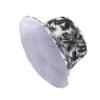
The main image provides useful visual evidence: a black palm motif covers the outer-facing side, the opposite side appears plain white, and repeated stitching follows the brim perimeter. These details establish the intended contrast and surface discipline.
They do not establish composition, GSM, button count, or performance. The development brief should record those items as To Confirm, while preserving the visible print scale, white ground, curved brim, and clean reversible presentation as approval references.
Print Placement Must Follow the Seam Map
Palm motifs are directional enough to reveal rotation and mismatched joins. Before cutting, the buyer should approve a placement map showing crown orientation, brim repeat, seam interruptions, and the relationship between the printed side and the plain reverse.
This map also supports button-spacing decisions. Hardware or stitched points should avoid visually dominant palm trunks and remain consistent when the hat is turned. VeeWen can use the approved map to coordinate pattern marking, cutting, sewing, and final inspection.
VeeWen Workflow for This Construction Axis
VeeWen's product-development workflow should begin with a reversible pattern review, then move to a construction sample focused specifically on edge stability, placket behavior, and button spacing. The sample should be examined both flat and worn before commercial specifications are released.
The approval record should capture the final reinforcement method, closure position, spacing tolerance, print placement, and brim-stitching appearance. This product-specific checkpoint gives production teams a measurable reference without assuming unverified materials or unseen hardware.
Buyer Approval Checkpoint
Approve this style when both sides retain their intended shape, the placket remains stable during turning, and any buttons or closures sit at consistent intervals. Inspect the brim from multiple angles for rippling, distortion, or interrupted stitching.
If the sample passes visually but feels difficult to reverse, the construction is not ready. Confirm the turning opening, edge finish, and handling sequence before authorizing the MOQ of 100 pieces per style for production planning.
Buyer Questions
Is the hat confirmed to include buttons?
No. The supplied main image does not visibly confirm button hardware, quantity, or placement, so those details remain To Confirm during the construction sample review.
What should buyers inspect first?
Inspect reversible turning behavior, placket stability, brim shape, print alignment, and button spacing together because each variable can change the others during wear.
Can the palm print be replaced?
The image establishes a palm-tree print direction, but artwork ownership and replacement options are not supplied. Confirm artwork, scale, repeat, and color references before sampling.
What is the commercial minimum?
The exact commercial minimum is MOQ: 100 pieces per style. Final quantities, packaging, and production planning should follow approved specifications and confirmed commercial terms.
Approve the Reversible Construction Brief
Send VeeWen your artwork, target measurements, and preferred closure details so the team can review placket stability, button spacing, reversible alignment, and the next sample checkpoint.


Reviews
There are no reviews yet.