
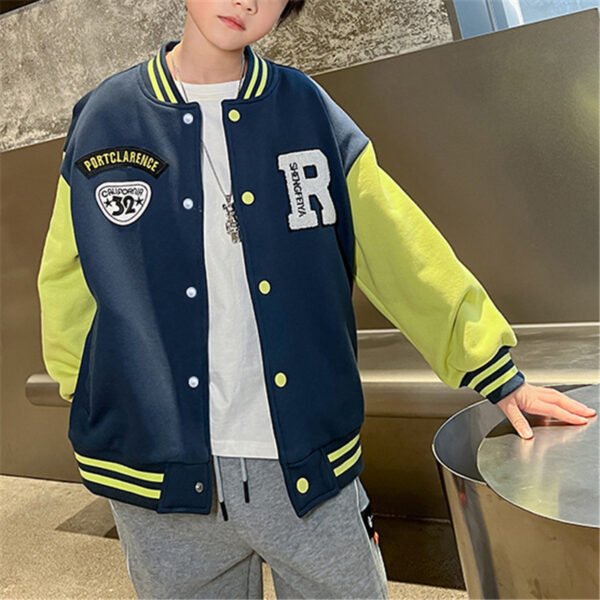
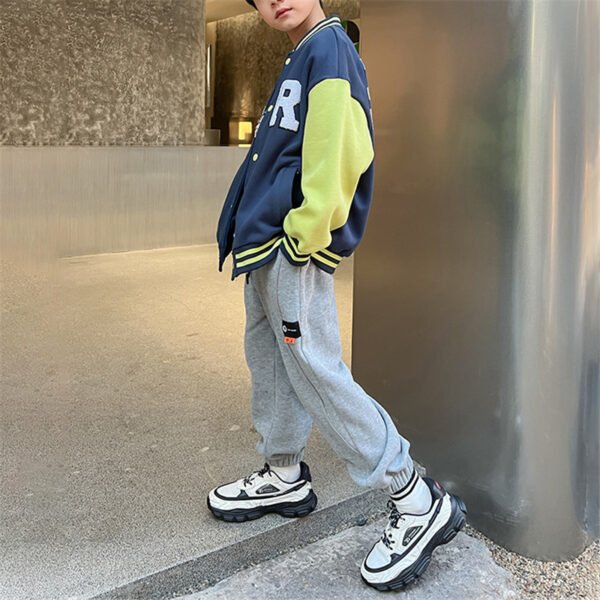
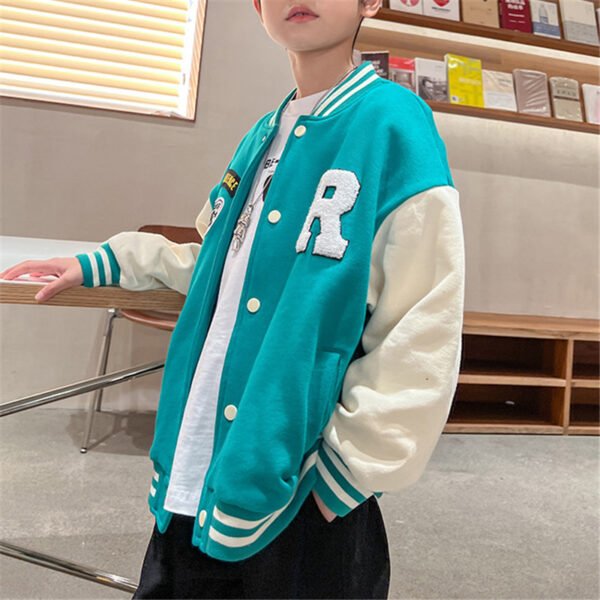
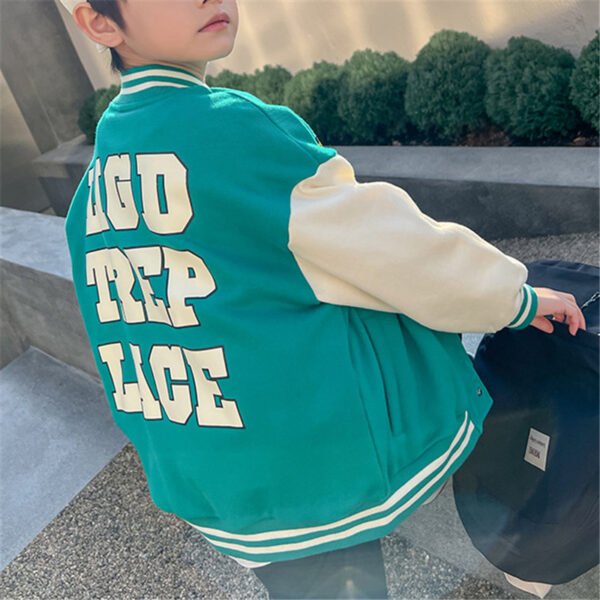
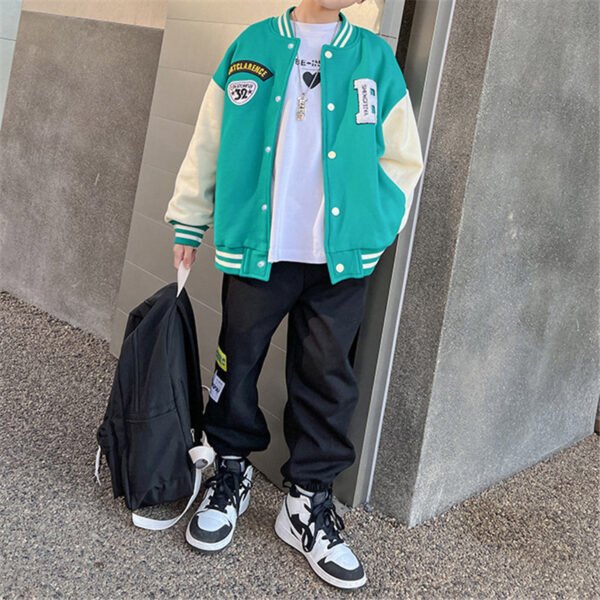





This children's varsity jacket uses a two-material visual block-navy body, bright sleeves, striped rib trim, and contrast snaps. For VeeWen development, the central challenge is graded sizing: ensuring proportions, patch placement, sleeve balance, and closure positions remain consistent across children's size labels without distorting the design.
Build the Grade Around Proportion
Grading this jacket begins with the relationship between shoulder width, body length, sleeve length, and rib-band depth. The supplied image shows a child-scale silhouette with sleeves extending from a compact body, so measurements must be checked together rather than enlarged uniformly across the size range.
Label logic should reflect the approved measurement chart, not only a child's age. Neck opening, armhole depth, cuff circumference, and hem ease influence comfort and visual balance; the navy-and-yellow contrast makes proportion errors conspicuous, especially when the same artwork is carried into smaller sizes.
Lock the Color Architecture Before Grading
The visible navy body and luminous yellow sleeves establish a fixed color architecture that should be locked before grading. A technical pack can assign color zones separately, preventing trim widths, snap positions, and patch boundaries from drifting as body panels change between approved children's sizes.
Because the image presents strong horizontal stripes at the collar, cuffs, and hem, those bands become visual checkpoints during sampling. Their spacing should remain optically even around the smaller torso, while contrasting front snaps stay centered and clear of artwork, pocket openings, and seam allowances.
Protect Movement Through Controlled Ease
Graded specifications must preserve movement, not simply reproduce the photographed outline. The broad sleeve shape, dropped-looking shoulder relationship, and compact hem suggest room for wear; however, ease should be distributed through the chart so the jacket does not become excessively wide or lose its child-focused silhouette.
Each size should receive a separate review of sleeve pitch, cuff recovery, and hem circumference because these areas determine how the garment sits during movement. The image's relaxed pose reveals generous sleeve reach, but it cannot verify comfort, stretch, or finished measurements; those remain sample-approval checkpoints.
Grade Decoration as a Composition
Patch and embroidery placement must be graded as a composition, not treated as a fixed coordinate. The supplied image shows a letter patch on the right chest and a shaped patch on the left, so artwork scale, spacing, and stitch density require size-specific rules before digitizing.
Smaller fronts may need reduced patch dimensions or repositioned artwork to protect snap clearance and preserve readability. VeeWen's development review should compare artwork against the graded front pattern, then confirm placement on a representative small, middle, and large size before bulk cutting is approved.
Translate the Argument Into VeeWen Workflow
VeeWen can translate this visual reference into a size-label matrix linking body measurements, sleeve measurements, rib dimensions, closure spacing, and artwork coordinates. The development output is not a generalized size range; it is an auditable set of linked specifications that keeps the design recognizable across labels.
At sample review, the buyer should inspect the smallest and largest approved labels beside the photographed reference, focusing on sleeve-to-body balance and patch scale. Any adjustment should update the measurement chart, pattern, artwork file, and label mapping together, preventing late corrections from creating inconsistent production instructions.
Set Boundary-Size Approval Checkpoints
Before approval, verify finished measurements against the child wearer, focusing on arm mobility, overlap, and cuff security. Confirm that rib bands sit evenly, snaps operate cleanly, and patches remain clear of stress points; these checks determine whether grading preserved function as well as appearance.
The production decision should be based on a signed graded specification, approved artwork placement, and physical samples representing boundary sizes. If the silhouette, trim alignment, or decoration changes materially between labels, revise the rule before ordering; MOQ: 100 pieces per style supports a controlled commercial checkpoint.
Buyer Questions
Can VeeWen develop this jacket across multiple children's size labels?
Yes. The style can be developed around a buyer-approved size chart, with each label mapped to body, sleeve, rib, closure, and artwork specifications before pattern release for sampling and review.
Why is uniform scaling unsuitable for this varsity jacket?
Because children's proportions change unevenly, uniform scaling can distort sleeve reach, hem balance, or decoration spacing. A graded chart assigns controlled adjustments to each measurement and checks visual continuity across labels.
Is the complete material composition verified from the image?
The photographed garment shows PU leather sleeves, but body fabric, lining, GSM, and composition are not verified. VeeWen should confirm these material decisions through the technical pack and representative development sample.
Which sizes should buyers inspect before commercial approval?
Use the smallest and largest approved sizes as boundary checks, then review a middle size for continuity. Confirm measurements, rib proportions, snap alignment, patch placement, and label mapping before issuing commercial production instructions.
Approve the Grade Before Production
Send your target size chart, artwork files, and preferred material direction to begin a VeeWen review. We will organize the graded specification, identify confirmation points, and define the sample approval evidence required before MOQ: 100 pieces per style.


Reviews
There are no reviews yet.