


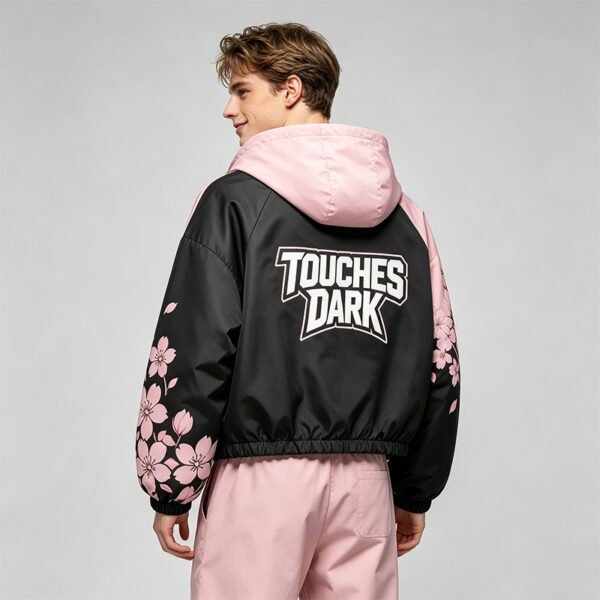
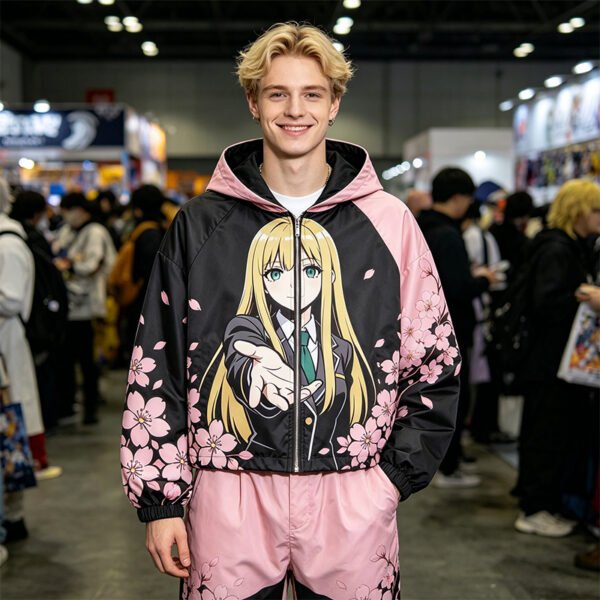




This custom cropped hooded jacket is developed around seam clearance rather than decoration alone. Its black and pink patchwork creates concentrated transition lines, while elasticated edges and a short body demand precise control over distress, print placement, and structural visibility.
Patchwork Seams Define the Distress Map
The supplied sleeve image shows black and pink materials meeting along a pronounced curved boundary. That line is visually important and structurally sensitive, so distress placed too close could blur the color break, expose seam allowances, or make the panel connection appear accidental.
VeeWen's workflow should create a seam map before distress development begins. The map can mark protected seam corridors, permitted abrasion fields, and visual stop points, allowing the buyer to review character placement against actual construction rather than approving an isolated artwork file.
Cropped Proportion Concentrates Visual Risk
A cropped jacket presents less vertical surface than a standard-length outer layer. As a result, hood, chest graphics, patchwork joins, sleeve shaping, and hem finish occupy a tighter field, leaving less room for distress to spread without competing with essential design elements.
VeeWen should validate the cropped block in a finished sample before setting artwork and distress distances. The buyer's checkpoint is whether the shortened body preserves coverage, graphic balance, and seam visibility across the approved size range, not only on the base size.
Elastic Edges Need Clean Clearance
The image clearly shows a gathered elastic sleeve edge with multiple controlled folds and visible stitching. Abrasion, printing, or excessive heat near this channel could disrupt gathering, obscure the edge, or create an uneven appearance where the sleeve finish needs to remain stable.
During development, VeeWen can reserve a no-application band around elastic channels and evaluate the finished sleeve after assembly. Clearance should be measured from the stitched edge, because the channel's actual position may differ slightly from the cut component outline.
Color Transitions Affect Graphic Registration
Black and pink panels produce different visual backgrounds for prints or patches. Artwork that crosses the transition may need separate registration control, adjusted underbase treatment, or a deliberate break, while artwork placed too close to the seam can look crowded after sewing.
The product workflow should test graphics on the assembled patchwork shell, including seam bulk and panel distortion. VeeWen can then confirm whether the preferred artwork remains legible within one panel or requires controlled overlap across the color boundary.
Distress Must Support Construction Visibility
Distress is commercially useful when it adds surface character without hiding the garment's engineering. On this jacket, the panel edges, hood attachment, sleeve elastic, and cropped hem are the features that communicate intentional construction and should remain visually readable.
VeeWen should compare restrained, moderate, and stronger distress placements on development samples. The buyer should select the level that supports the design language while preserving seam integrity, clean edge definition, and a repeatable appearance at bulk inspection.
Production Approval for Patchwork Repeatability
The stated commercial minimum is MOQ: 100 pieces per style. For this style, repeatability depends on panel cutting, color matching, seam alignment, distress placement, elastic recovery, and graphic registration being controlled as one linked production system.
VeeWen's approval checkpoint should consolidate the panel pattern, seam map, artwork coordinates, protected zones, and finished measurements. The buyer can then confirm whether the complete cropped silhouette performs visually across sizes before authorizing production under the agreed minimum.
Buyer Questions
Can distress cross the black and pink seam?
It can be designed to cross selectively, but the buyer should first review seam bulk, color separation, and edge clarity. A protected corridor usually improves repeatable visual control.
How are graphics handled on two panel colors?
Artwork may remain within one panel or cross the transition with adjusted registration. Final print method, underbase requirements, and artwork separation should be confirmed on an assembled sample.
Will the cropped fit grade consistently?
It can be graded from an approved base block, but cropped length, hood scale, sleeve volume, and hem position require review across sizes before bulk approval.
What is the order minimum for this style?
The commercial minimum is MOQ: 100 pieces per style. Planning also requires approved panel materials, color standards, artwork, distress limits, size range, and construction measurements.
Approve the Seam-Clearance Map
Share the target quantity, graded size range, artwork, and distress preference so VeeWen can build a controlled development brief for this cropped patchwork jacket.



Reviews
There are no reviews yet.