


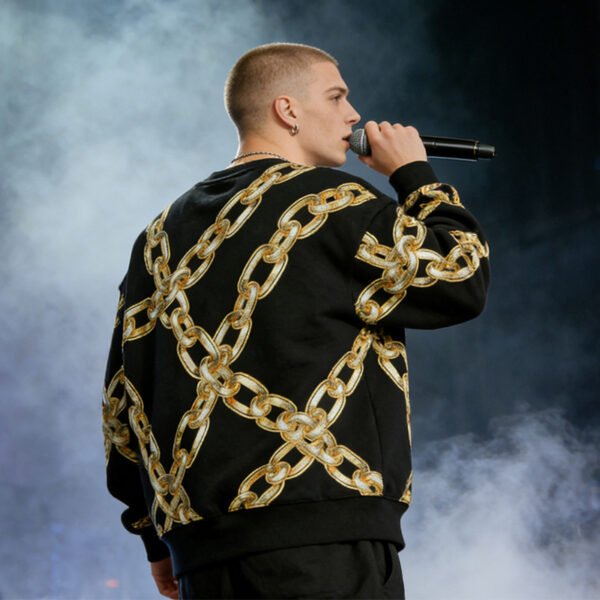

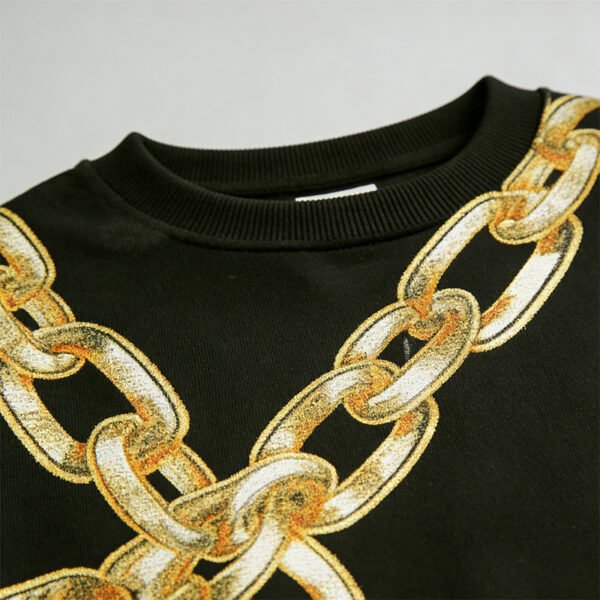






This black chain-graphic top should be developed around laundering stability, because every printed or embroidered chain path magnifies side-seam rotation. The ribbed cuffs, hem, and crew neck frame a relaxed long-sleeve shape whose visual impact depends on the body staying square after care.
Why Spirality Is the Central Risk
Side-seam spirality is a rotational distortion that can develop when knitted panels, yarn paths, cutting, or sewing tensions are not balanced. On this garment, rotation would shift chain paths around the torso and make the sleeves appear to wind forward or backward.
The supplied image shows gold chain routes crossing large areas of a black top, creating clear reference lines for inspection. A small seam turn may therefore look more disruptive than it would on a plain garment with no continuous directional artwork.
Reading the Graphic as a Test Grid
The repeated chain motif provides practical checkpoints from neckline to hem and across each sleeve. During development, the team can photograph the garment flat and worn, comparing chain junctions against center front, side seams, cuffs, and rib hem before and after laundering.
This visual method does not replace measurement, but it connects dimensional change to buyer perception. If artwork paths migrate noticeably after care, the issue may involve panel torque, seam balance, fabric recovery, or decoration behavior, requiring structured diagnosis.
Knit and Seam Variables to Confirm
The image establishes a soft-looking black long-sleeve construction with ribbed edges, but it does not verify fiber content, GSM, yarn type, or finishing. Those variables can influence relaxation, shrinkage, recovery, and the likelihood of spirality appearing after laundering.
VeeWen should confirm the knit specification alongside stitch density, seam type, thread tension, and panel grain. The goal is not to promise a universal result, but to identify which controllable inputs most strongly affect the approved graphic balance.
Fit and Edge Stability
The relaxed body, crew neck, rib cuffs, and rib hem create a sweatshirt-like frame for the artwork. Edge stability matters because a twisting body can pull the hem off level, while unstable ribs may exaggerate the impression of rotation at cuffs and neckline.
Fit approval should examine shoulder width, sleeve pitch, body length, cuff recovery, and hem opening together. A comfortable oversized block is commercially useful only when its proportions remain coherent after the intended laundering and handling sequence.
VeeWen Workflow for Spirality Approval
VeeWen can build this product around a pre-wash and post-wash comparison: confirm the knit and decoration method, produce the first sample, record side-seam alignment, then repeat the agreed laundering process before fit and graphic review.
The production file should preserve seam-construction notes, orientation marks, measurement checkpoints, and decoration tolerances. The buyer's approval gate is a washed sample whose chain paths, rib edges, and side seams remain acceptable in both flat and worn inspection.
Decoration Trade-Offs and Final Decision
Source wording describes an embroidered gold-chain direction, while the supplied image confirms the visual effect rather than the exact technique. Embroidery, print, or a combined method can change weight, hand feel, flexibility, and seam stress, so execution must be selected deliberately.
A buyer should compare the decoration method against spirality risk, surface comfort, visual sharpness, and laundering response. Approve bulk only after the chosen technique, side-seam tolerance, wash assessment, and production sample have been documented as one decision.
Buyer Questions
What does side-seam spirality mean?
It is rotational twisting that can move seams and graphics around the body after laundering, often becoming visible through uneven hems, sleeve positions, or shifted artwork.
Is the chain decoration definitely embroidery?
The source wording identifies embroidery, but the supplied image alone confirms appearance rather than technique; VeeWen should verify execution through artwork and sample approval.
How should this top be tested during development?
Compare documented measurements and graphic checkpoints before and after the agreed laundering process, inspecting the garment flat and worn for seam rotation and edge distortion.
Can VeeWen develop this under the stated MOQ?
Yes. The commercial minimum is MOQ: 100 pieces per style, while final materials, grading, decoration, tolerances, and laundering requirements remain subject to approval.
Approve the Washed Graphic Sample
Share your target fit, artwork files, decoration preference, and care expectations with VeeWen to review spirality checkpoints and approve a stable production direction.



Reviews
There are no reviews yet.