

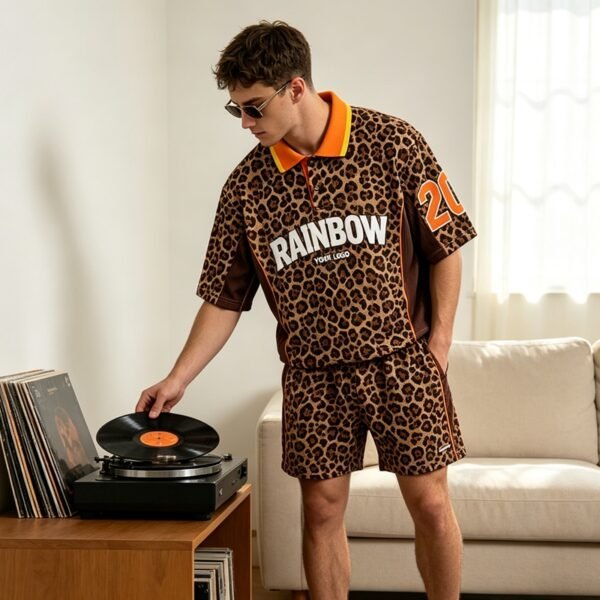




This custom men's leopard mesh polo shirt is developed around applique edge control, managing raised decoration where layered materials meet a breathable patterned base. The objective is a graphic-rich silhouette that keeps sleeve mobility and surface balance intact while avoiding unnecessary bulk at attachment edges and contrast transitions.
Applique Stack and Edge Behavior
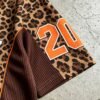
The supplied image shows a large orange numeral bordered in white, creating a layered graphic with visible raised boundaries over leopard-patterned mesh. Each layer adds thickness, needle handling, and an edge that must remain registered through sewing and subsequent garment movement.
Edge control begins with the approved artwork hierarchy, seam allowance, and attachment sequence. VeeWen should confirm whether the white border is a separate applique layer, embroidery-style treatment, or combined construction before setting stitch paths and evaluating the final hand feel.
Managing Bulk Over Mesh
Mesh presents a flexible, visually open base, while layered applique introduces localized weight and stiffness. If the backing or stitch density extends too far beyond the graphic, the decorated area may resist drape and create a noticeable transition around the numeral.
A development sample should compare the applique face with the surrounding leopard ground under natural folding and sleeve movement. The buyer should approve the smallest stable support area that prevents distortion without turning the graphic zone into a rigid panel.
Ribbed Contrast at the Sleeve
The image reveals brown ribbed material beside the decorated sleeve, producing a clear change in texture, direction, and thickness. That interface can amplify bulk where rib compression meets the applique edge, particularly if both components are secured within one crowded attachment sequence.
Pattern and sewing review should keep the ribbed section flexible enough for the oversized sleeve to move freely. The approval checkpoint is a clean transition with no trapped fullness, exposed backing, or edge collision between rib channels and applique layers.
Oversized Sleeve Movement
An oversized short sleeve gives the polo a relaxed streetwear proportion, but its added volume changes how decoration swings and folds during wear. A heavy applique can pull the sleeve downward or distort the opening if its support is not balanced against the pattern.
The buyer should inspect the sleeve on a form and during arm elevation, checking whether the graphic remains centered and the hem hangs evenly. Edge control must support the visual statement without compromising the movement promised by the relaxed silhouette.
VeeWen Development Workflow
VeeWen's product-development workflow should translate the image into an applique construction map showing layer order, edge distances, ribbed interface limits, and the zones that must remain free of excess backing. This map gives pattern, artwork, and sewing decisions one shared reference.
Sample comments should identify edge lift, puckering, stiffness, registration drift, and sleeve imbalance separately. The team can then adjust applique dimensions, attachment sequence, backing coverage, or local pattern allowances before the buyer approves the style for its MOQ.
Approval Gate for Surface Complexity
The key trade-off is graphic prominence against flexible comfort. A thicker applique may deliver stronger relief and visibility, while a lighter stack can preserve drape but may require more precise edge securing and support decisions.
Approve the style when the numeral border remains crisp, the leopard pattern stays visually continuous around it, and the sleeve moves without pulling. If bulk overwhelms the mesh, revise the layer stack before confirming production artwork and construction specifications.
Buyer Questions
What is the main applique risk?
The main risk is excess localized bulk causing mesh distortion, edge lift, sleeve drag, or an abrupt transition where the applique meets ribbed contrast material.
Can the graphic be resized for grading?
Yes, the applique can be graded with the pattern, but each size should preserve edge clearance, visual balance, and manageable layer bulk across the sleeve and body.
Does the image verify the fabric composition?
No. It verifies visual texture and construction cues only; fiber content, GSM, backing method, and performance requirements need separate confirmation during development.
What is the commercial minimum?
The stated commercial minimum is MOQ: 100 pieces per style. Final size ratios, packaging, decoration approvals, and order details require confirmation in the production brief.
Approve the Applique Construction
Share your artwork, size range, and preferred applique hierarchy with VeeWen for a sample review focused on edge registration, layer bulk, ribbed transitions, sleeve mobility, and production approval.


Reviews
There are no reviews yet.