



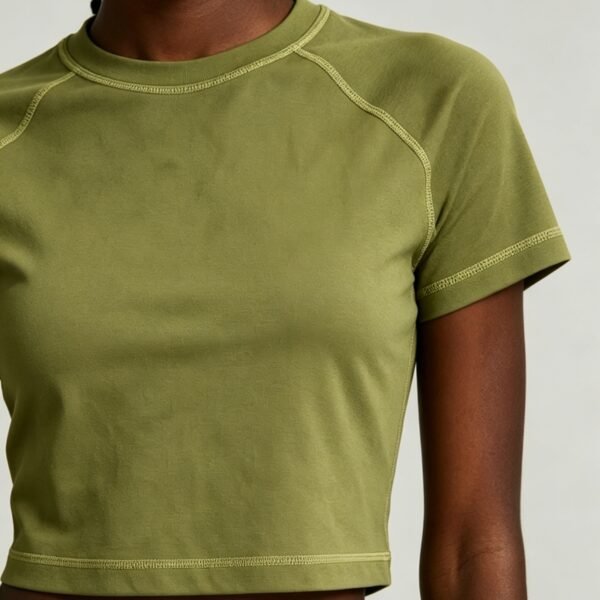






This cropped raglan top depends on reinforcement discipline, not simply more stitches. Bartacks must sit where dressing and movement loads converge, while avoiding hard points that pucker the close silhouette. The development objective is controlled stress distribution across neckline, underarm, sleeve, and hem transitions.
Locate Real Load Paths Before Reinforcing
A bartack works by concentrating multiple stitches across a short zone, helping resist seam opening where force repeatedly changes direction. On a close crop top, likely review areas include neckline entry points, raglan-to-underarm transitions, and any hem or side-seam junction exposed during dressing.
More reinforcement is not automatically safer. If a dense bartack sits beside a flexible seam, the reinforced point may stop extending while surrounding fabric continues moving. Stress can then migrate to the bartack edge, creating distortion, discomfort, or damage in an adjacent unreinforced area.
Treat the Raglan Junction as a System
The visible raglan line curves from the neckline toward the underarm, where sleeve and body movement interact. Arm lifting applies multidirectional force rather than a simple straight pull, so reinforcement must account for seam geometry, stretch direction, stitch elasticity, and allowances at the junction.
Bartack orientation should bridge the actual opening tendency without crossing excessive bulk. A poorly angled reinforcement may lock the seam in the wrong direction or form a tactile ridge. The sample therefore needs arm-raise, forward-reach, and dressing checks before the position and dimensions are finalized.
Balance Neckline Security and Entry Stretch
A close crew neckline must expand sufficiently as the garment passes over the head, then recover without waviness. Reinforcement near a neckband or raglan intersection can secure vulnerable starts and stops, but excessive density may restrict entry or create a visible notch in the neckline curve.
The image's lighter contrast stitching makes neckline behavior especially exposed. Any skipped alignment, tension imbalance, or local puckering becomes part of the design surface. VeeWen should coordinate bartack thread, placement, and stitch coverage with the visible seam language instead of treating reinforcement as a hidden afterthought.
Prevent Underarm Stress Migration
Underarm areas combine perspiration exposure, repeated arm movement, seam bulk, and intersecting force paths. A bartack placed exactly on the thickest junction may become hard against the body, while one positioned too far away may fail to support the point where seam allowances begin separating.
Development should compare the junction from both face and reverse sides, checking whether reinforcement lies flat and whether adjacent stitches remain elastic. The target is gradual load transfer through the seam system, not an isolated anchor that forces all movement into one needle-perforated edge or narrow fabric.
Keep the Cropped Hem Responsive
The short hem sits around a high-motion torso area and may be pulled during dressing or styling. Reinforcement at side-seam and hem intersections can stabilize thread starts, yet a dense bartack may interrupt stretch, flare outward, or produce a hard bump on a close-fitting silhouette.
Because the photograph shows a compact body length and fitted shape, hem response should be judged during seated and raised-arm positions. Buyers should confirm the edge remains level, the side seam stays vertical, and any reinforcement avoids drawing attention through puckering or asymmetric tension.
Build Bartack Approval into VeeWen Sampling
VeeWen can begin with the buyer's target block, fabric reference, and intended movement profile, then annotate proposed reinforcement points on the construction sheet. Each bartack should have a stated purpose tied to a load transition, allowing unnecessary reinforcement to be removed before production-intent sampling.
The approval sample should be reviewed on the intended size and through dressing, reaching, sitting, and arm rotation. The buyer's checkpoint is whether neckline, raglan, underarm, and hem junctions remain secure and comfortable without rigid spots, stress migration, visible puckering, or broken design continuity.
Buyer Questions
Does every seam junction need a bartack?
No. Bartacks should answer a defined load or thread-security requirement. Reinforcing every junction can add stiffness, bulk, puckering, and new stress edges without improving the garment's actual movement performance.
Where should raglan crop-top reinforcement be reviewed first?
Start with neckline entry transitions, raglan-to-underarm junctions, and side-seam-to-hem intersections. Final placement depends on fabric behavior, seam construction, intended fit, and movement findings from the production-intent sample.
Can contrast bartacks become a visible design detail?
Yes, if color, dimensions, orientation, and consistency are deliberately approved. Because contrast reinforcement attracts attention, it must align cleanly with surrounding topstitching and remain visually controlled across graded garment sizes.
How should buyers approve stress distribution?
Review the intended size during dressing, reaching, sitting, arm lifting, and torso rotation. Look for seam opening, restricted movement, localized puckering, hard contact points, stress whitening, and distortion beside reinforcements.
Place Reinforcement Where the Garment Actually Needs It.
Share your target fit, size range, fabric reference, contrast-stitch direction, and intended use with VeeWen. We will develop and sample a purpose-led bartack map for movement-based buyer approval. MOQ: 100 pieces per style.



Reviews
There are no reviews yet.