


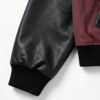


This custom spliced varsity jacket is built around edge control. The supplied close-up shows a black washed faux-leather sleeve meeting a burgundy body and a substantial rib cuff, making binding width, recovery, and junction comfort central to the product-development decision.
Binding Controls the Spliced Silhouette
The image presents a strong black-and-burgundy contrast, but the jacket's visual discipline comes from the black rib cuff framing the sleeve opening. Its width creates a deliberate transition between flexible rib and the softly folded outer sleeve material.
If the binding is too narrow, the sleeve edge can look visually weak beside the substantial faux-leather surface. If too wide, it can shorten the sleeve appearance and dominate the color block. The approved proportion should balance both materials.
Stretch Recovery Protects Wearability
Rib binding must expand over the hand and return closely to the wrist without twisting. The close-up shows a dense vertical rib structure and a gathered sleeve edge, indicating that recovery influences both comfort and the crispness of the finished opening.
Development should measure relaxed circumference, extension circumference, and recovery after repeated hand-entry cycles. These checkpoints help separate a cuff that merely stretches from one that maintains a stable opening while the sleeve moves naturally.
Sleeve Junctions Need Flexible Transitions
The sleeve folds visibly near the junction with the burgundy body, showing where material flexibility and seam allowance affect movement. A rigid or poorly balanced join can create drag across the upper arm, especially when contrast panels have different surface behavior.
Keep the sleeve seam, armhole allowance, and binding transition aligned through the pattern review. A worn prototype should be checked with the arm raised, bent, and extended to identify pulling, excess bulk, or seam migration.
Width Must Continue Across Openings
A cuff specification cannot be isolated from the hem and neckline. The visible black rib establishes an edge language that should be coordinated across the jacket, while each opening may need a different finished width because body weight and stretch demands are not identical.
Set finished dimensions independently, then review them as a family on the complete garment. The buyer should confirm that cuff, hem, and neckline proportions support the burgundy body without making the jacket appear cropped, tight, or visually top-heavy.
VeeWen Workflow for Binding Development
VeeWen's development work for this style should begin with a binding matrix covering rib specification, relaxed width, stretch range, recovery expectation, seam allowance, and opening circumference. That matrix connects the visible contrast design to repeatable pattern and sewing decisions.
The useful checkpoint is a fully assembled sample using the intended sleeve material, body fabric, rib, and patch-spliced details. Review the jacket worn and flat, then record approved measurements before discussing the MOQ: 100 pieces per style.
Approve Material and Edge Behavior Together
The washed sleeve appearance may vary with surface treatment, while rib can vary in density, width, and recovery. Approving those elements separately risks a mismatch where the sleeve looks soft but the cuff feels overly rigid or loses its shape.
Before bulk approval, confirm final composition, backing, color contrast, binding dimensions, stretch recovery, seam comfort, and wash appearance. The buyer's decision should be based on the complete assembled sample rather than the close-up finish alone.
Buyer Questions
Can the rib binding width be customized?
Yes. Finished width can be developed for the cuff, hem, and neckline independently, then coordinated visually and tested for comfort on the assembled sample.
Why test stretch recovery instead of stretch alone?
Stretch shows expansion, while recovery shows whether the opening returns to shape. Both are needed to prevent loose cuffs, twisting, and inconsistent fit.
Can the sleeve and body use different materials?
Yes. The visible design already uses contrasting components, but material compatibility, seam bulk, color balance, and wash behavior require combined sample review.
What is the minimum order for this jacket?
The commercial minimum is MOQ: 100 pieces per style. Final quantities, color combinations, and material details should follow the approved development record.
Approve the Binding Matrix
Share the intended rib, sleeve, body, and size specifications for coordinated development. VeeWen can align binding width, stretch recovery, contrast balance, and sample approval before MOQ planning.

Reviews
There are no reviews yet.