


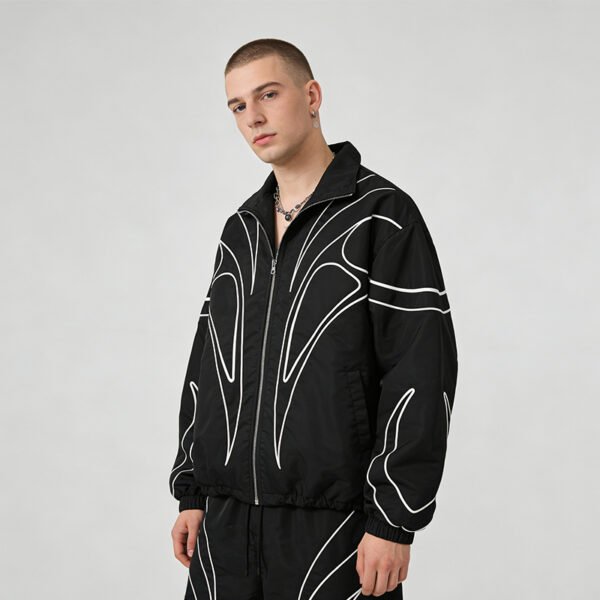






This custom men's jacket is developed around a practical tension: bold embroidery adds visual authority, while lightweight nylon must retain movement through the body and sleeves. The supplied image shows a black stand-collar shell, sweeping white lines, gathered edges, and a centered zipper requiring coordinated engineering.
Where Embellishment Starts Changing Drape
The visible embroidery covers much more than a chest logo. Mirrored white lines travel from the collar area toward the hem and continue along both sleeves, distributing decoration across moving panels rather than concentrating weight at one point.
That distribution can still alter how nylon folds, especially around the upper chest, elbow, and side seam. The development question is therefore not simply whether the artwork is attractive, but whether stitch density allows the shell to recover its relaxed shape after movement.
Mapping Stitch Weight Across the Jacket
The artwork should be divided into production zones before sampling: upper chest, sleeve runs, pocket surroundings, and lower-front curves. Each zone can receive an appropriate stitch plan, minimizing abrupt changes where decorated and undecorated nylon meet.
The supplied image suggests deliberate left-right visual symmetry, but symmetry does not require identical stitch loading at every seam intersection. VeeWen should review artwork scale against panel dimensions, seam allowances, and access for embroidery before confirming the final file.
Closure and Edge Control
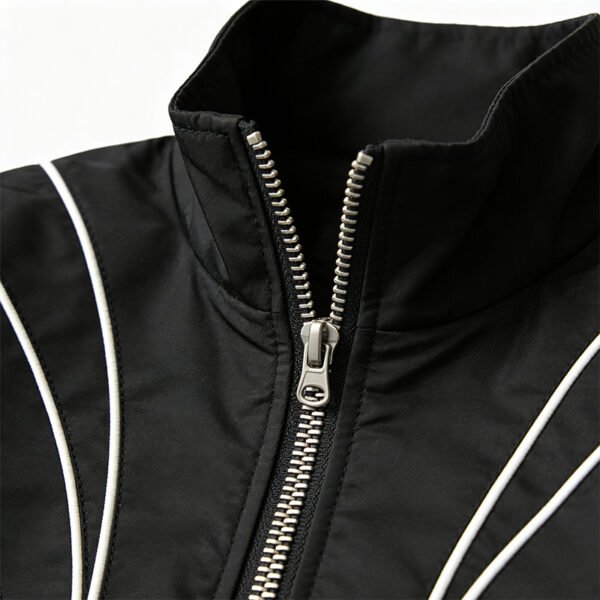
The stand collar and center zipper establish a narrow, firm axis through the jacket. Keeping the densest embroidery away from the zipper tape and collar fold helps the front close cleanly and prevents decoration from competing with the garment's primary vertical line.
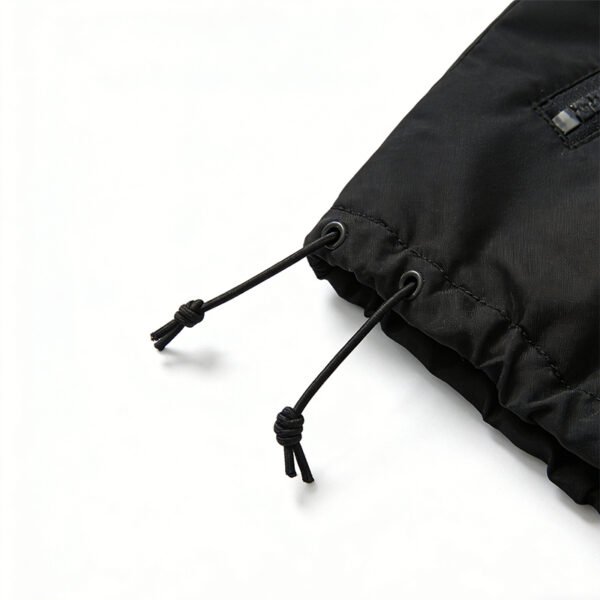
At the hem and cuffs, visible gathering creates a compact finish that can visually absorb some surface irregularity. However, excessive embroidery near elastic channels may restrict contraction, so the placement approval should include clear exclusion zones around each edge construction.
Pocket Placement as a Drape Check
The angled welt pockets provide a useful interruption within the large embroidered front field. Their openings should remain visually legible and physically accessible, with embroidery routed around the welt rather than crossing the opening or thickening its immediate seam area.
Pocket bags and front-panel stabilization can also influence how the lower jacket hangs. During development, compare a decorated pocket panel with an undecorated control panel to identify whether the artwork or pocket structure is causing unwanted front-body stiffness.
VeeWen Development Workflow for This Axis
VeeWen's workflow should begin with an embroidery placement file over the actual jacket pattern, followed by a targeted panel test using the proposed nylon reference. The test should examine stitch density, backing visibility, puckering, and recovery after handling across curved lines.
Once the panel test is reviewed, the sample should be assessed on a form and in motion, focusing on chest fold, sleeve bend, zipper closure, and hem contraction. The buyer then approves the artwork-density combination before the full style is released at MOQ: 100 pieces per style.
Approval Checkpoint Before Production
The key approval is a decorated-shell sample that proves the desired graphic impact does not overpower the jacket's intended drape. Review the garment frontally for symmetry, then inspect side and sleeve movement where embroidery crosses curved or bias-sensitive areas.
Also confirm the nylon composition, lining decision, waterproof performance requirements, thread specification, and care instructions before bulk authorization. These details remain open because the supplied evidence identifies the style direction but does not verify final technical specifications.
Buyer Questions
How can embroidery preserve a softer nylon drape?
Use a controlled stitch plan, suitable backing, and panel testing to limit concentrated loading, then review chest and sleeve movement before approving production artwork.
Should the embroidery cross the zipper area?
The supplied image keeps the center zipper visually clear. Retaining an exclusion zone generally protects closure function and preserves the jacket's strong vertical front balance.
What should the first sample prove?
The first sample should prove artwork scale, stitch density, backing behavior, zipper operation, pocket accessibility, hem contraction, cuff recovery, and overall drape on the selected shell.
What is the minimum order for this style?
The commercial minimum is MOQ: 100 pieces per style. Final material, decoration, labeling, and packaging details should be approved before production release.
Approve the Embroidery-Drape Direction
Send the artwork, target measurements, and nylon reference for a focused placement review. VeeWen can then align decoration weight, closure clearance, edge construction, and the MOQ: 100 pieces per style checkpoint.


Reviews
There are no reviews yet.