


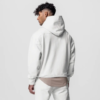


This pullover hoodie is developed around one practical question: how much internal ease can a substantial shell provide before the hood, sleeves, and body lose everyday mobility? VeeWen can translate the shown relaxed silhouette into a measured shell-to-lining balance for repeatable sampling.
Shell Volume Sets the Mobility Baseline
The image presents a relaxed body that leaves visible room over the torso, while the sleeves fall naturally from the shoulders. That volume creates the starting point for lining ease: enough internal clearance for layering, but not so much that the garment appears inflated or loses proportion.
For development, the shell should be measured through chest, armhole, sleeve, and hem relationships together. A thicker interior can reduce usable movement even when exterior measurements look generous, so fitting must observe reaching, bending, and pocket access before approving the base block.
Hood Stability Depends on Internal Balance
The hood rises clearly around the model's neck instead of lying flat against the back. That visible stance suggests that shell weight, neckline shape, and internal support must work together; excessive lining tension could pull the hood backward, while excess looseness could make the opening appear shapeless.
VeeWen's development checkpoint should compare hood depth, opening circumference, neckline attachment, and lining turn of cloth in one sample. The buyer should review the hood both worn and resting, because a comfortable opening is not sufficient if the silhouette collapses after movement.
Sleeve Ease Meets Ribbed Containment
The sleeves appear roomy through the upper arm and narrow into visibly ribbed cuffs. This combination creates comfort above the wrist while controlling the final opening, making cuff stretch and sleeve lining ease especially important. A tight internal sleeve can undermine the relaxed exterior during layering.
During pattern review, the buyer should assess bicep circumference, elbow articulation, sleeve length, and cuff recovery as a connected system. The target is a sleeve that slides over a base layer without bunching, yet remains visually gathered at the wrist rather than drifting over the hand.
Pocket Placement Reveals Front-Shell Tension
The kangaroo pocket spans the lower front without obvious distortion, giving a useful visual test for shell stability. If the lining pulls unevenly or the front panels carry excessive tension, pocket openings can twist, gape, or sit asymmetrically when the wearer places both hands inside.
VeeWen should sample pocket height, opening angle, reinforcement, and front-body ease together rather than treating the pocket as an isolated trim detail. Approval should include hand insertion and seated wear, because pocket comfort exposes restrictions that a static front photograph cannot show.
Color Supports Controlled Private-Label Development
The warm orange shown in the image is commercially distinctive without relying on graphics, making surface consistency and tonal branding important. A clean front gives the buyer flexibility to add embroidery, print, woven labels, or subtle trims without competing with a complex base design.
The buyer should define whether the shown color is a visual direction or a lab-dip target, then approve branding placement against the final shell and lining. VeeWen's workflow can record color, logo scale, placement, and tolerance together so later revisions do not disturb the fit argument.
VeeWen Workflow Converts Ease Into Approval
VeeWen can begin with a measurement brief built from the shown hood, relaxed torso, sleeve volume, cuff containment, and pocket position. The first sample should isolate shell-to-lining balance, allowing the buyer to judge mobility and hood behavior before adding decorative branding or broader color options.
After fitting, comments should separate pattern changes from material changes, because either can alter perceived thickness and ease. The approval gate is a signed specification covering measurements, lining treatment, hood behavior, cuff opening, pocket placement, and branding coordinates before the 100-piece-per-style order proceeds.
Buyer Questions
Can this hoodie be developed with a different lining treatment?
Yes. Lining type, weight, finish, and attachment can be developed separately, provided the approved shell-to-lining balance preserves movement, hood stance, and sleeve comfort.
Is the relaxed appearance a confirmed oversized specification?
No. The relaxed appearance is visual evidence only. Final oversized, regular, or custom proportions require a measurement sheet, fit sample, and buyer approval.
Can branding be added without changing the argument?
Yes. Branding can be positioned after the base fit is approved, with placement and application reviewed so added structure does not distort the front shell.
What is the commercial minimum for this style?
The commercial minimum is MOQ: 100 pieces per style, with final ordering dependent on approved materials, measurements, branding details, and production documentation.
Approve the Balance Before Branding
Send your target measurements, lining preference, color direction, and branding artwork to begin a focused hoodie sample. VeeWen will develop the shell-to-lining balance for buyer review before bulk commitment.



Reviews
There are no reviews yet.