


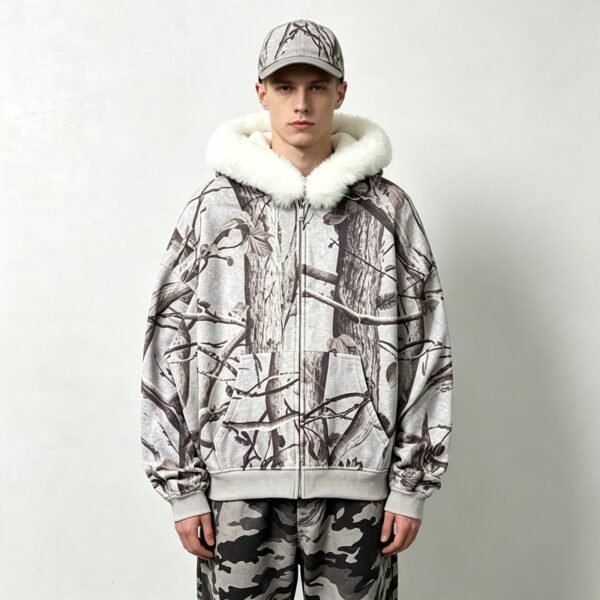





This development record treats the tree camouflage as a placement problem, not simply an all-over graphic. The center zipper, hood opening, pocket, sleeves, and rib boundaries create visible transitions where controlled matching can sharpen the garment's winter streetwear presence.
Why Join Matching Matters Here
Camouflage depends on irregular branches, trunks, and tonal breaks. When those elements stop abruptly at the zipper or pocket edge, the eye notices the interruption quickly. Matching selected landmarks across adjoining panels can preserve the forest impression while keeping production decisions measurable.
The goal is not perfect continuity everywhere. A full repeat match may increase marker planning, cutting controls, print registration demands, and fabric consumption. The approval question is which joins deserve alignment, especially the center front, hood seam, sleeve attachments, and pocket perimeter.
Reading the Supplied Garment Evidence
The image shows a pale gray tree composition with dark branches crossing a hooded, zip-front body. The same graphic language appears across the sleeves and pocket, giving VeeWen a clear visual basis for mapping repeat direction and prominent landmarks during development.
The white faux fur hood border creates a strong contrast against the printed shell, while rib cuffs and hem contain the silhouette. These boundaries can mask minor graphic interruptions, allowing the development team to prioritize the zipper and pocket transitions where alignment remains most exposed.
Print Placement and Panel Control
For sampling, the artwork should be divided according to actual pattern pieces rather than treated as one flat front image. The center-front opening, pocket overlay, hood panels, and sleeves each need reference points so branches do not drift unpredictably across joins.
A practical matching map can identify primary, secondary, and acceptable-break seams. Primary seams preserve recognizable trunks or branch paths; secondary seams maintain tonal balance; acceptable breaks protect yield. This hierarchy helps buyers control visual quality without demanding identical placement across every panel.
Fleece and Graphic Trade-Offs
The source describes heavy fleece, but no composition or weight is supplied for verification. A heavier brushed or unbrushed fleece may support winter positioning, yet its surface, loft, and shrinkage behavior can influence print clarity, seam dimensions, and the final accuracy of matched artwork.
The buyer should therefore approve the fabric hand and print appearance together. A softer, loftier surface may improve warmth perception while softening fine branches; a smoother surface may preserve detail but change comfort, drape, or the intended substantial winter feel.
VeeWen Development Workflow
VeeWen can translate this argument into a development checkpoint by first confirming the pattern, artwork scale, and selected matching seams. The team can then review a placement sample with the zipper and pocket assembled, because those operations reveal alignment more reliably than isolated printed panels.
Before bulk approval, the buyer should compare the approved sample against the matching map and record permitted breaks. The commercial checkpoint remains MOQ: 100 pieces per style, while composition, measurable weight, shrinkage, and final tolerances remain to confirm.
Approval Criteria for Production
A production-ready version should show intentional transitions at the center zipper and kangaroo pocket, with no distracting branch collisions caused by uncontrolled panel placement. The hood, sleeves, and lower body should retain balanced tonal distribution after assembly, not only before cutting.
Approve when the garment's visual hierarchy is clear: faux fur frames the face, camouflage carries the body, and selected joins demonstrate control. Hold approval if matching consumes unacceptable yield or if print registration obscures the branches that define the design.
Buyer Questions
Is this garment a pullover or zip-front hoodie?
The assigned category is Pullover Hoodies, but the supplied image visibly shows a center-front zipper. Confirm the final taxonomy and closure specification before production approval.
Must every camouflage seam match exactly?
No. Prioritize the center front and pocket transitions, then define acceptable breaks elsewhere. This balances visual control with yield, cutting complexity, and print registration considerations.
What fabric information is verified?
The source wording identifies heavy fleece, but it does not verify fiber composition or GSM. Request fabric confirmation, handfeel approval, and shrinkage information during development.
What is the minimum commercial quantity?
The exact commercial minimum is MOQ: 100 pieces per style. Confirm size assortment, colorway planning, and approved artwork placement within that style definition.
Approve the Matching Map
Send the intended artwork repeat, pattern, fabric target, and priority seams for review. VeeWen can develop the placement sample so your team decides alignment, yield, and final visual balance.


Reviews
There are no reviews yet.