


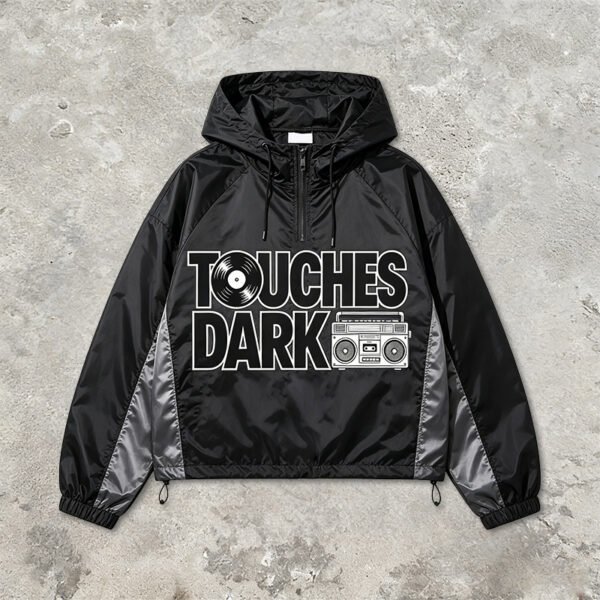







This hooded graphic jacket is built around thread choice versus seam appearance, because dark reflective fabric, diagonal raglan construction, contrast inserts, and oversized artwork compete for attention. The supplied image shows a compact black silhouette whose production quality depends on controlling every visible stitch line.
Make Thread Part of the Design
On a black, light-catching shell, thread is not a hidden utility; it becomes part of the visual surface. A matching thread can quiet raglan seams, while a contrasting thread can sharpen them and make the jacket feel more technical or graphic.
The development workflow should begin with thread swatches against the actual shell, not a flat color chart. Buyers should approve whether seams recede, outline the panels, or intentionally echo the strong geometry of the front artwork.
Clarify Raglan Seam Visibility
The diagonal raglan seams are among the first construction features noticed in the image. Their direction frames the chest graphic, so uneven stitch spacing, wavering seam lines, or excessive thread contrast could compete with the lettering and boombox artwork.
VeeWen should review the raglan seam on a fully assembled sample with the hood positioned naturally. The approval checkpoint is a front-view assessment confirming consistent stitch tracking, balanced visibility, and clean transitions into the neckline and underarm.
Coordinate Contrast Inserts
Lighter inserts along the side or sleeve areas introduce another seam relationship. Their edges need enough definition to separate panels, but excessive thread contrast may create fragmented lines that distract from the jacket's otherwise concentrated black-and-white composition.
During product development, panel boundaries, seam allowances, and thread colors should be reviewed as one map. Buyers should confirm that the contrast inserts remain intentional from front and three-quarter views, including when the fabric catches directional light.
Protect Artwork Edge Quality
The large front lettering and boombox motif occupy the jacket's most visible uninterrupted panel. Their edges need a stable surrounding surface, because nearby seam shadows, puckering, or mismatched thread can make applied graphics look misregistered even when their coordinates are correct.
The workflow should sequence graphic placement after shell and seam behavior are understood on the sample. Approval should verify artwork centering, edge smoothness, and clearance from raglan seams, zipper or opening details, and lower elastic construction.
Engineer Hood and Neck Junctions
The hood rises directly behind the front neckline, adding bulk and several joining points near the upper chest. Thread color and stitch density at this junction can either create a crisp technical frame or produce visual noise around the graphic's upper edge.
VeeWen's development review should inspect the hood opening, drawcord exits, neckline seam, and raglan intersections together. The buyer checkpoint is a worn or mannequin-based review confirming that the hood sits correctly without pulling the visible seam lines out of alignment.
Approve Surface Behavior Together
The reference shows a smooth, reflective-looking shell, but it does not verify fiber composition, coating, lining, water resistance, or performance testing. Those unknowns matter because surface sheen changes how thread, seam allowances, and artwork are perceived under different lighting.
Before production, the buyer should approve the shell reference, thread card, stitch specification, graphic sample, and fit sample as a linked package. MOQ: 100 pieces per style applies after these product-specific decisions are confirmed.
Buyer Questions
How do you choose thread for a dark reflective jacket?
We compare matching and contrast thread against the approved shell, then assess seam visibility under practical lighting before finalizing the construction specification.
Can the raglan seams be made more prominent?
Yes, seam prominence can be adjusted through thread color, stitch density, and panel contrast, subject to assembled-sample review and artwork clearance.
Can the front graphic be replaced with our artwork?
Yes, your artwork can replace the reference graphic, with placement, scale, edge treatment, and seam clearance reviewed during technical development.
What is the minimum order quantity for this style?
The exact commercial minimum is MOQ: 100 pieces per style, with final requirements confirmed after shell, graphics, fit, and seam details are approved.
Align Thread and Artwork
Share your artwork, shell preference, contrast-panel direction, and desired seam visibility with VeeWen for a coordinated development review before sampling.


Reviews
There are no reviews yet.