


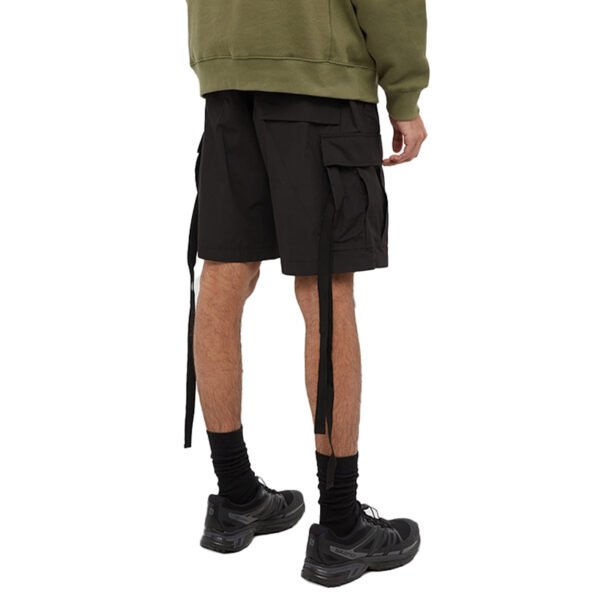




This custom utility cargo short is developed around applique edge control: multiple side-pocket layers must deliver usable depth and graphic structure without creating excessive bulk, rigid corners, or a visually crowded silhouette in the black woven reference.
The Pocket Stack Defines the Product
The supplied image presents a large upper flap pocket over a lower pocket structure, making layered construction the dominant design signal. Each added panel increases edge length, seam interaction, and local thickness, so the pocket stack must be engineered as one system.
Applique edge control determines whether the layers look intentional or become wavy and overbuilt. Turn width, corner geometry, stitch distance, and panel alignment should be specified together, because a small mismatch becomes highly visible across tonal black surfaces.
Managing Layer Bulk at the Side Seam
The pocket sits across the outer thigh, where movement repeatedly bends and compresses the layers. Excessive bulk can change the shorts' drape and make the side profile project outward, while insufficient structure may cause flap collapse or edge curling.
A balanced construction may use differentiated support across the flap, pocket face, and attachment zone, but the exact interlining and fabric behavior remain To Confirm. The buyer should assess hand feel, compression, and silhouette while walking, sitting, and entering a vehicle.
Flap Clearance and Functional Readability
The upper flap appears broad and rectangular, visually covering the pocket opening while leaving a clear horizontal edge. Its proportions should allow the pocket to read as a purposeful utility feature without masking the lower layer or creating an awkward overlapping ridge.
Flap clearance affects both appearance and access. A tight clearance can hold the flap neatly but slow use and increase edge stress; excessive clearance can look loose. Sampling should confirm the opening, closure method, and corner behavior under realistic hand access.
VeeWen Development Workflow
VeeWen should translate the visual reference into a pocket engineering sheet showing layer order, finished edge turns, corner radii, attachment sequence, and seam intersections. The first sample should be reviewed inside out as well as on body, exposing hidden bulk and alignment causes.
Subsequent comments should identify whether a problem comes from panel shape, edge finishing, reinforcement, or sewing sequence. This workflow keeps the technical argument focused: reduce uncontrolled thickness while retaining the stepped pocket architecture that gives the shorts their identity.
Trade-Offs in Edge Definition
Sharper applique corners create a more graphic utility appearance, but they concentrate stress and can amplify sewing irregularities. Softer corners reduce visual severity and may improve durability, though they can make the pocket look less architectural in a minimal black colorway.
A heavier support structure can improve flap stability and edge crispness, yet it may restrict drape at the thigh. A lighter build preserves movement and softness but requires tighter control of turn width, stitch placement, and panel handling.
Production Gate for This Style
Approve the complete pocket stack on a graded sample, checking layer count, edge turn consistency, flap clearance, seam intersections, and side-profile projection. The approval should include a defined tolerance for visible waviness and a clear decision on acceptable tactile bulk.
The buyer's final checkpoint is whether the pocket architecture remains clean during movement, not only when photographed flat. Confirm access, drape, and edge stability across the size range, then release the specification for MOQ: 100 pieces per style.
Buyer Questions
Which pocket detail should receive first approval?
Approve layer order, finished edge turns, flap clearance, and side-profile bulk first, because these decisions control both appearance and movement.
Does the image confirm the shorts are performance fabric?
No. The image shows a woven-looking utility garment, but fiber content, stretch, moisture behavior, and performance claims require confirmation.
How can layered pockets avoid looking overbuilt?
Control panel thickness, turn widths, corner geometry, seam placement, and attachment sequence, then evaluate the complete stack during walking and sitting.
What is the commercial minimum for this style?
The stated commercial minimum is MOQ: 100 pieces per style, subject to approved specifications, materials, construction, and production planning.
Approve the Pocket Layering Plan
Send the desired pocket dimensions, closure direction, edge finish, size range, and material references to VeeWen for focused sample development, with MOQ: 100 pieces per style.


Reviews
There are no reviews yet.