


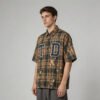

This plaid shirt is built around controlled inconsistency: the plaid remains legible while garment washing and spray dye create softened, irregular surface variation. Topstitch gauge becomes the stabilizing production variable, protecting seam definition, panel alignment, and patch placement as finishing processes alter the fabric.
Topstitch Gauge as the Visual Baseline
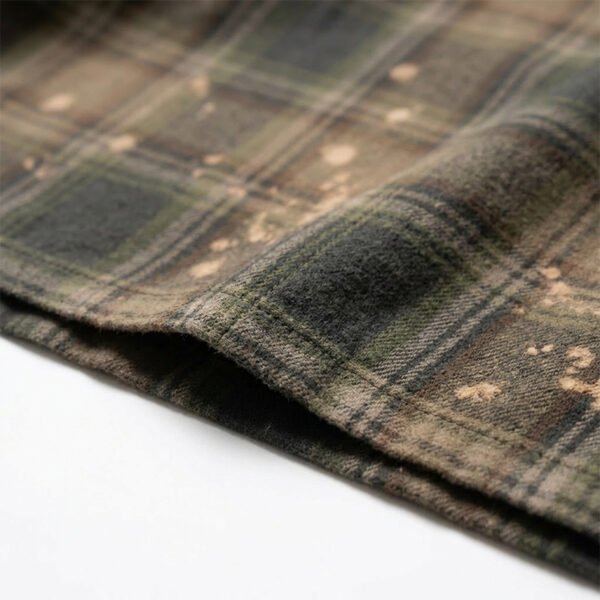
The close-up shows a continuous edge stitch following the folded fabric boundary, making gauge and parallelism visible at short range. A controlled stitch distance gives buyers a measurable baseline that survives later wash variation better than purely visual approval.
The trade-off is straightforward: tighter stitching can sharpen the seam but may increase puckering or needle perforation, while a wider gauge may relax the appearance. VeeWen should record stitch count, needle choice, thread size, and seam allowance on the control sample.
Protecting Plaid Alignment at Seams
Plaid introduces a second consistency requirement because horizontal and vertical lines expose panel shifts immediately. Topstitching cannot correct poor cutting, so body, sleeve, cuff, pocket, and yoke pieces must be aligned before the visible stitch standard is evaluated.
The supplied image shows plaid lines crossing a raised fold with softened edges, demonstrating how texture can obscure small mismatches while still revealing major drift. VeeWen should use matching points at each join and identify acceptable displacement before washing changes the surface.
Managing Garment-Wash Dimensional Change
Garment washing softens the hand and can change seam behavior, panel dimensions, and stitch appearance. The production question is not whether every shirt remains visually identical, but whether the approved gauge and key measurements stay within agreed tolerances after finishing.
A stronger wash may improve the worn character while increasing shrinkage, seam relaxation, or puckering. VeeWen should establish a pre-wash control, a finished measurement chart, and a side-by-side review so the buyer can separate intentional character from avoidable construction drift.
Spray-Dye Variation Without Losing Structure
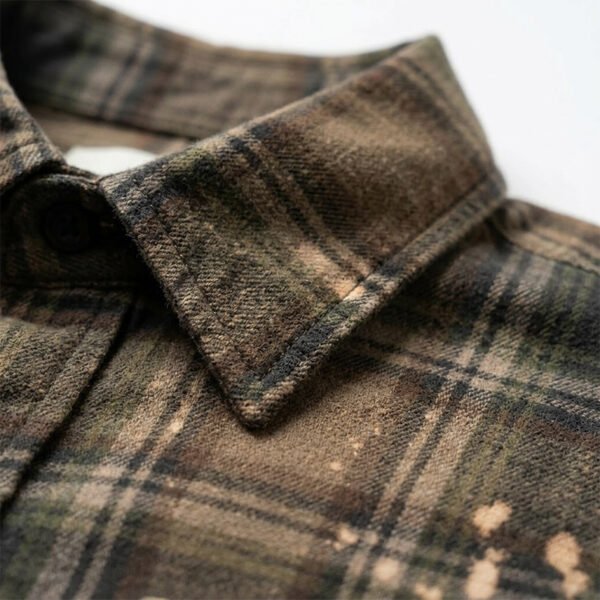
Irregular lighter marks interrupt the plaid in the supplied close-up, creating depth across the muted base. Spray dye should be mapped by panel or expressed through controlled tolerance language, because random application can overwhelm plaid readability or create inconsistent tonal balance between sizes.
Uniform dye placement would reduce the intended aged character, but excessive variation can complicate replenishment and buyer approval. VeeWen should define the acceptable range of contrast, placement, and overspray, then assess those limits against topstitch visibility and panel matching.
Patch Embroidery and Seam Interaction
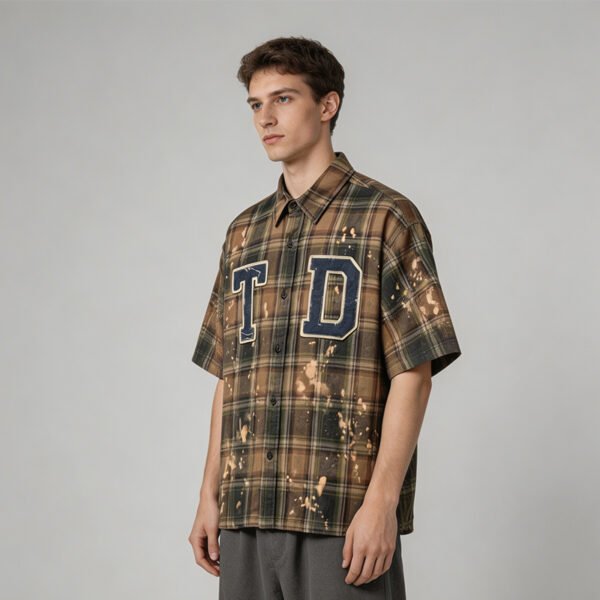
Patch embroidery adds another raised element to a fabric already affected by washing and spray dye. Its edge, backing, stitch density, and placement should remain clear without competing with the plaid or causing nearby seams to distort during production.
The visible source wording identifies patch embroidery, but the supplied close-up does not establish its exact location or dimensions. VeeWen should therefore keep patch specifications open until the full reference set and buyer artwork are reviewed, then lock placement relative to seams.
VeeWen Development Checkpoint
VeeWen's workflow should begin with an unwashed construction sample that proves topstitch gauge, seam allowance, plaid matching, and patch placement. That sample becomes the technical control against which garment washing and spray-dye development are judged.
The buyer should approve the finished appearance only after comparing construction, surface variation, and measurements together. Confirm MOQ: 100 pieces per style during commercial planning, while composition, fabric weight, shrinkage, and performance remain To Confirm pending documentation or testing.
Buyer Questions
Why is topstitch gauge central to this shirt?
It provides a measurable construction baseline that keeps seams visually consistent while washing, spray dye, and embroidery introduce intentional surface variation.
Should the plaid be approved before the wash?
Yes. Approve cut-panel alignment and a pre-wash construction control first, then evaluate finished plaid readability, seam behavior, and dimensional change after washing.
Does the image verify a cotton percentage?
No. The source wording references cotton, but the supplied evidence does not verify a percentage, fabric weight, blend, or performance specification.
What is the minimum order quantity?
The commercial minimum is MOQ: 100 pieces per style, with final fabric, trim, grading, packaging, and production details confirmed during development.
Set the Stitch Control Before Finishing
Share the target fit, plaid repeat, artwork, fabric reference, and desired wash contrast. VeeWen can establish the topstitch control sample before developing spray dye, embroidery, grading, and bulk approvals.


Reviews
There are no reviews yet.