






This custom garment-washed T-shirt is developed around a critical decoration question: how much embroidery can the softened knit support without puckering, distortion, or uncomfortable stiffness? VeeWen coordinates fabric selection, stabilization, digitizing, and wash sequencing so buyers can approve appearance and wearability together.
Density Must Match the Softened Knit.
Embroidery converts flexible fabric into a locally reinforced panel. If stitch density exceeds the knit's ability to recover, thread tension can draw the surrounding surface inward, producing ripples. A lower-density fill, suitable underlay, or adjusted artwork may preserve the intended washed drape.
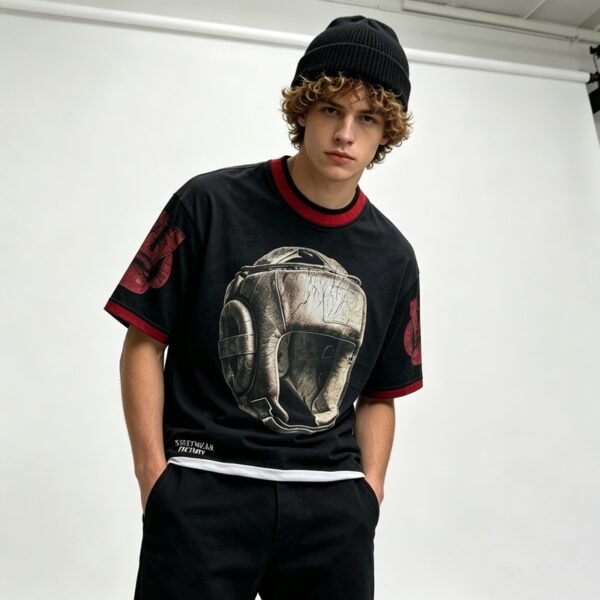
The charcoal body appears soft and slightly mottled, while the neckline remains visibly structured through layered rib components. That contrast suggests decoration settings should follow the body fabric rather than the firmer collar. Fabric weight, stretch, and dimensional recovery therefore require confirmation before digitizing.
Stabilization Controls Puckering Without Creating a Patch.
Backing must resist needle penetration and hoop movement while avoiding an unnaturally rigid area against the wearer. Tear-away, cut-away, or alternative support should be selected through sampling, because each option changes edge definition, reverse-side feel, laundering behavior, and production handling requirements.
A stabilizer that is too light may permit registration drift across detailed shapes. One that is too heavy can remain visible through a softened body or create a hard perimeter. Buyers should evaluate the decorated panel both flat and worn, not only immediately after embroidery.
Artwork Geometry Determines the Embroidery Load.
Large solid fills, narrow lettering, stacked color changes, and closely spaced outlines create different needle and tension loads. VeeWen can translate supplied artwork into an embroidery plan, but the buyer should authorize simplification where the original graphic would overpower the nominated T-shirt fabric.
The partially visible chest decoration indicates a graphic-led placement on a flexible body area. Before approval, its finished width, distance from neckline, color sequence, and relationship to garment sizing should be specified. Placement may require graded adjustment rather than one coordinate across every size.
Wash Sequence Changes the Final Decoration Character.
Embroidering before garment washing may integrate the decoration with the vintage surface, yet exposure to the wash process can alter thread appearance, backing behavior, and surrounding shrinkage. Embroidering afterward offers cleaner control but can create a visually newer decoration on an aged body.
The correct sequence depends on the desired contrast between graphic and garment. A development sample should reproduce the intended production order, including fabric preparation, garment assembly, washing, embroidery, and finishing. Approval from an unwashed strike-off alone cannot demonstrate the final interaction adequately.
The Layered Neckline Establishes a Competing Focal Point.
The image shows a broad red rib field framed by black rib edges, producing strong color contrast and several concentric seam lines. Embroidery scale should respect that visual weight; an undersized chest mark may appear incidental, while excessive coverage can compete with the neckline.
Collar stretch and recovery also matter because the decorative neckline must pass comfortably over the head without waviness or seam failure. Buyers should confirm rib composition, finished opening, edge thickness, and wash behavior separately from body-fabric approval, since these zones perform differently.
VeeWen Builds Approval Around a Decorated Wash Sample.
VeeWen's workflow begins by confirming artwork, placement, nominated fabric, neckline construction, and intended wash character. Digitizing settings and stabilizer are then tested on the relevant knit, allowing the development team to identify puckering, excessive stiffness, weak registration, or unsuitable detail before bulk authorization.
The decisive checkpoint is a representative garment carrying the proposed embroidery and processed through the intended finishing sequence. Buyers should approve front appearance, reverse-side comfort, measurements, placement, thread colors, and surface recovery together. MOQ: 100 pieces per style applies after specifications are confirmed.
Buyer Questions
How is the appropriate embroidery density selected?
Density is evaluated against artwork geometry, fabric weight, knit recovery, thread choice, and backing. VeeWen recommends approving a decorated sample because a stitch setting cannot be validated from artwork alone.
Should embroidery happen before or after garment washing?
Either sequence may be developed. Pre-wash embroidery can appear more integrated, while post-wash embroidery offers different control. The buyer should approve a sample produced in the proposed manufacturing sequence.
Can the red and black neckline be customized?
Yes, color layout, rib dimensions, opening, and seam treatment can be developed. Final choices depend on confirmed materials and require approval for appearance, stretch, recovery, and compatibility with washing.
What is the commercial minimum for this T-shirt?
MOQ: 100 pieces per style. The style should have confirmed fabric, color, measurements, wash direction, embroidery file, thread selections, backing method, label details, and packaging requirements before production approval.
Approve Embroidery and Fabric as One System.
Send VeeWen your artwork, target measurements, color direction, neckline concept, size range, and wash reference. We will structure a development checkpoint around embroidery density, stabilization, placement, and the finished garment response before production confirmation.


Reviews
There are no reviews yet.