

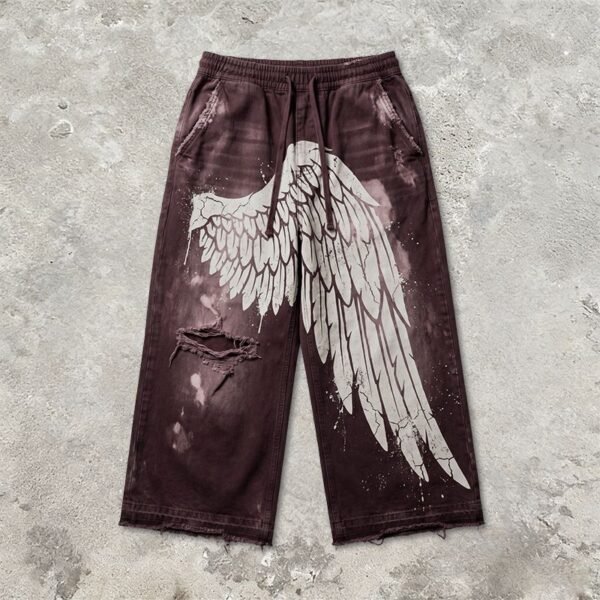


This development record centers on the tension between embellishment weight and garment drape. The supplied image shows oversized wing artwork, distressed openings, pale surface marks, and cropped volume, making placement, hand, and reinforcement decisions essential to preserving movement without flattening the silhouette.
Why Embellishment Weight Changes Drape
The supplied image shows a large off-white wing motif covering much of one front leg. A graphic of that scale can stiffen or pull the panel, particularly after washing, so the visual placement must be considered together with fabric hand, leg width, and movement.
The design's cropped volume gives the artwork room to read, but excessive surface build can make the leg hang flat. The development target should be a recognizable wing shape that follows the panel's fall instead of acting like a rigid front shield.
Artwork Scale Across the Leg
The wing graphic extends vertically through the thigh and knee area, creating a strong directional line. That line should be aligned with the leg grain and major seam positions, because skewed placement can make the silhouette appear twisted when the wearer walks or sits.
VeeWen should define artwork boundaries at the pattern stage, including allowances around pocket openings, side seams, and the distressed knee. The buyer should review the motif on the actual cropped block before approving final scale.
Distressing as a Drape Variable
The image includes a ripped knee, irregular hems, and scattered pale marks across the burgundy surface. These treatments remove or weaken localized structure, meaning the leg can open, curl, or relax differently from an intact panel carrying the wing artwork.
Distress placement therefore needs a stability plan. The knee opening should be positioned away from critical graphic contours where possible, while hem abrasion and surface marking should be graded consistently so the finished pair retains deliberate asymmetry.
Balancing Surface Contrast
The deep burgundy base gives the off-white wings strong contrast, while pale marks add a worn, irregular field around the artwork. That contrast hierarchy is commercially useful, but uncontrolled marking can reduce the wing's edge definition and make the product look visually noisy.
The wash and embellishment sequence should be treated as one decision. Confirm whether surface effects occur before or after the graphic process, then compare a full-leg sample for contrast retention, hand change, and any visible distortion around seams.
VeeWen Product-Development Workflow
VeeWen can structure development around controlled weight studies using the same cropped pattern and wing placement. Compare a lighter surface route with the intended graphic treatment, then inspect leg fall, knee opening behavior, hem curl, and recovery after movement.
The technical pack should identify artwork dimensions, panel coordinates, distress boundaries, reinforcement zones, and wash order. A decorated sample should be photographed front and side, then reviewed on-body to confirm that embellishment supports the intended cropped drape.
Buyer Approval Checkpoint
The approval question is whether the visual impact survives physical movement. The supplied image proves the design language, but it cannot establish fabric weight, attachment durability, or post-wash behavior; those variables must be resolved through a representative sample.
Approve production only after confirming wing scale, panel alignment, distress limits, hem stability, surface contrast, and leg movement together. The final decision should prioritize a controlled fall that keeps the embellishment expressive without making the pants feel board-like.
Buyer Questions
Will the wing artwork make the pants feel stiff?
It may influence hand and drape depending on process and coverage. Test the complete decorated leg, not a small swatch, to judge flexibility, weight distribution, and movement.
How should the ripped knee be coordinated?
Keep distress boundaries mapped against the wing contour and structural seams. Confirm reinforcement and opening behavior on a washed sample so the knee remains intentional without destabilizing the leg.
Can the cropped length be changed?
Yes, length can be adjusted during pattern development, but changing it alters wing proportion, knee placement, hem treatment, and perceived volume. Reapprove artwork coordinates after any length change.
What is the minimum order quantity?
The commercial minimum is MOQ: 100 pieces per style. Final production remains subject to approved artwork, construction details, materials, grading, components, and sample confirmation.
Approve the Drape Strategy
Send the target cropped length, wing artwork, distress map, and wash direction to VeeWen. We can validate embellishment scale and leg movement on a representative development sample.



Reviews
There are no reviews yet.