


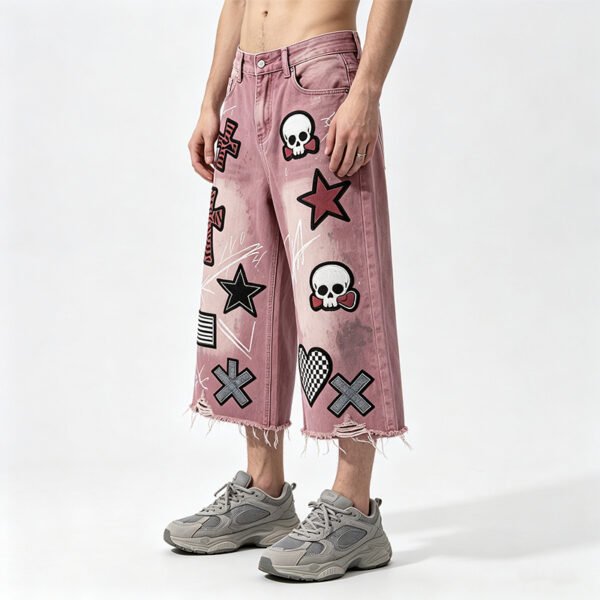


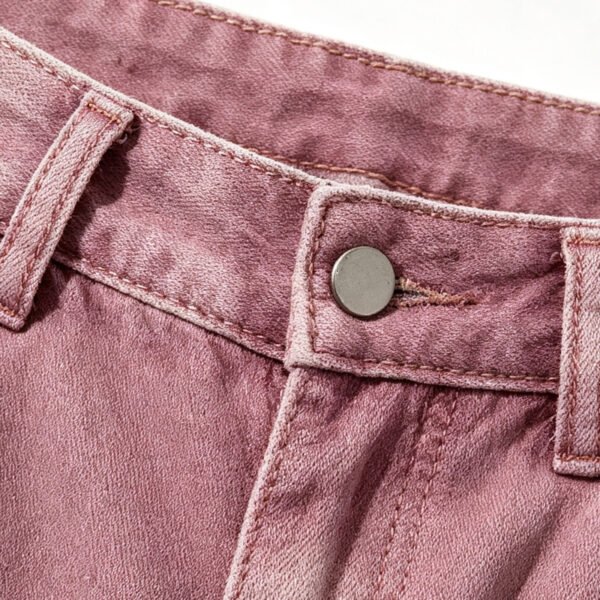






This development treats the cropped trouser as a proportion system, not merely a decorated bottom. The supplied image shows a dusty rose capri silhouette, visible fly, dense appliques, rivets, abrasion, and frayed hems. The key approval question is whether the front body remains balanced.
Why zipper length controls the silhouette
On a cropped pant, the fly occupies a larger share of the visible front body than it would on a full-length trouser. If the zipper is too long, the rise appears crowded; if too short, the closure can look visually weak and constrain wearability.
The supplied image shows a buttoned front, belt loops, curved pockets, and decoration concentrated across the upper legs. Their spacing must be designed around the fly and rise, because each element competes for attention within a shortened vertical field.
The mechanism behind front-body balance
Zipper length affects fly extension, overlap, rise shaping, waistband alignment, and the available area below the closure. Changing one measurement can move pocket openings, alter topstitch paths, and reduce the clear space needed for applique or rivet placement.
A cropped hem removes visual length from the leg, making upper-body density more noticeable. The pattern should therefore establish the waist, rise, fly, pocket bags, and thigh width first, then place decoration inside protected zones that do not interrupt movement or fastening.
Reading the supplied image
The image shows large crosses, skull motifs, stars, a heart, geometric patches, white marks, and dark outlines distributed across dusty rose legs. This creates deliberate asymmetry, but the decoration still needs negative space around the fly and pocket openings.
The frayed hem, abrasion, and rivet details reinforce a rebellious surface direction while exposing any proportion error. Review the garment frontally and in motion, checking whether the upper motifs dominate, whether the fly disappears, and whether the cropped legs retain a clear outline.
VeeWen development checkpoint
VeeWen can build the development around a front-body trial: lock the base block, test two zipper lengths, mark pocket and applique boundaries, then evaluate the decorated sample on the intended size range. This isolates proportion decisions before broader surface development begins.
The buyer checkpoint should record fly length, rise, waistband depth, pocket opening, belt-loop placement, rivet clearance, and graphic coordinates. Approve one front-body map before grading, because scaling decoration independently can make smaller and larger sizes appear disproportionately crowded.
Trade-offs buyers should approve
A longer zipper can improve opening access and reinforce a traditional trouser impression, but it consumes front space and may compete with upper-leg artwork. A shorter zipper can create a cleaner graphic field, yet requires careful rise shaping and closure testing.
More applique and hardware increase visual impact, but they add weight, stiffness, sewing operations, and possible interference near pockets or the fly. Buyers should decide which motifs are essential, where rivets support the story, and which areas need uninterrupted flexibility.
Final approval logic
The approval decision should prioritize the relationship among closure, rise, pockets, decoration, and cropped length. Confirming artwork alone cannot show whether the pant opens comfortably, sits correctly, or preserves visual balance across sizes.
Before production, sign off the zipper specification, front-body measurements, applique placement, rivet map, wash route, hem treatment, grading, and tolerances. Once approved, VeeWen can develop the MOQ: 100 pieces per style against one controlled construction reference.
Buyer Questions
Why is zipper length important on capri pants?
The cropped leg reduces vertical length, so the fly occupies more visual space. Its length directly affects rise comfort, pocket spacing, waistband balance, and decoration clearance.
Can the applique layout remain asymmetrical?
Yes, asymmetry can remain intentional when each motif has approved coordinates, seam clearances, and size-grade rules that preserve the front-body hierarchy across the collection.
Should rivets be placed near the zipper?
Only after closure testing confirms clearance. Rivets can strengthen the hardware story, but excessive concentration near the fly may create bulk, discomfort, or production interference.
What is the commercial minimum?
The exact commercial minimum is MOQ: 100 pieces per style, subject to approved fabric, hardware, decoration, grading, construction, and production requirements.
Approve the front-body proportion map
Share the target size chart, preferred zipper range, applique artwork, rivet locations, and wash direction so VeeWen can test the cropped silhouette before production approval.


Reviews
There are no reviews yet.