
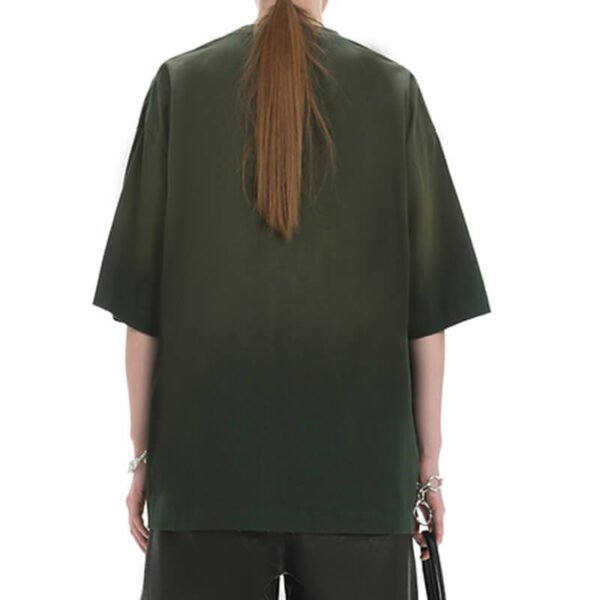


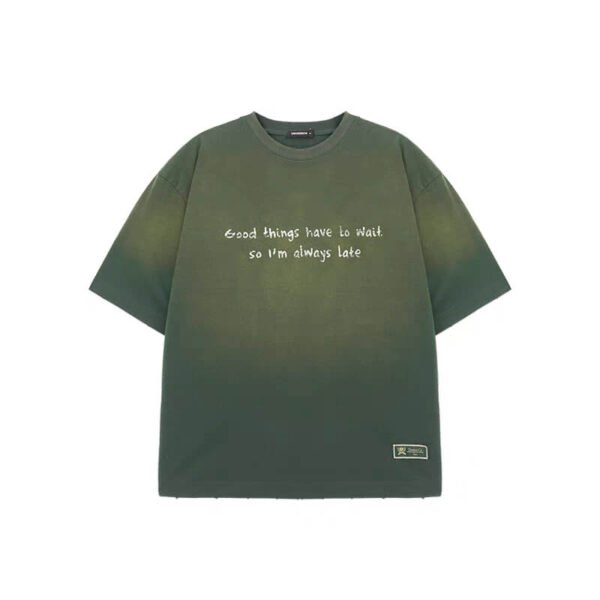




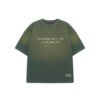


This washed gradient T-shirt should be developed around what remains after processing, because washing can alter dimensions and shift the visual position of tonal color. The supplied rear image emphasizes a long straight body, broad sleeves, muted green depth, and a clean hem that require post-process measurement recovery.
Why Post-Process Recovery Drives The Design
A washed garment can change length, width, opening dimensions, and surface appearance at the same time. On an oversized T-shirt, those shifts may alter the balance between broad sleeves and a longer body, making pre-wash approval insufficient for the final silhouette.
The supplied rear image shows a clean straight hem and generous body volume. Those features should be treated as post-process targets, with finished measurements recorded after the chosen wash route so the approved visual proportion survives production handling.
The Measurement Sequence
VeeWen should record the base pattern, cut measurements, sewn measurements, and post-process measurements in sequence. This creates a recovery map for body length, chest width, sleeve length, shoulder position, neckline, and lower opening before grading decisions are finalized.
The key trade-off is straightforward: adding process allowance can protect finished dimensions, but excessive allowance may distort the pre-wash fit or change seam relationships. The correct allowance must come from sample evidence rather than a generic wash assumption.
Reading The Supplied Rear Image
The image shows a dark olive-looking rear panel, broad sleeves, a relatively long body, and a level lower edge. The color appears softly distributed rather than divided by a sharp horizontal boundary, so both measurement stability and tonal consistency influence the final impression.
Because the back is visually quiet, dimensional errors will be easy to notice. A hem that shortens unevenly or a sleeve that loses its intended width could interrupt the simple architecture, even if the gradient itself remains attractive.
Gradient Placement After Washing
A gradient is not only a color decision; its apparent position depends on garment length, surface texture, and dimensional change. If the body shortens, a transition intended for the lower back may move upward visually and change the balance of the design.
The buyer should approve a defined transition zone rather than expecting every piece to display identical pixel-level placement. VeeWen can establish acceptable tonal boundaries, then review washed panels and finished garments for a commercially coherent range.
Grading The Washed Silhouette
Grading should be based on finished post-process measurements, not merely on the unwashed pattern. Body width and length, sleeve extension, shoulder drop, and openings must grow in coordinated increments so the oversized character remains recognizable from the smallest to largest size.
The approval checkpoint is a full size range washed under the intended process. Compare each size for body-to-sleeve balance, hem levelness, and gradient position, then adjust the pre-process pattern or process allowance before confirming production specifications.
VeeWen Development Workflow
VeeWen's workflow should place wash trials before final measurement approval: confirm the material reference, create the base sample, process it, and document the dimensional delta at each critical point. That evidence then informs pattern correction and graded-size preparation.
Before bulk authorization, the buyer should sign off on the post-process measurement chart, gradient tolerance, shade direction, and care communication. Composition, exact wash recipe, colorfastness expectations, and final construction details remain confirmation items within development.
Buyer Questions
Why measure this garment after washing?
Washing can change length, width, openings, and visual gradient position. Finished measurements confirm whether the approved oversized silhouette remains stable after the intended process.
Is the olive color confirmed?
The supplied image appears deep olive or dark green, but the production shade, color standard, and acceptable variation remain To Confirm.
Should gradient placement be identical?
The buyer should approve a controlled transition zone and tonal tolerance, recognizing that washing and surface variation may prevent perfectly identical placement on every garment.
What is the minimum order?
MOQ: 100 pieces per style. Final quantities, wash development, packaging, and production details should be confirmed after post-process samples receive approval.
Approve The Post-Wash Measurement Map
Share your target size chart, wash preference, gradient direction, and color reference with VeeWen. We can organize post-process measurement review and confirm the MOQ: 100 pieces per style.


Reviews
There are no reviews yet.