
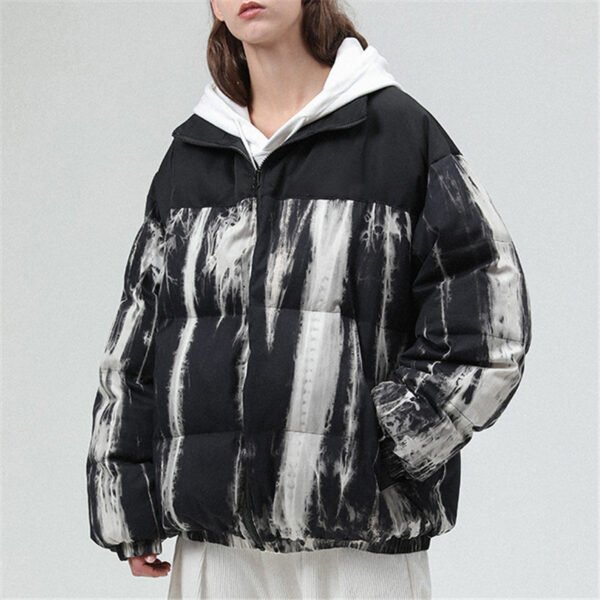
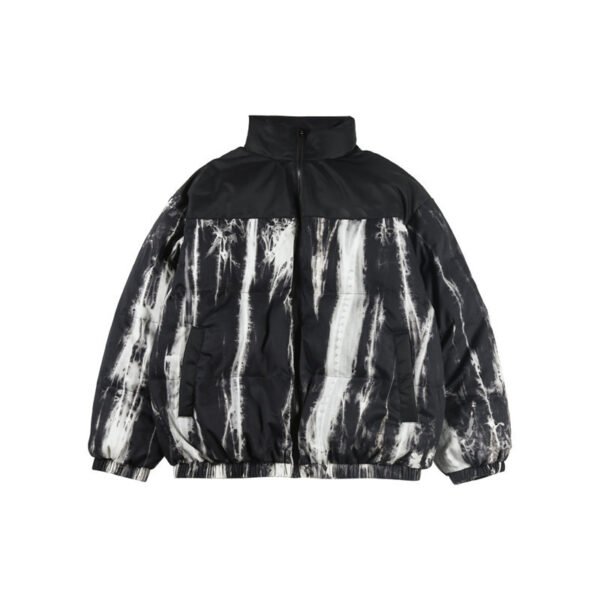


This hooded puffer-effect jacket should be developed as a shade-control problem. The supplied image shows an irregular black-and-white wash across the body and sleeves, a solid upper contrast area, horizontal padded divisions, and elastic edges that can all influence perceived color consistency.
Irregular Color Needs Defined Limits
The jacket's visual identity depends on irregular black-and-white contrast, but irregularity without limits creates avoidable disagreement at approval. A usable shade range should define acceptable lightness, darkness, edge softness, and placement drift across the body, sleeves, and hood.
The supplied image shows strong vertical variation rather than an even all-over pattern. That evidence suggests the buyer should approve a visual direction with boundaries, not demand identical artwork on every garment. The goal is controlled character within an agreed commercial range.
Panel Lines Can Shift Perceived Shade
Horizontal padded divisions interrupt the wash, changing how the eye reads contrast from one section to the next. Seams, loft, and surface angle can make a matching shade appear darker or lighter, particularly where panels compress or catch light differently.
VeeWen's development workflow should map the wash direction against panel layout before sample approval. A shade that looks balanced on a flat shell may become visually fragmented after construction, so the complete assembled jacket is the correct decision surface.
Solid Upper Areas Anchor the Design
The image shows a comparatively solid dark upper chest and hood area above the more active washed sections. This boundary gives the jacket a visual anchor, but its height and cleanliness will strongly affect whether the lower wash reads intentional or accidental.
The tech pack should identify the solid-to-washed transition as a controlled placement zone, then verify it on a fully constructed sample. Buyers should decide how much boundary softness is acceptable before grading or bulk cutting begins.
Sleeves Require Separate Shade Review
Sleeves display the same black-and-white family but not the same visual distribution as the torso. Their curved shape, seam orientation, and movement can make vertical streaks appear longer or more concentrated, creating a different perception from the front body.
A sleeve-specific shade review helps prevent the body reference from masking unacceptable variation. VeeWen should capture front, back, and sleeve views in the approval record, allowing production teams to compare the same zones consistently during repeat orders.
Edges Expose Repeatability
The zipper, elastic cuffs, and gathered hem are clean structural borders around the washed shell. These edges reveal whether the shade process was controlled, because uneven transitions, staining, or contrast drift become more obvious when positioned beside dark hardware or compressed elastic.
Development should therefore inspect edge zones independently from central panels. Buyers need to approve zipper tape contrast, cuff appearance, hem gathering, and shade behavior after the selected finishing process, since each can alter the final visual balance.
Reorders Depend on a Shade Standard
A repeat order cannot rely on memory or a single attractive garment. It needs a retained reference set or documented shade windows covering the body, sleeves, hood, panel transitions, and edge zones. This preserves the intended range while acknowledging process variation.
VeeWen should convert the approved range into production notes and a pre-release checkpoint for future runs. With MOQ: 100 pieces per style, the buyer's decision is whether the visual standard is specific enough to support confident reordering.
Buyer Questions
Why is shade range important for this jacket?
The irregular black-and-white appearance is the product's central visual feature, so uncontrolled variation could change its identity between samples, sizes, panels, or repeat production.
Can the wash look identical on every jacket?
Not necessarily. Buyers should approve a defined visual tolerance covering contrast, placement, edge softness, and panel behavior instead of assuming absolute visual uniformity.
Should shade approval happen before quilting or assembly?
Review both the shell and the assembled jacket, because quilting divisions, loft, seams, and surface angles can materially change perceived shade and balance.
What is the commercial minimum for this jacket?
VeeWen's commercial minimum is MOQ: 100 pieces per style, subject to approved shade standards, construction details, and final production documentation.
Set the Wash Approval Standard
Share the desired shade boundaries, panel map, wash direction, and repeat-order expectations with VeeWen for a complete-jacket sample review and documented production approval.



Reviews
There are no reviews yet.