


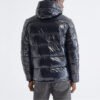
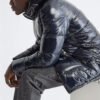
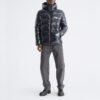
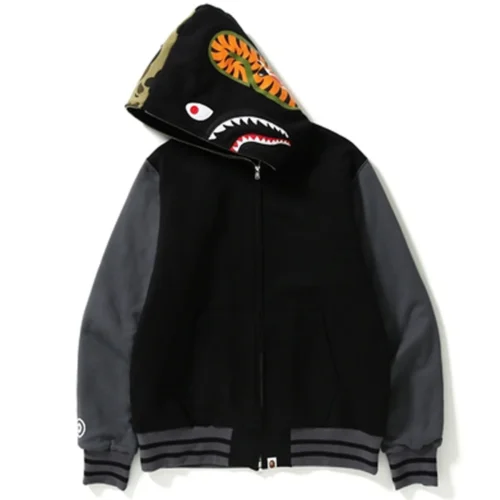
This custom hooded puffer jacket is built around print-registration control across padded panels. The supplied image shows a glossy black shell, horizontal quilting, chest pockets, a central zipper, and a hood, all of which can interrupt artwork alignment and change its scale visually.
Panel Breaks Define the Artwork Problem
The supplied image shows a padded jacket divided by horizontal quilting, vertical front boundaries, chest pockets, and a center zipper. These breaks segment the printable surface, so a continuous graphic can shift whenever panels are cut, sewn, filled, or compressed.
Registration is therefore a pattern-engineering issue rather than a final decoration check. Artwork must be placed against confirmed pattern pieces, with compensation for seam allowances, zipper coverage, pocket construction, hood curvature, and the dimensional change created by insulation and quilting.
Glossy Surfaces Increase Perceived Misalignment
The shell appears dark, reflective, and smooth, with highlights moving across the padded sections. On this surface, even a small graphic offset can become noticeable because reflections emphasize panel edges and make neighboring sections read as separate planes.
A print approval should evaluate the jacket under direct and angled lighting, not only on flat fabric. The buyer should inspect horizontal bands, vertical motifs, pocket boundaries, and zipper alignment after the jacket is fully assembled and lofted.
Artwork Must Follow the Cut Plan
The production file should begin with a panelized artwork map rather than one unbroken front or back image. Each body, sleeve, hood, pocket, and side panel needs a named placement, repeat direction, bleed allowance, and alignment reference.
Before printing, VeeWen should confirm whether the chosen method can hold the required detail on the shell and whether registration marks remain outside finished areas. The buyer should approve a paper or digital placement proof tied directly to the latest pattern version.
Padding Changes Registration After Sewing
Puffer construction introduces loft, compression, and seam draw-in, which can alter how printed lines appear once panels are joined. A motif aligned on flat shell pieces may look shortened, bowed, or displaced after quilting and filling create three-dimensional volume.
The sample review should compare artwork at rest and during natural movement. Inspect sleeve rotation, hood wear, pocket access, and front closure operation, because tension around these areas can expose registration errors that remain hidden on a static flat lay.
VeeWen Workflow Converts Alignment Into Approval Gates
VeeWen can place this manufacturing axis into the workflow by locking the pattern, panel names, artwork map, print method, and seam reference points before cutting. Any pattern or pocket change should trigger a renewed registration review rather than silent artwork adjustment.
The development checkpoint is a fully assembled sample with print placement inspected before and after filling. Record acceptable alignment zones at zipper edges, pocket openings, hood joins, and quilting lines so the production team has a clear visual standard.
Approve Continuity, Not Just Surface Appeal
The image establishes a strong black padded outerwear direction, but it does not prove printed execution. Approval should depend on whether the intended artwork remains coherent across interruptions without compromising pocket function, zipper operation, hood comfort, or the jacket's padded structure.
Proceed when the buyer accepts the planned registration tolerance across every major panel and confirms the print appearance under realistic loft and lighting. If alignment breaks distract from the graphic, revise the repeat, panel layout, or placement before grading and production.
Buyer Questions
Does the image show an all-over print?
No. The supplied image shows a glossy dark jacket without visible artwork, so print registration is a proposed development axis rather than confirmed finished-product evidence.
Why can padded panels disrupt print alignment?
Cutting, quilting, seam draw-in, filling, and loft change each panel's dimensions and angle, causing artwork to shift or appear distorted when flat printed pieces become a finished jacket.
What artwork file is needed first?
Provide the intended repeat or placement artwork plus panelized pattern references. Final files should follow confirmed body, sleeve, hood, pocket, zipper, seam, and bleed requirements.
What is the commercial minimum?
The commercial minimum is MOQ: 100 pieces per style. Final artwork, color quantities, sizing, and production documentation should follow the approved outerwear sample.
Approve the Panel-Registration Sample
Share your artwork, panel priorities, and confirmed shell direction with VeeWen so the first padded sample can validate continuity around quilting, pockets, zippers, and hood joins.


Reviews
There are no reviews yet.