










This pullover hoodie is developed around a tension between hand-marked surface energy and repeatable panel control. The charcoal, black, and white graphic needs a stable centerline so the expressive drip field, heart embroidery, hood, cuffs, and kangaroo pocket read as one intentional front.
A Graphic That Needs a Production Centerline
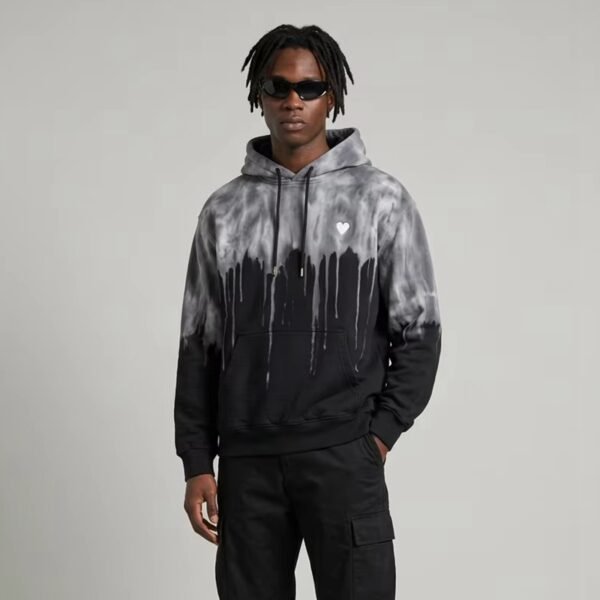
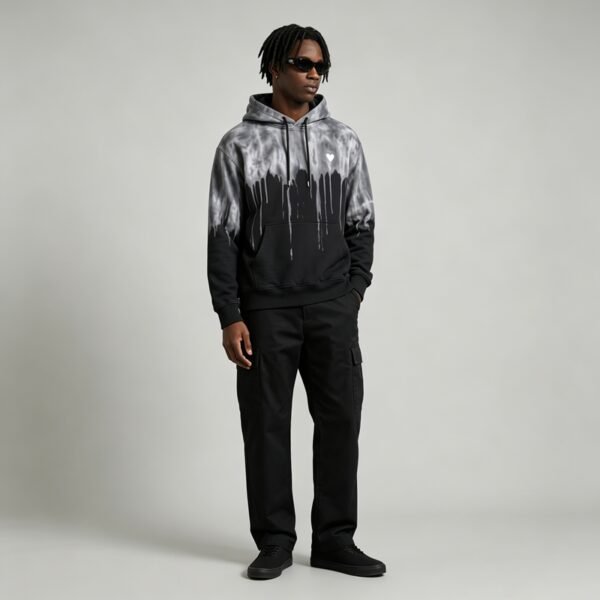
The supplied image shows a tonal charcoal upper body interrupted by white spray-like marks and a heavy black lower field. Because the artwork is irregular, symmetry does not mean duplicating every brush edge; it means controlling the visual mass around the garment center.
That distinction matters during pattern and print planning. If the left and right body panels receive uncontrolled artwork shifts, the heart, drip boundary, and pocket opening can compete for attention. VeeWen should establish centerline reference points before approving artwork separations and cutting markers.
Mirrored Components Protect the Front View
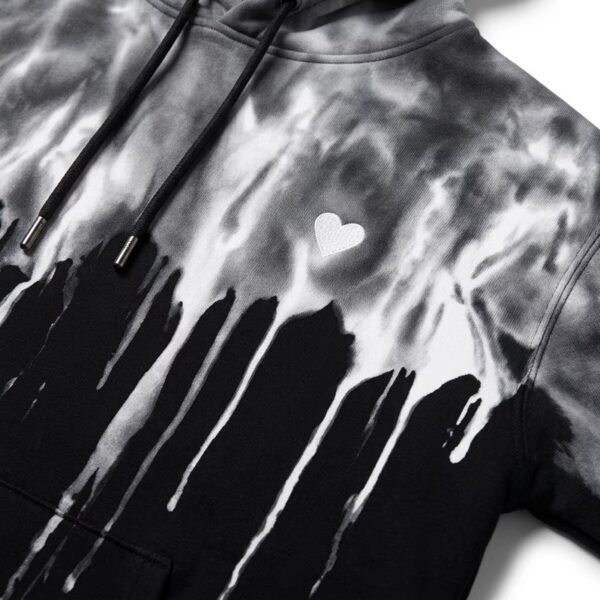
The close-up clearly exposes two dark drawcords descending from the hood, while the seam and neckline create a strong central framework. Their visible relationship makes hood construction a key approval area, because uneven exits or channel placement can make a balanced graphic appear misaligned.
The kangaroo pocket adds another mirrored component beneath the artwork. Pocket entry angles, topstitch lines, and attachment points should be checked against the body centerline, with the graphic planned around the pocket rather than allowed to disappear unpredictably into its opening.
Managing Irregular Drip Boundaries
The black lower treatment rises in uneven vertical shapes, with narrow white channels separating several dark extensions. This evidence supports a placement-print approach requiring controlled boundaries, because small registration changes can alter perceived balance even when the artwork file itself remains unchanged.
A practical development sample should show the full front at natural scale, not only a cropped detail. The buyer can then judge whether the strongest black concentration sits evenly across the torso and whether the white interruptions remain visible after pocket construction and laundering trials.
Embroidery Placement Must Support the Artwork
The white heart embroidery is positioned high on the chest, isolated against the mottled charcoal ground. Its small scale creates a visual anchor above the drip field, so stitch density, edge definition, and distance from the centerline should be reviewed as placement decisions rather than decorative afterthoughts.
VeeWen's workflow can lock the embroidery file and placement reference alongside the front-panel artwork. A sample review should verify that the heart remains legible, does not drift toward a seam, and maintains the intended relationship with the hood opening and drawcords.
Constructing a Repeatable Approval Standard
For this design, approval should record paired measurements for hood points, shoulder seams, cuff widths, pocket edges, and principal graphic landmarks. The objective is not sterile uniformity; it is a repeatable framework that keeps every expressive deviation within a buyer-approved visual range.
VeeWen can translate that framework into a development checklist tied to the pattern, artwork placement, embroidery file, and cutting plan. This product-specific record gives production teams a shared reference when reviewing panels, sewing first samples, and correcting mirrored component drift.
Buyer Checkpoint Before the MOQ Decision
Before moving toward MOQ: 100 pieces per style, the buyer should inspect a complete sample from front, back, hood, and pocket views. Confirm the charcoal fade, black drip balance, heart position, drawcord exits, and cuff pairing under the intended lighting used for approvals.
The final decision is whether the visual irregularity feels authored while the garment architecture remains controlled. If the centerline and mirrored components pass review, the style is ready for a measured production brief; if not, revise artwork or pattern references first.
Buyer Questions
Is the fabric composition confirmed for this hoodie?
No. The source references French terry, but fiber percentages, fabric weight, blend, and recovery are not supplied and must be confirmed during development.
Why is symmetry important for an irregular drip graphic?
Symmetry controls visual mass around the centerline, helping the heart, pocket, hood, and black drip field remain balanced despite intentionally uneven artwork edges.
What should the first sample prove?
It should prove centerline placement, mirrored hood and pocket construction, embroidery positioning, graphic registration, and the buyer-approved relationship between irregular fading and stable garment architecture.
What is the commercial minimum for this style?
The exact commercial minimum is MOQ: 100 pieces per style. Final development approval should precede quantity confirmation, color assortment decisions, and production planning with VeeWen.
Approve the Symmetry Framework
Send the artwork, target measurements, and preferred French terry reference to VeeWen for a centerline-led development review, then approve the complete sample before proceeding with MOQ: 100 pieces per style.




Reviews
There are no reviews yet.