
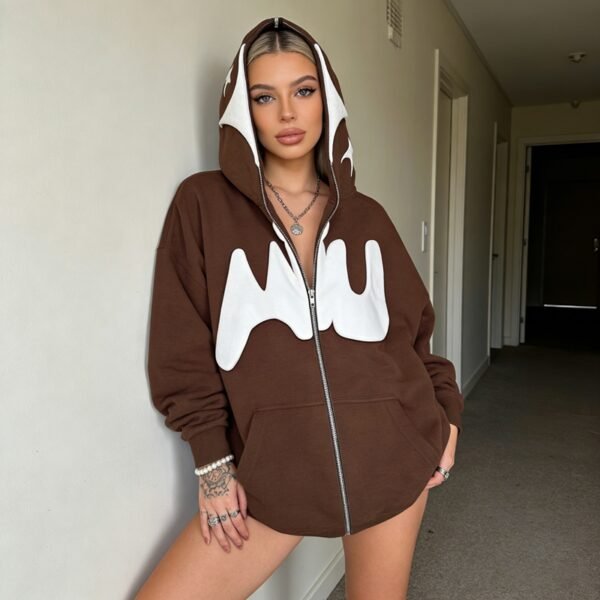
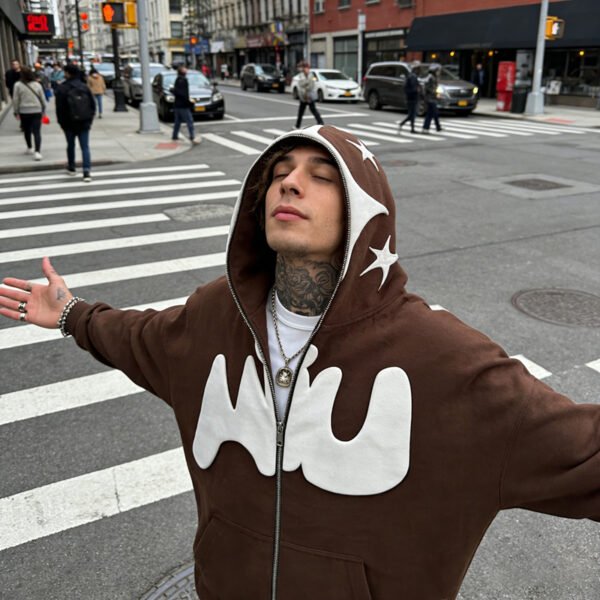




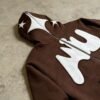
This custom hoodie jacket turns a raised graphic into a placement-engineering exercise. The brown body, white drip motif, hood continuation, and oversized silhouette require stretch direction to be mapped before artwork and panels are finalized.
Directional Stretch Is the Primary Pattern Decision
An oversized hoodie jacket does not stretch uniformly. The chest expands across the body, sleeves rotate around the arms, and the hood shifts independently. Mapping each panel's dominant direction helps the finished silhouette remain balanced instead of pulling the graphic sideways.
The supplied image makes this risk visible through the large white chest motif crossing the center front and zipper. Its edges must be positioned against stable pattern landmarks, while hood artwork follows a separate curved surface and movement path.
Graphic Placement Must Follow Garment Landmarks
The central zipper is the strongest reference line on this design. Artwork should be split with controlled allowances, then checked against the pocket opening, shoulder drop, hood seam, and hem. This prevents the drip shapes from appearing unintentionally offset after assembly.
The white motif also climbs onto both hood sides, so the placement plan must connect body and hood without assuming a flat surface. A placement template can preserve visual rhythm while allowing seam, turn, and grading tolerances.
Oversized Volume Changes Artwork Behavior
Dropped shoulders and roomy sleeves create a relaxed profile, but they also introduce folds that interrupt raised print visibility. The pattern should distinguish intended drape from distortion, especially where the chest graphic approaches the armhole and front pouch pocket.
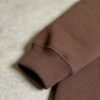
Longer body coverage gives the jacket a coat-like stance, while gathered cuffs control sleeve volume. Buyers should decide whether the graphic remains dominant during motion or intentionally becomes more dimensional through natural folding.
Raised Print Requires Movement-Aware Clearance
Puff print adds physical height, making placement more sensitive to zipper teeth, seam bulk, and repeated folding. Keep the raised areas clear of hardware contact zones and confirm that the graphic does not bridge construction points that need frequent opening or flexing.
The source image shows a bold, uninterrupted white surface against dark brown fleece-like visual texture, but composition is not a verified fiber claim. Development should therefore separate appearance approval from material, handfeel, and durability confirmation.
VeeWen Workflow: Map Before You Sample
VeeWen should begin this style by converting the supplied front and hood observations into a panel-level placement sheet. The sheet can mark stretch grain, zipper center, seam allowances, pocket boundaries, and artwork registration points before the first development sample.
During review, VeeWen's product-development workflow should compare the sample in relaxed, zipped, and worn positions. That sequence tests whether the motif remains balanced when the body expands, sleeves rotate, and the hood is raised.
Approval Checkpoint for Production Readiness
Before releasing bulk instructions, approve a complete size set with the zipper closed and open. Inspect chest symmetry, hood continuity, cuff recovery, pocket alignment, and graphic clearance. Record any grade-specific movement before freezing the final pattern and print placement.
The commercial decision is not simply whether the artwork looks striking on one model. Approve only when directional stretch behavior supports consistent placement across sizes and the finished jacket still delivers the intended oversized layering function.
Buyer Questions
What material should be specified for this hoodie jacket?
The supplied evidence does not verify composition or GSM. VeeWen should confirm the selected fabric, weight, stretch behavior, recovery, and surface compatibility before sampling.
How should the chest graphic be positioned around the zipper?
Use the closed zipper as the center reference, split artwork with controlled allowances, and verify symmetry after opening, closing, grading, and wearing the jacket.
Why does the hood graphic need separate placement planning?
The hood curves, folds, and moves independently from the torso. A dedicated template helps maintain visual continuity without forcing artwork across seams or unstable stretch zones.
What is the minimum order for this style?
MOQ: 100 pieces per style. Final quantities, colorways, size ratios, and production specifications should be confirmed during commercial development.
Approve the Stretch and Placement Map
Send VeeWen your artwork, target measurements, color references, and intended size range. We will align the panel map, placement checkpoints, and sample review criteria before production approval.


Reviews
There are no reviews yet.