


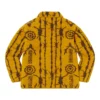
This custom fleece jacket is developed around sleeve openings that preserve wrist mobility and layering clearance, allowing a midlayer to sit beneath the shell without bunching, drag, or blocked cuff access during active urban wear across changing temperatures throughout the day.
Sleeve Openings Set the Layering Experience
A fleece jacket can feel warm yet restrictive when the sleeve opening grips a base layer or traps a midlayer cuff. The opening should release over planned sleeve stacks, preserving wrist articulation while keeping the garment visually controlled at the hem.
The supplied close-up confirms a plush, raised surface and a horizontal zipper, but it does not reveal cuff geometry. That absence makes sleeve pattern development the central approval task, because opening circumference, rib treatment, and seam allowance will determine practical clearance.
Translate Surface Texture into Pattern Allowance
The mustard fleece appears lofty, with dark brown lines interrupting the pile in a deliberate grid-like arrangement. Loft changes perceived thickness at seams and cuffs, so the pattern should account for compression without allowing excess volume to collapse the intended silhouette.
During development, VeeWen can map the visible surface direction against sleeve seams, cuff construction, and zipper placement. The technical review should record whether the pile compresses evenly at the opening and whether stacked sleeves remain smooth when the arm bends.
Balance Cuff Access with Wind Exposure
A wider sleeve opening improves layering clearance and makes cuff access easier, but it can also increase exposure around the wrist. A tighter opening improves containment yet risks catching underlying sleeves, especially when the fleece surface has substantial loft.
The buyer should therefore set a measurable tolerance around the opening rather than approving a visual sample alone. Review the jacket with the intended base layer, midlayer, and watch or glove use, then select the narrowest opening that remains mobile.
Control Contrast Around Functional Areas
Dark brown contrast bands create strong visual interruptions across the mustard fleece, making alignment near sleeves and openings commercially important. Any shift at the cuff can make the garment look unbalanced, even when the underlying construction remains technically sound.
VeeWen's development workflow should treat contrast placement as a pattern-and-cutting coordination issue. Mark the line positions on the sleeve panels, verify mirrored placement, and inspect how the opening finishes affect the continuity of the graphic surface.
Use Fitting to Confirm Movement
The critical fitting question is not simply whether a hand passes through the sleeve opening. It is whether the cuff clears the underlying layer while the wearer reaches, bends, zips, and removes the jacket without the sleeve riding upward or twisting around the forearm.
A staged fitting can compare the approved opening against several layer combinations without changing the product thesis. Record forearm drag, cuff exposure, wrist movement, and recovery after motion, then lock the preferred measurement before grading the size range.
Approve the Production Block Before Scaling
Once the opening, cuff finish, and layering tolerance are approved, the remaining risk shifts from concept interpretation to repeatable execution. The buyer should confirm the approved fleece reference, contrast layout, zipper position, and measurement points as one coordinated package.
For VeeWen, this checkpoint connects directly to product development: the technical pack should carry the sleeve-opening measurement, layered fit notes, visual alignment marks, and confirmation items. Production grading should begin only after those details are signed off together.
Buyer Questions
What should be measured first on this jacket?
Measure sleeve opening circumference, cuff depth, bicep ease, and layered forearm clearance before finalizing the pattern and size grading.
Can this fleece be developed for different layers?
Yes, the pattern can be evaluated against specified base and midlayers, but the buyer must approve the intended stack and clearance tolerance.
Is the fleece composition confirmed?
No. The supplied visual evidence confirms texture and appearance only; fiber composition, weight, backing, and care requirements remain To Confirm.
What does MOQ: 100 pieces per style mean?
VeeWen's commercial minimum is MOQ: 100 pieces per style, subject to final specifications, approved development details, and order confirmation.
Approve the Layering Block
Send the intended layer stack, target measurements, and contrast references so VeeWen can develop the sleeve opening around a clear movement and clearance decision.


Reviews
There are no reviews yet.