
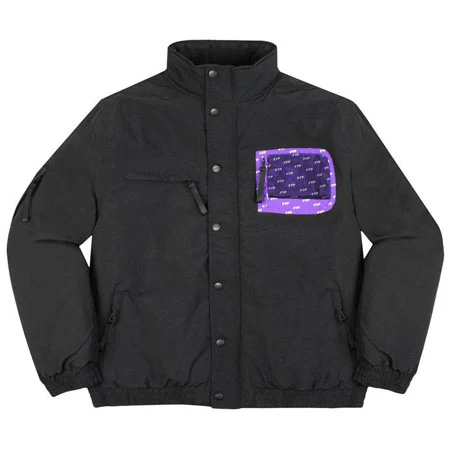
This custom black puffer jacket is developed around closure reliability rather than insulation claims. Its snap-front architecture, raised collar, elasticized edges, and contrasting chest pocket create a compact streetwear shell whose hardware support should be approved through measured pull-resistance sampling.
Closure Architecture Sets the Development Priority
The central placket places snaps at regular intervals, creating a repeated load path from collar through hem. Each opening transfers force into the facing, shell, and reinforcement, so the development target is balanced retention without puckering or permanent distortion.
The raised collar adds a stiffened transition around the top snap, while the elastic hem limits lower-body movement. Together, these details can make closure behavior feel consistent, but only if spacing, backing, and stitch density are reviewed at sample stage.
Visible Evidence From the Supplied Jacket
The image shows a black jacket with a clean snap line, elasticated sleeve ends, and a compact hem. A purple, mesh-like chest pocket interrupts the otherwise dark surface, making its edge binding and attachment method important visual checkpoints.
The lower pockets appear to use dark pull hardware, while the chest pocket presents a different construction language. This combination suggests separate stress zones: the placket needs repeated vertical pull testing, whereas pocket openings need localized reinforcement and snag review.
Pull Resistance Must Include the Garment Structure
Snap performance cannot be judged by hardware alone. A secure closure depends on cap and socket selection, prong setting, facing stability, seam allowance, and reinforcement beneath each point. Weak support may cause fabric tearing even when the snap itself remains functional.
VeeWen should record opening force and retention behavior for representative sizes, then inspect distortion after repeated cycles. The approval sample should document whether the shell, lining, and internal support maintain a flat placket under practical hand operation.
Trade-Offs in a Firm Snap Front
Higher retention can reduce accidental opening during movement, but excessive force may frustrate wearers and stress the placket. A softer setting improves access yet may increase gaping risk, especially around the chest where the contrasting pocket draws attention.
The right balance depends on intended layering, snap diameter, backing material, and spacing. Buyers should decide whether the jacket prioritizes quick ventilation, secure coverage, or a middle position, then approve a written pull-resistance range before bulk cutting.
Workflow Checkpoint for VeeWen Development
VeeWen's product-development workflow should convert the reference image into a closure package: marked snap locations, hardware callouts, reinforcement sketches, graded measurements, and a test record. This keeps the manufacturing axis attached to pattern engineering rather than treating it as a finishing inspection.
At the pre-production approval checkpoint, the buyer should review the closure sample on the actual shell and pocket configuration. VeeWen can then lock approved hardware and support details into the technical file before the MOQ: 100 pieces per style run.
Approval Standard Before Bulk Production
Approval should cover visual alignment, hand-opening comfort, retention during garment handling, and fabric recovery around every snap. Inspectors should compare the top collar area, chest level, waist level, and hem because load and stiffness can vary along the placket.
The buyer's final decision is whether the closure feels dependable without becoming difficult to operate. Record accepted hardware, reinforcement, spacing, and tolerance in the sample comments, while leaving insulation composition, GSM, and laboratory performance To Confirm.
Buyer Questions
What should be tested first on this jacket?
Test snap opening force, retention, placket distortion, and reinforcement behavior across representative sizes before approving the final hardware package.
Is the chest pocket confirmed as mesh?
The image shows a mesh-like contrasting panel, but its fiber content, backing, opening method, and wash behavior require source confirmation.
Can VeeWen develop this private-label style?
Yes, VeeWen can review the reference, engineer the closure package, and develop a private-label sample under MOQ: 100 pieces per style.
Which specifications remain unconfirmed?
Insulation type, shell composition, lining, GSM, snap material, zipper details, measurements, testing values, and production timing remain To Confirm.
Approve the Closure Test Plan
Send your target size range, layering intent, and preferred snap feel to VeeWen for a closure-focused development review and sample approval pathway.


Reviews
There are no reviews yet.