


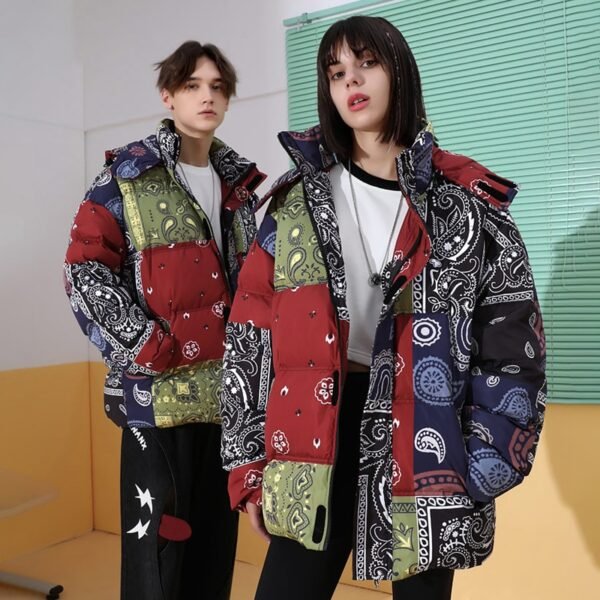


This custom patchwork puffer jacket is developed around the relationship between reflective hardware and a high-contrast printed shell. The supplied image shows black, navy, red, and olive blocks, a raised hood, horizontal quilting divisions, and several areas where finish choices will dominate the surface.
Read the Surface and Hardware Relationship
The jacket's shell is visually busy, with contrasting printed blocks and ornamental motifs. Bright or highly reflective hardware can become a competing focal point, while a muted plating may integrate more cleanly with the dark and saturated panel mix.
This is a material-interaction decision rather than a decoration preference. Closure size, puller shape, and plating reflectivity should be reviewed against each panel color, especially where black-and-white borders meet red or blue printed fields.
Map the Patchwork Before Treatment
The image shows a structured grid across the body, sleeves, and hood, with horizontal divisions crossing vertical boundaries. Any wash, coating, spray, or surface process must therefore be evaluated for seam exposure and panel-to-panel consistency.
VeeWen's product-development workflow should lock the panel map before treatment trials, then compare treated and untreated swatches from every major color group. This reveals whether the process deepens some panels, dulls motifs, or changes the perceived separation between blocks.
Choose Plating by Visual Role
Hardware can either disappear into the jacket or deliberately punctuate it. On this style, the choice should be made by closure location: a subdued finish may protect the print hierarchy, while a controlled contrast can define the front opening and hood connection.
The first sample should present plating options on the actual shell, not isolated metal cards alone. Reviewers should inspect reflection, color cast, edge wear, and how the hardware photographs beside the printed motifs before selecting the production direction.
Resolve the Removable Hood Interface
The source wording identifies a removable hood, and the image shows the hood attached above a raised collar. That interface concentrates hardware, seam bulk, and visual interruption in a highly visible upper-body zone.
Development should confirm whether the hood uses a zipper, snaps, buttons, or another attachment system, because each option changes plating exposure and comfort. The approval sample should test attachment ease, collar lay, and whether the detached configuration remains visually finished.
Separate Treatment from Performance Claims
A surface treatment may alter hand feel, print contrast, noise, or resistance to scuffing, but none of those outcomes should be assumed from the image. The patchwork layout only identifies where the treatment will be most noticeable.
VeeWen can structure the review around observable checkpoints: surface uniformity, motif clarity, seam cleanliness, hardware movement, and contact comfort. Buyers should define acceptable appearance and function before requesting any production commitment tied to treatment performance.
Set the Outerwear Approval Gate
Approve the style when the chosen plating supports the print hierarchy, the hood interface operates cleanly, and treatment results remain consistent across the patchwork grid. The decision should be made on a complete garment with all hardware installed.
The final technical package should record hardware finish, component references, hood attachment, treatment limits, panel artwork, and inspection points. That package enables VeeWen to advance the style toward sampling and the MOQ: 100 pieces per style commercial threshold.
Buyer Questions
Can the hood be made removable?
The source wording identifies a removable hood, but the image only confirms the hood attached. Confirm the attachment method, component selection, and detached appearance during development.
Which plating finish should buyers choose?
Choose after comparing candidate finishes on the actual printed shell. Evaluate reflectivity, color cast, visibility, movement, and expected surface interaction before locking the hardware specification.
Can the shell receive a garment treatment?
A treatment can be explored, but compatibility with print clarity, seam appearance, hand feel, and hardware must be tested. Do not assume performance or uniformity without approved evidence.
What is the minimum order quantity?
VeeWen's exact commercial minimum is MOQ: 100 pieces per style. Confirm colorway quantities, size ratios, component approvals, and treatment requirements within the final production brief.
Approve the Plating and Treatment Direction
Share the panel artwork, preferred hardware mood, hood requirements, and treatment objectives with VeeWen for a complete-garment review aligned with MOQ: 100 pieces per style.


Reviews
There are no reviews yet.