

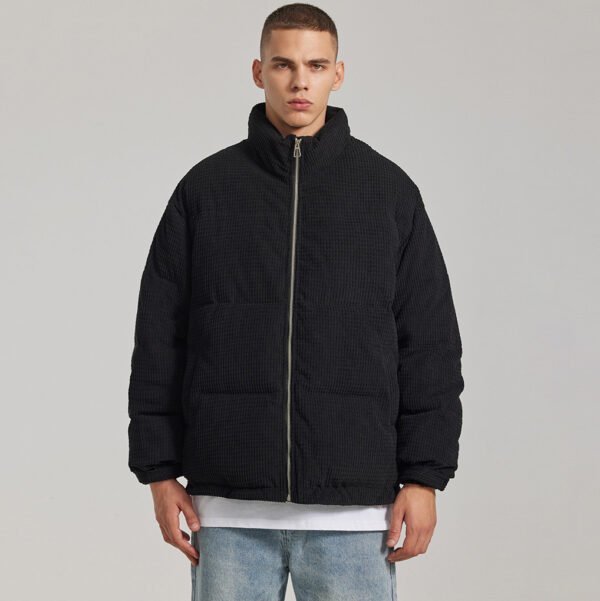
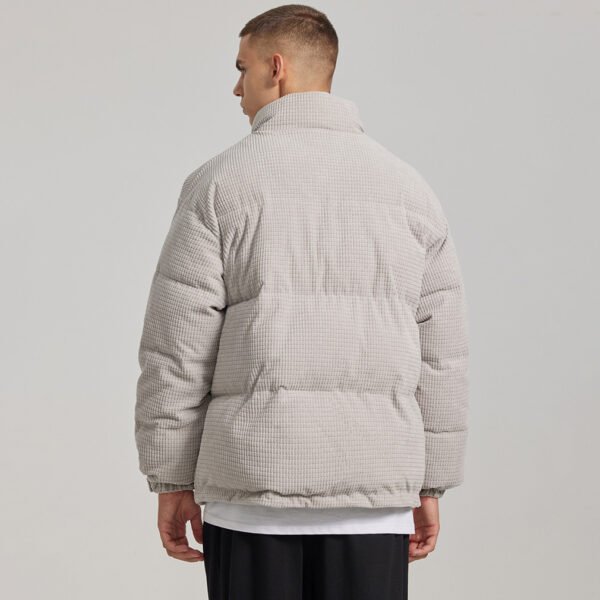

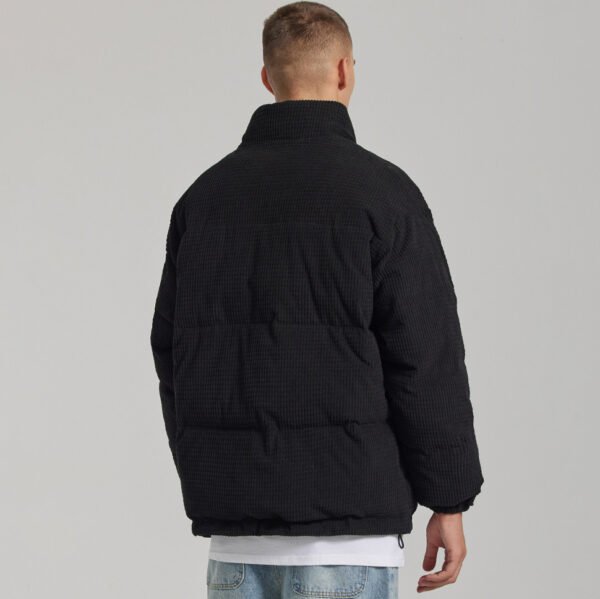




Built around marker direction and material consumption, this men's waffle-textured coat requires planning that respects both visual symmetry and efficient cutting. The supplied image shows a light grey loose silhouette with horizontal padded sections, a stand collar, and a centered zipper, making layout approval central to development.
Marker Direction Controls More Than Efficiency
On a textured or padded coat, marker direction determines how surface rhythm appears across neighboring pieces. Aligning the waffle texture and horizontal body sections can protect symmetry at the center front, side panels, sleeves, and pocket areas shown in the main image.
The trade-off is straightforward: a fully directional marker may preserve appearance while consuming more material, whereas rotating selected pieces can improve yield but create visible texture changes. The buyer should define which areas require strict direction before reviewing cost implications.
What the Main Image Establishes
The supplied image shows a light grey coat with a loose fit, raised waffle texture, horizontal padded bands, a high stand collar, and a centered front zipper. These features create repeated lines that make mismatched orientation easy to notice around the torso.
The sleeves appear fuller than the body and finish with ribbed cuffs, while pocket openings sit within the lower front sections. That arrangement means marker planning must consider both texture continuity and the placement of functional openings.
Managing Consumption Across Broad Panels
Broad front and back panels usually dominate material usage, especially when the style includes a fuller fit and padded construction. A production marker should therefore be reviewed with the approved graded pattern, seam allowances, facing widths, sleeve volume, and collar dimensions.
Consumption cannot be responsibly fixed from the image alone. VeeWen's development record should capture the measured result from the actual material and cutting plan, then identify whether directional exceptions are acceptable at hidden or low-visibility components.
Symmetry at Functional Components
The centered zipper and stand collar establish a strong vertical axis, while the padded bands establish horizontal repetition. Their intersection should remain balanced so the coat looks intentional when closed, particularly around the upper chest, collar base, and pocket entrances.
Pocket bags, facings, cuffs, and collar pieces can offer limited opportunities for consumption control, but only where their orientation does not disturb the visible front. A buyer should approve a component-by-component direction map instead of applying one rule universally.
VeeWen Development Workflow Checkpoint
For VeeWen, this argument should enter development during pattern engineering and marker review, before the sample is treated as a costing reference. The supplied image can guide the intended texture flow while the technical team maps directional requirements onto each component.
After the first sample, compare the front closure, collar, sleeve panels, pocket zones, and padded bands under consistent viewing conditions. Record approved exceptions directly in the production brief so the final marker reflects the buyer's visual priorities.
Approval Logic for the Coat Brief
The buyer's decision should combine three approvals: visual alignment, graded pattern balance, and measured material consumption. This prevents a marker from being accepted solely for yield when the waffle texture or padded bands lose the symmetry that defines the style.
Fiber composition, insulation, GSM, and performance remain technical confirmation items, separate from the visible design argument. Bulk readiness begins when the buyer accepts the direction map, consumption basis, and sample appearance as one controlled package.
Buyer Questions
Why is marker direction important for this coat?
Directional marker planning helps keep the waffle texture and padded bands visually aligned across broad panels. Rotating pieces may improve yield, but it can introduce noticeable changes in surface rhythm.
Does the image confirm cotton content or GSM?
No. The image supports the visible textured coat appearance, but cotton content, blend ratio, GSM, insulation, and performance require technical source or sample confirmation.
Can selected hidden pieces be rotated for efficiency?
Potentially, if the buyer approves exceptions by component. Hidden or low-visibility pieces may offer savings, but pocket areas, collar parts, sleeves, and front panels need separate alignment review.
What is the commercial minimum for this style?
The exact commercial minimum is MOQ: 100 pieces per style. Planning should follow approval of the marker direction, graded pattern, material specification, consumption basis, and reference sample.
Approve the Coat Marker Direction
Share your target measurements, color reference, and material expectations for review. VeeWen can connect marker direction, panel symmetry, and measured consumption before your MOQ: 100 pieces per style decision.


Reviews
There are no reviews yet.