


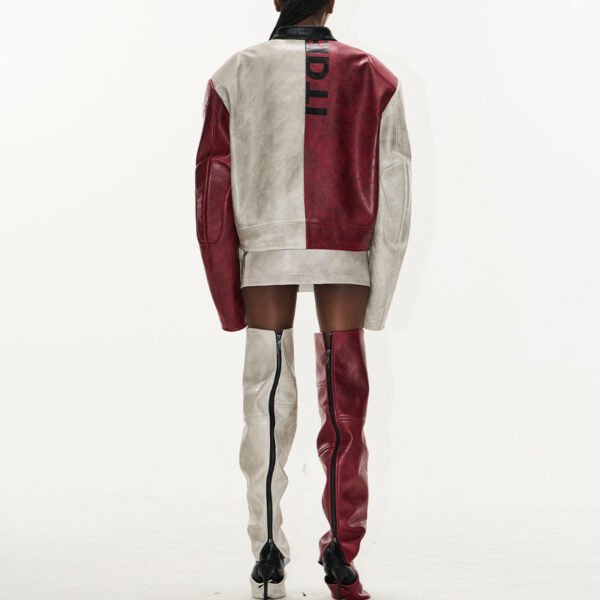
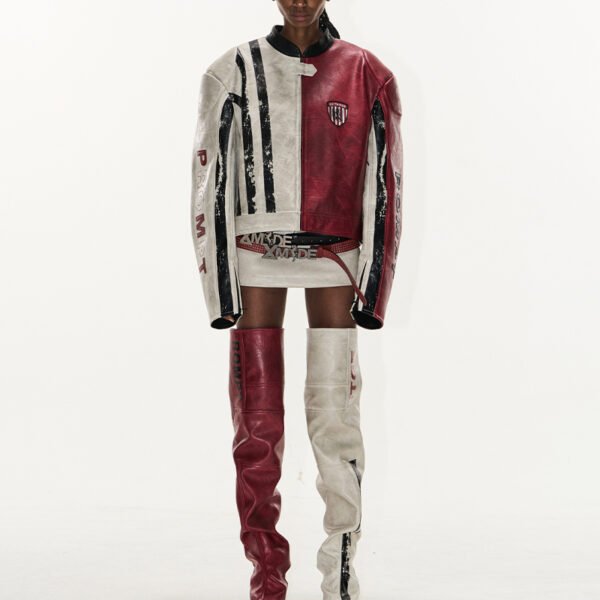


A bold colorblocked racing bomber gains commercial value from its weathered surface, but that appearance must remain intentional after handling and wear. VeeWen can develop the balance through controlled distress placement, considered panel mapping, and reinforcement decisions focused on sleeves, seams, closures, and other exposed zones.
Finish Intensity Must Be Designed, Not Assumed
The visual impact comes from contrast between smooth burgundy coverage, pale ivory panels, and broken black graphics. That contrast should be documented as a finish map, identifying where distress is dense, where edges stay clean, and how much underlying color remains visible.
Distressing creates character by removing visual uniformity, yet excessive abrasion can weaken a coating, expose backing, or make production consistency difficult. The development target is therefore repeatable irregularity: an approved range of marks, edge softness, and contrast for every production panel.
Abrasion Resistance Depends On Surface Construction
Abrasion resistance cannot be inferred from the image alone because the substrate, coating system, and backing are unspecified. The team should review how the proposed material reacts to rubbing, flexing, folding, and repeated sleeve movement before fixing the distress process.
The sleeves are especially important because the imagery places black-and-ivory graphics along long, mobile surfaces. Their treatment should preserve legibility without creating thin, vulnerable zones. Material choice, finish depth, and artwork placement must be evaluated together rather than approved as separate aesthetic decisions.
Colorblock Seams Need Controlled Stress Management
The vertical split across the front makes panel alignment highly visible, while the sleeve joins introduce additional transitions. Small mismatches in color, grain direction, or graphic placement could disrupt the racing layout, so the pattern and cutting plan should lock reference points early.
Stress concentrates near armholes, pocket openings, collar joins, and the center-front closure. Reinforcement can be considered at these locations after material testing confirms the actual failure risks. The goal is discreet support that protects wear performance without flattening the jacket's structured, graphic appearance.
Artwork Should Survive Movement Without Losing Edge Character
The chest patch and sleeve lettering create layered focal points against the colorblocked base. Their attachment method is not verified by the image, so development should compare suitable options for edge definition, flexibility, and resistance to lifting during normal garment movement.
A finish that looks convincingly aged should not be confused with uncontrolled damage. Artwork boundaries, patch placement, and distressed overlays need measurable approval references, including close views and tolerance notes. This gives production room to repeat the intended character while avoiding accidental over-processing.
VeeWen Workflow: Translate the Axis Into Approval Gates
For VeeWen's development workflow, the manufacturing axis becomes a linked review sequence: material swatches first, finish trials second, then a mapped prototype showing distress density and abrasion-sensitive areas. Each stage should retain the same panel artwork and reference positions for meaningful comparison.
The product-development pack should record approved substrate references, finish limits, reinforcement locations, artwork methods, and inspection priorities. A representative sample can then answer the commercial question directly: whether the desired aged surface remains stable enough for the intended wear and retail positioning.
Final Buyer Checkpoint: Choose Character Within Tolerance
Buyers should approve this style when the surface still reads distinctive after flex and rub review, while colorblock boundaries, graphics, and closure alignment remain controlled. If the finish degrades too quickly, reduce distress intensity or redirect it toward less exposed visual zones.
The final checkpoint is a signed sample and specification covering material composition, thickness, finish process, artwork attachment, seam support, and acceptable variation. That approval protects the design argument: expressive wear must be repeatable, commercially credible, and proportionate to the garment's use.
Buyer Questions
Is the jacket genuine leather?
The supplied imagery indicates a leather-look surface, but genuine leather, synthetic composition, backing, and thickness are not verified and require material confirmation.
Can the distressed appearance be adjusted?
Yes, the distress map can be developed by panel, with agreed limits for density, edge irregularity, contrast, and exposed base material before approval.
Which areas need the closest abrasion review?
Prioritize sleeves, armholes, closure edges, pocket openings, and distressed graphic zones because these areas combine movement, handling, and visible surface treatment.
What is the minimum order quantity?
The commercial minimum is MOQ: 100 pieces per style, with final requirements governed by the approved specification and production documentation.
Approve the Finish Direction
Send your target material reference, artwork files, size range, and distress preference for a VeeWen development review focused on surface stability, panel control, and abrasion-sensitive construction.


Reviews
There are no reviews yet.