


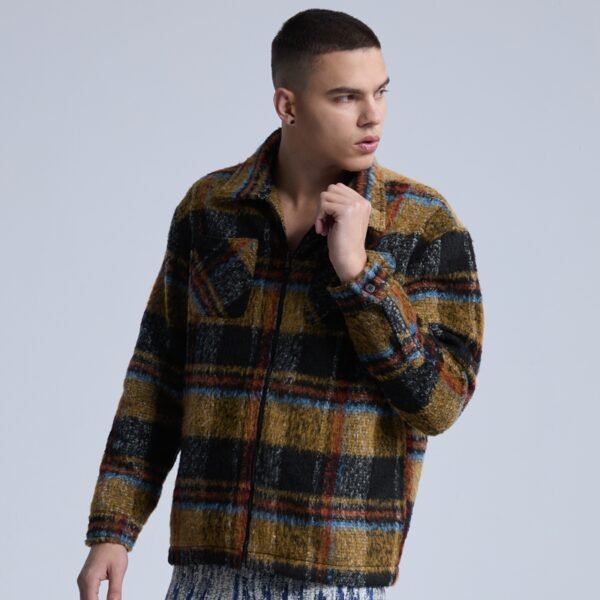




This men's shirt jacket is defined by a bulky brushed surface and a high-visibility plaid structure. The collar-to-zipper intersection must control thickness, pattern matching, and opening behavior together, because a small junction error can disrupt both the garment's utility and its strongest visual feature.
The Junction Carries the Garment's Visual Logic
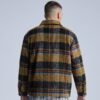
The supplied rear view shows a broad collar and a large-scale check with camel and black blocks, crossed by blue and red lines. On the front, the zipper must begin directly beneath that collar without creating a broken or visibly tilted transition.
This makes the opening more than a functional seam. The collar, front edge, and first plaid repeat establish the buyer's first impression, while the brushed surface increases seam bulk. The development target is a junction that looks intentional when closed, open, or partially zipped.
Plaid Matching Meets Zipper Placement
A large check requires a planned relationship between the center front, collar points, pocket positions if added, and sleeve joins. Zipper tape and seam allowances occupy space that can shift the visible repeat, so the pattern must be mapped before final cutting instructions are released.
Strict matching may improve visual precision but can increase fabric consumption and complicate marker efficiency. Looser placement may reduce waste, yet it can make the front opening look unstable. The buyer should define which matching lines are mandatory before approving the marker.
Bulk Control Shapes the Opening Experience
The image presents a visibly fuzzy, substantial-looking face, so the collar-to-zipper area may accumulate thickness where layers overlap. The pattern and construction review should examine seam turn, zipper tape width, collar stand height, and edge finishing as a connected package.
Reducing layers can create a flatter and easier-running zipper, but it may change the collar's support or expose less refined edges. Adding structure can improve control while increasing stiffness. Approval should follow a hands-on sample review of comfort, alignment, and opening movement.
Collar Proportions Affect Layering
The broad collar visible from the back frames the neck and sets the perceived scale of the jacket. Its front points must meet the zipper start symmetrically, especially when the garment is worn over a shirt, hoodie, or lighter knit layer.
A larger collar can strengthen the outerwear statement and provide more coverage, but it increases the amount of material converging at the zipper head. A narrower collar simplifies the junction yet may weaken the intended visual balance. Confirm proportion against the planned layering use.
VeeWen Workflow Targets the Intersection Early
VeeWen's workflow should isolate this junction during technical development rather than waiting for a full garment review. The team can mark collar points, zipper start, plaid balance lines, and seam bulk directly on the first construction sample.
The useful checkpoint is a front-opening inspection supported by close photographs and measurements. Reviewers should assess closed alignment, partial opening, zipper travel, collar symmetry, and edge thickness together, then record one coordinated revision for the next sample.
Approval Checkpoint: Function, Pattern, and Bulk
Before production approval, the buyer should request front, back, and open-position images, plus confirmation of the selected zipper construction and plaid matching priorities. The supplied rear image supports the pattern and collar discussion, but it does not verify the front zipper execution.
Approve when the collar points remain balanced, the zipper runs without resistance, and the key plaid lines meet the agreed standard. If pattern matching conflicts with cost or bulk, document the priority explicitly before freezing the construction pack.
Buyer Questions
Is the front zipper visible in the supplied image?
No. The supplied main image shows the back, while the source wording references a front opening. Zipper type, placement, and operation should therefore be confirmed through development samples.
What does collar-to-zipper engineering control?
It controls collar symmetry, opening alignment, seam bulk, tape placement, and zipper movement at one junction. These variables should be reviewed together because changing one can affect the others.
Can the plaid be changed or recolored?
Yes, the check scale and accent colors can be developed against your collection direction. Confirm the repeat, matching priorities, and color standards before final marker and sampling decisions.
What is the minimum order quantity?
The commercial minimum is MOQ: 100 pieces per style. Final production remains subject to approved measurements, materials, color standards, construction details, and the confirmed development package.
Approve the Collar and Zipper Junction
Share your preferred zipper, collar proportion, plaid repeat, and layering intent. VeeWen can coordinate the junction sample, bulk review, pattern matching checks, and approval record before production.

Reviews
There are no reviews yet.