
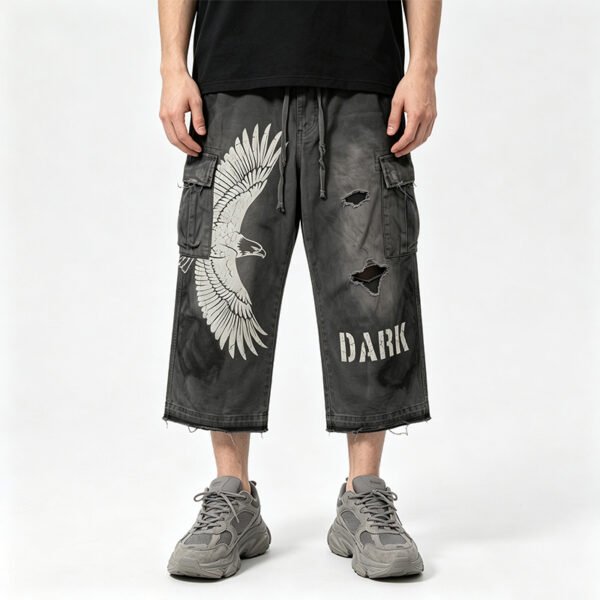
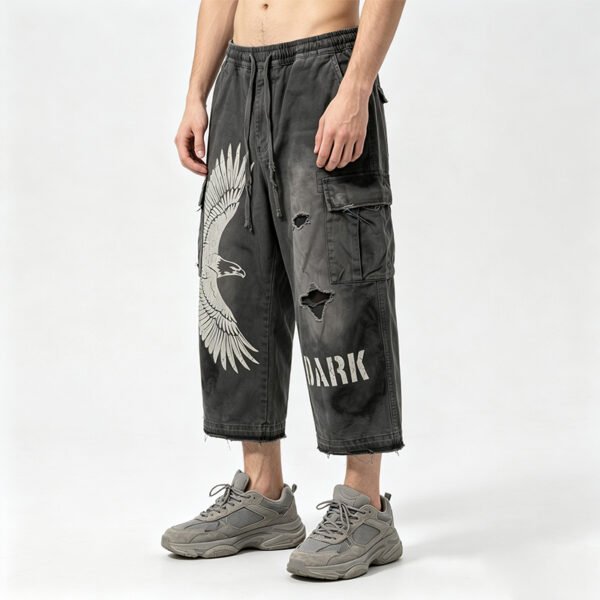

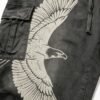
This cargo trouser concept is built around a high-contrast eagle graphic on washed charcoal utility bottoms. VeeWen can develop the artwork, placement, ink deposit, and garment finishing as one coordinated approval sequence for buyers balancing visual impact with wearable surface comfort.
Graphic Clarity Across the Leg
The charcoal ground gives the pale eagle and lettering strong tonal separation, but clarity depends on deposit control across seams, pocket edges, and curved legs. The buyer should approve a strike-off on the proposed washed base before judging final contrast.
The large left-leg eagle contains fine feather lines that can close up when ink viscosity, mesh selection, or squeegee pressure is poorly matched. Request a scaled artwork proof showing minimum line weights, registration tolerance, and coverage beside cargo construction before sampling begins.
Ink Film and Wearable Hand Feel
For this reference, an opaque graphic film or screen deposit may be appropriate, but the final system remains To Confirm. Heavier coverage can sharpen pale artwork while increasing stiffness, surface drag, and cracking risk on articulated knees during wear.
A softer deposit can improve drape and reduce a plastic sensation, yet excessive softness may weaken edge definition on distressed fabric. VeeWen should compare controlled hand-feel strike-offs, recording opacity, flex response, surface tack, and visual coverage after laundering trials.
Pocket Placement as a Graphic Constraint
The side cargo pockets sit close to the illustrated leg area, creating a practical interruption that can either frame or damage the composition. Artwork files should include pocket opening, flap, seam, and stitch allowances so visual elements do not disappear beneath construction.
Pocket bulk also changes how the fabric lies during printing, pressing, and inspection. The development sample should be assessed flat and worn, checking whether the eagle remains balanced when pockets are loaded and whether the ink film catches against adjacent hardware or folded fabric.
Wash Effects and Distressed Surfaces
The charcoal appearance reads as intentionally aged rather than uniform, while tears and raw-looking hems add irregularity around the graphic. Wash development must therefore protect the artwork's tonal hierarchy instead of producing random fading that erases critical feather lines.
A stronger wash may create authentic abrasion but can alter ink appearance, hand feel, and edge stability. Buyers should define which irregularities are acceptable, then review prewash and postwash panels together before locking the sequence for bulk production under MOQ: 100 pieces per style.
VeeWen Development Workflow
VeeWen's workflow should begin with a construction-aware artwork pack: graded placement maps, pocket overlays, line-weight rules, and a stated target hand feel. This lets pattern, printing, and garment-wash decisions address the same visual risk from the beginning.
After artwork and fabric confirmation, VeeWen can coordinate strike-offs, a full garment sample, and wash review around measurable buyer comments. The useful checkpoint is not simply whether the sample looks bold, but whether clarity and tact remain consistent across all affected panels.
Buyer Approval Checkpoint
The central approval decision is a controlled compromise between crisp artwork and a natural cargo-pant hand. Buyers should rank opacity, softness, crack tolerance, and vintage irregularity, because maximizing one can compromise another on this construction.
Before production authorization, approve the final artwork proof, pocket placement, fabric reference, wash appearance, and ink-film sample together. Confirm size grading and wear-test expectations separately, then release the style only when the complete garment supports the intended graphic edge.
Buyer Questions
What should be approved first for this graphic cargo style?
Approve the artwork scale, minimum line weight, and strike-off hand feel first, because those decisions govern readability across pockets, seams, wash effects, and movement.
Can the eagle graphic be moved or resized?
Yes, placement and scale can be developed, but changes should be reviewed against pocket openings, leg proportions, seam allowances, and the smallest feather details before sampling.
Is the listed fiber composition confirmed?
The supplied source title states 90% cotton and 10% polyester. Fabric weight, finishing, lot consistency, and final composition documentation still require confirmation.
What is the commercial minimum for development?
The exact commercial minimum is MOQ: 100 pieces per style. Final quantities, size ratios, packaging requirements, and production details should be confirmed during quotation.
Approve the Graphic Direction
Send VeeWen the artwork, target fabric reference, and preferred wash character. We will align placement, ink-film hand, pocket construction, and approval checkpoints before sampling begins at MOQ: 100 pieces per style.


Reviews
There are no reviews yet.