

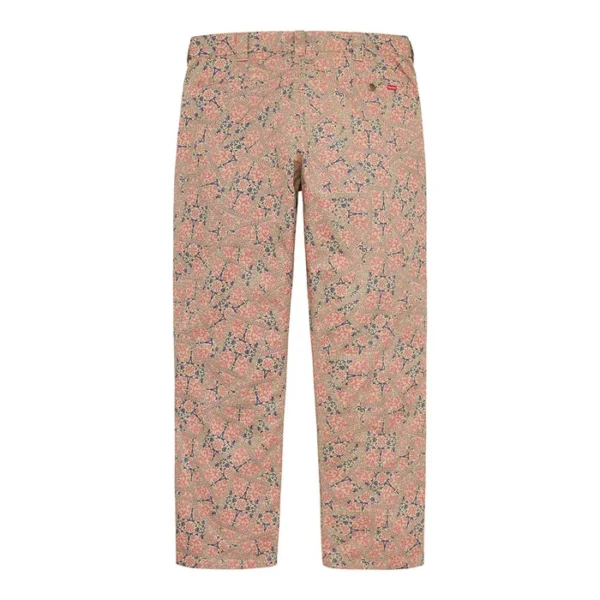

These custom floral work pants are developed around one commercial risk: keeping a muted khaki ground visually consistent while preserving contrast in a dense all-over print. The photographed trousers provide a clear appearance reference, but bulk approval requires measurable shade checkpoints and repeat-lot controls.
Why the Ground Shade Controls the Product
Wash shade control begins with a defined base cloth, dye route, and approval standard before cutting starts. The supplied image shows a muted khaki ground carrying dense pink and dark motifs, so shade consistency must protect both background tone and print contrast across repeat orders.
Because patterned work pants can hide small tonal drift until garments are assembled, VeeWen's development file should separate ground-shade tolerance from motif registration. A retained lab-dip and sewn-panel approval gives buyers a reference for matching repeat lots without treating the photographed color as measurable standard.
Reading the Supplied Trouser Evidence
The image presents a full-length trouser with an uninterrupted patterned surface, straight legs, a structured waistband, and clean lower hems. Those visible elements suggest that shade evaluation should include waistband, leg panels, pocket areas, and hems rather than relying on one isolated fabric swatch.
The pink and dark artwork is visually subordinate to the khaki base, which makes the ground color commercially important. Buyers should decide whether the print is applied before or after the relevant wash process, because sequence can change contrast, hand feel, and dimensional stability.
Trade-Offs in Wash and Print Sequencing
A stronger wash effect may create desirable variation, but it can also soften motif contrast or introduce panel-to-panel differences. A more controlled process improves repeatability while potentially reducing the worn character buyers may expect from a workwear-inspired presentation.
For this reason, development should compare approved samples against the intended commercial priority: uniform shade, visible pattern clarity, or a managed balance. The decision belongs in the technical pack, with tolerance language that production and future reorder teams can interpret consistently.
Construction Checkpoints for Shade Review
The straight silhouette gives buyers useful inspection zones because long leg panels expose gradual shade differences. VeeWen can organize review around cut components, then confirm whether sewing tension, pressing, and finishing alter the perceived tone across the completed trouser.
Waistband and hem construction also matter because folded or doubled fabric can appear darker than the main leg. Approval should therefore include a complete sewn garment, photographed under agreed lighting, alongside the retained fabric and print references.
VeeWen Development Workflow
VeeWen's workflow for this style should begin by locking the fabric base, print artwork, wash sequence, and shade-reference method as one connected development brief. The image establishes the visual target, while lab dips and sewn panels convert that target into production decisions.
Before bulk cutting, the buyer should review a complete sample for ground shade, motif contrast, silhouette, waistband behavior, and hem appearance. Once those checkpoints are signed, the same references can support reorder evaluation and reduce ambiguity between development and commercial production.
Buyer Approval and Reorder Discipline
The key approval is not simply whether the sample looks khaki and floral; it is whether the buyer can describe acceptable deviation. Define the ground shade, contrast range, wash character, and construction appearance in language supported by retained physical references.
For the first order and every reorder, maintain the approved garment and fabric references with the purchase specification. If a new fabric lot or process change is proposed, require a fresh sewn-panel comparison before release, especially where contrast could shift.
Buyer Questions
Can the floral artwork be changed for my collection?
Yes, artwork direction can be developed around your supplied file, placement needs, color palette, and approval process; print method and repeat scale require technical confirmation.
How should I approve the khaki shade?
Approve a lab dip, printed fabric panel, and complete sewn garment under agreed lighting, then retain those references for production and reorders.
Is the photographed fabric composition verified?
No. The image supports visual assessment only, so fiber content, fabric weight, construction, and wash behavior must be confirmed during development.
What is the minimum order quantity?
MOQ: 100 pieces per style. Final quantities, colorways, artwork versions, and size breakdown should be confirmed before commercial quotation and production planning.
Approve the Shade-Control Brief
Send your artwork, target khaki direction, size range, and reorder expectations to VeeWen. We will align the development sample with measurable shade and print-contrast checkpoints before production approval.


Reviews
There are no reviews yet.