Fabric air permeability testing for apparel measures airflow through a known fabric area under a stated pressure difference. It gives buyers a controlled way to compare approved materials, but it is not a universal comfort score. A useful specification defines the exact fabric, construction, finish, test method, reported units, and what happens when a result falls outside the agreed range.
What air permeability actually measures
Air permeability is the rate at which air passes through a known area of textile under a stated pressure difference. In apparel development, the result can help a buyer describe how open or resistant a fabric structure is to airflow. ASTM D737 covers measurement of textile-fabric air permeability and applies across constructions including woven, knitted, layered, pile, treated, and coated fabrics. It also notes that structure and finishing can materially affect the airflow path. ASTM D737
That definition is deliberately narrow. Air permeability is airflow; it is not a promise that a garment will feel cool, dry, light, or comfortable in every condition.
Keep these properties separate in a tech pack and in consumer-facing copy:
- Air permeability: airflow through fabric under the stated test conditions.
- Water-vapor resistance: resistance to water vapor passing through a material or assembly.
- Wicking: liquid moisture movement along or through a textile.
- Drying: how quickly retained moisture leaves a material under a defined procedure.
- Thermal resistance: resistance to heat transfer.
- Garment comfort: a wearer experience influenced by fit, activity, climate, layers, skin contact, construction, and individual preference.
Intertek lists thermal resistance and water-vapor resistance as distinct textile performance tests and notes that these may be carried out on fabrics, films, coatings, foams, leather, and multilayer assemblies. That distinction is useful when a product brief says “breathable” but the actual requirement concerns vapor movement or insulation rather than airflow. Intertek Textile Testing Solutions
Why buyers should specify the test, not just say “breathable”
“Breathable fabric” is an incomplete sourcing instruction. It invites a supplier, lab, designer, and buyer to attach different meanings to the same word.
A defensible buyer specification identifies the item being tested and the conditions that make one report comparable to another. At minimum, record the following metadata:
- Fabric supplier or mill reference, composition, construction, color, and lot or roll identification.
- Whether the specimen is greige, dyed, washed, brushed, peached, calendared, coated, bonded, laminated, printed, or otherwise finished.
- The named test method and edition requested by the buyer.
- The pressure difference used by the reported method.
- Test area and the reporting units.
- Airflow direction where the two fabric faces differ.
- Conditioning, specimen selection, number of observations, and whether the reported figure is an average.
- The agreed acceptance range, tolerances, and retest procedure.
Do not compare figures simply because both reports use the phrase “air permeability.” A different method, pressure difference, area, unit, conditioning approach, specimen direction, or finish can make a direct comparison misleading. ASTM specifically notes that fabrics with differing surface textures on each side can show different permeability depending on airflow direction. ASTM D737
For a U.S.-focused apparel program, ASTM D737 may be the method named in the specification when it matches the buyer’s product and compliance workflow. If a customer, retailer, market, or internal protocol requires another method, name that method rather than converting a result into an assumed equivalent. The important procurement discipline is method consistency within the approval comparison.
A practical framework for choosing an airflow target
There is no single “good air permeability value” for all apparel. Higher airflow may suit one garment purpose and undermine another. Choose a target as part of a product brief, not as a generic badge of quality.
Start with the intended exposure. An open, warm-weather layer may prioritize air exchange. A wind-facing outer layer may reasonably prioritize reduced airflow. A uniform may need a stable balance among coverage, durability, hand feel, laundering, and climate expectations. A fashion piece may need to preserve a particular drape or visual density even if a more open construction would pass more air.
Then assess the complete material and construction system:
- Base construction: Knit gauge, yarn size, stitch or weave density, yarn twist, crimp, and cover influence open spaces and airflow paths. ASTM identifies yarn, weave, and finishing factors as meaningful influences on permeability. ASTM D737
- Finishing: Softening, raising, calendaring, resin treatments, coatings, and other finishes can alter the material buyers originally approved.
- Stretch state: A body-hugging knit may change when worn compared with an unstretched lab coupon. Specify whether the fabric is tested in its supplied state and do not imply that the result predicts every worn condition.
- Garment architecture: Lining, interlining, pocket bags, plackets, seam overlap, rib, taped areas, and layered panels can change local airflow.
- Decoration: Large plastisol logo hits, high-density prints, transfers, embroidery, patches, and appliqué can block or redirect airflow at the decorated area.
A simple decision path is more reliable than selecting the highest available result:
- Define the use case and exposure: indoor casual, warm-weather streetwear, training layer, wind-facing shell, or another specific situation.
- Identify the garment zones where airflow matters: whole body, back panel, underarm, side panel, lining, or an unprinted body area.
- Select the representative material state: finished, washed if applicable, and in the color or decoration condition that matters to the claim.
- Set a buyer-owned acceptance band only after reviewing comparable development materials under one method.
- Approve product language that matches the evidence, such as “air-permeable fabric tested to the stated specification,” rather than an absolute comfort claim.
Material, finish, and print matrix for buyer review
Use the following matrix in development meetings to decide whether a base-fabric test is enough.
- Unprinted single-layer jersey: A base-fabric report may support a fabric-level airflow statement if the bulk fabric matches the approved construction and finish. It does not prove fit, thermal comfort, or moisture management.
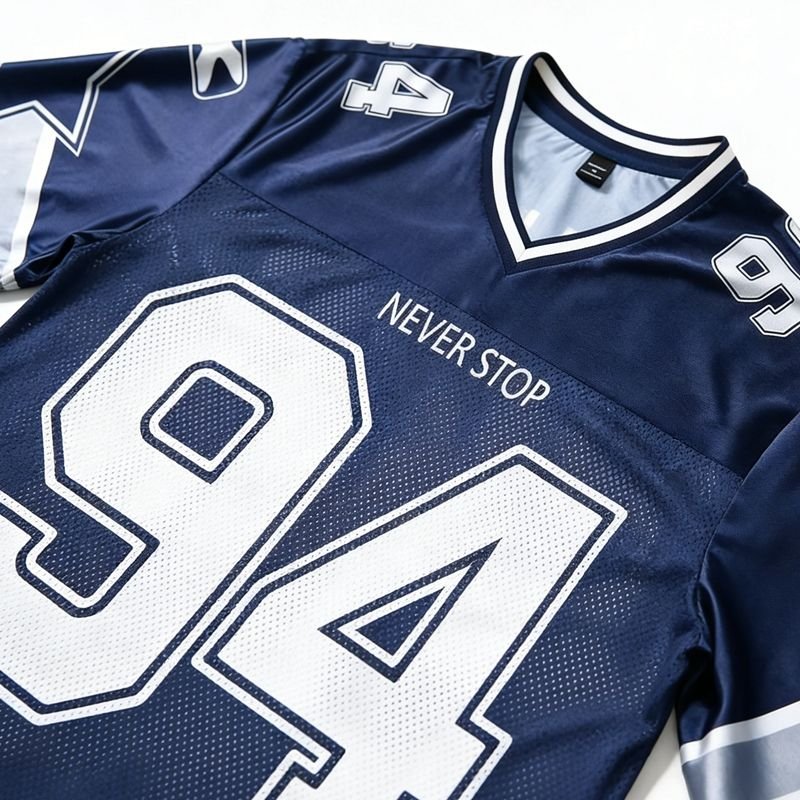
- Mesh panel combined with dense body fabric: Test and describe each relevant zone separately. A high-airflow panel does not characterize the full garment.
- Brushed fleece or napped knit: Treat surface finish as part of the tested identity. Do not rely on a report from the unbrushed construction.
- Coated, laminated, or bonded fabric: Specify the complete assembly. Testing an uncoated face fabric does not substantiate an airflow claim for the finished composite.
- Large chest or back print: Test an unprinted base-fabric coupon for material control, then separately decide whether the printed coverage makes a garment-level airflow claim inappropriate.
- Embroidery, patch, or appliqué zone: Do not extrapolate from surrounding fabric to the embellished area.
- Lined overshirt or jacket: A shell report may be useful for shell selection, but it does not describe airflow through shell, lining, seams, and closures together.
A product photo can illustrate a mesh panel, open knit, shell, or logo placement. It is never proof that a particular SKU passed an air-permeability test.
Approval workflow for apparel programs
- Write the performance question. State why airflow information is needed: material comparison, incoming-material control, a product-development gate, or carefully bounded marketing support. Avoid beginning with a vague request for “more breathable.”
- Lock the fabric identity. Put composition, construction, weight target where relevant, color, finish, supplier reference, and intended garment use into the development record. Connect this work to the broader Fabric & Material Sourcing brief so the approved test specimen and bulk fabric are traceable to the same sourcing decision.
- Name the test protocol. Specify the requested standard, lab, pressure difference, test area, units, specimen direction, and report fields. Do not request a conversion between methods as an acceptance shortcut.
- Sample representative conditions. Select material from the approved finished state. If a wash, coating, bonding process, print coverage, or color route can alter airflow, identify which condition is being approved and which conditions are exceptions.
- Review the full report. Check that the fabric identifier, method, units, pressure difference, test area, airflow direction, conditioning, specimen count, observations, average, and report date all align with the request. A single isolated result without this context is weak purchasing evidence.
- Decide against the product brief. Compare only like-for-like reports. Accept, reject, or request development revision based on the buyer’s approved range and the intended garment architecture—not on whether the figure sounds high.
- Control bulk exceptions. Define when retesting is needed: a substituted mill, changed finish, changed coating, significant construction revision, new decoration coverage, or a disputed lab result. ASTM notes that when laboratories report practically significant differences, comparative testing of homogeneous material may be needed to investigate bias. ASTM D737
- Approve claim language last. Keep the internal lab specification separate from consumer wording. A fabric-level result supports a fabric-level statement. A whole-garment comfort promise needs evidence appropriate to the complete garment and claim.
Buyer guide: RFQ questions, red flags, and checklist
For an RFQ, ask for the proposed fabric construction and finish, the exact test method to be used, the report units, whether the sample represents bulk finishing, and how substitutions will be controlled. If the garment has lining, bonded layers, or large embellishments, ask whether the proposed test is for the shell, a panel, or the finished assembly.
Also ask how the supplier will identify lots against the approved sample; whether production changes require buyer approval; and whether the test result is being used for material selection, shipment acceptance, or marketing. Those are different decisions and should not share an undocumented threshold.
Red flags include a result with no method or units; a report that names only “breathability”; a figure compared across different standards without methodology; an unprinted coupon used to promote a heavily printed garment; a shell result presented as evidence for a lined jacket; and a supplier promise of “maximum breathability” without a use-case definition.
Compact buyer checklist
- Confirm the use case before setting an airflow target.
- Match the test specimen to the approved finished fabric.
- Keep the test method, units, pressure difference, area, and airflow direction on every comparable report.
- Treat fabric, panel, and finished-garment claims as different scopes.
- Review decoration, lining, seams, and coatings before approving copy.
- Establish a written exception and retest path before bulk production.
- Keep after-laundering appearance as a separate acceptance question; use a separate after-laundering appearance review when that risk matters.
How to write credible breathability claims
Prefer narrow, auditable phrasing. “Fabric air permeability tested according to the stated buyer specification” is more defensible than “guaranteed breathable in all conditions.” If a product has an air-permeable panel but a denser main body, say which component is being described.
Avoid converting airflow into water-vapor performance, wicking, drying, thermal performance, or overall garment comfort. Those properties answer different questions. Do not make medical-mask, personal protective equipment, health, or protection claims from an apparel air-permeability result.
For collection development, VeeWen can help translate the buyer’s approved fabric, construction, decoration, and report requirements into a production-ready specification.
FAQ
How do you test whether fabric is breathable?
For airflow, use an air-permeability test that measures airflow through a known fabric area under a stated pressure difference. Record the method, units, test area, airflow direction, and material condition so the result can be compared meaningfully.
What is the purpose of an air permeability test in textiles?
It helps buyers quantify airflow through a textile for material comparison, specification control, and end-use decisions. ASTM describes air permeability as relevant to textile performance and notes that purchase specifications can use it where permeability matters. ASTM D737
What is a good air permeability value for apparel?
There is no universal good value. Select an acceptance range after defining intended exposure, fabric construction, layers, finishes, decoration coverage, and the buyer’s desired trade-off between airflow and other product needs.
Are ISO standards required for textile testing?
Not automatically. The applicable method depends on the buyer, destination market, retailer requirements, product category, and purchase specification. Name the required standard in the RFQ instead of assuming one method fits every program.
Can an unprinted fabric report support a claim for a printed T-shirt?
Only as evidence about the unprinted base fabric. Large prints, embroidery, patches, seam overlap, lining, and paneling can change airflow in the finished garment, so they should be reviewed before using broader garment-level language.
Discuss your collection
Bring the intended use, fabric reference, construction details, and proposed claim to Request a Custom Quote so the test brief can be aligned before sampling.