


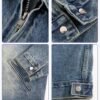





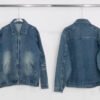
This jacket concept is defined by the discipline of its visible stitching. The supplied image shows a blue zip-front denim jacket with a pointed collar, structured sleeves, and a 543G reference. Consistent topstitch gauge must preserve proportion across curved collar edges, zipper lines, cuffs, pockets, and hem.
Why Stitch Gauge Defines the Jacket
Topstitch gauge is the repeatable distance and visual spacing between stitch rows and fabric edges. On a structured denim jacket, inconsistent gauge can make one panel look softer, wider, or less deliberate, particularly around the collar and central zipper.
The supplied image makes those lines easy to read because the jacket uses contrasting blue tonal fading and prominent construction edges. A buyer should approve stitch spacing as a visible design standard, not treat it as an invisible factory detail.
Reading the Supplied Jacket Evidence
The image shows a pointed collar, center zipper, long sleeves, cuffs, lower hem, and a compact body worn over a layered outfit. These elements create multiple edge conditions where stitch distance must remain visually balanced through curves and intersections.
The source wording identifies the garment as 543g denim, while the image supports a substantial blue denim appearance. Fiber percentages, stretch, seam construction, and exact stitch specifications are not verified, so they remain development items for confirmation.
Heavy Denim Magnifies Small Variations
A heavier denim reference can make seam ridges, folded edges, and stitch rows more pronounced, although the source does not confirm the fabric's final hand or dimensional behavior. Needle penetration, thread selection, tension, and seam layering may all affect visible consistency.
The prototype should be checked at collar points, zipper tape edges, sleeve cuffs, and hem corners. These areas combine turning, compression, and direction changes, so a gauge that looks correct on a straight seam may not remain convincing around the full garment.
Collar and Zipper Alignment
The pointed collar establishes a symmetrical visual frame above the zipper, while the center front establishes the jacket's vertical axis. If topstitch rows drift near either feature, the deviation can make the body appear twisted even when the panels are correctly cut.
VeeWen's review should measure both sides from the relevant edge and compare the collar points against the center-front line. The buyer should specify whether symmetry, edge distance, or a defined tolerance takes priority where construction layers create unavoidable thickness.
VeeWen Development Checkpoint
VeeWen's product-development workflow should convert the visual requirement into a stitch map covering collar edges, zipper borders, cuffs, pockets, shoulders, and hem. The map can then be checked on a sewn prototype, where fabric thickness and seam buildup are visible together.
Before confirming production, the buyer should approve the prototype under the intended wash and thread appearance. Confirm gauge consistency on straight and curved paths, zipper framing, collar symmetry, and cuff transitions before releasing the style at MOQ: 100 pieces per style.
Trade-Offs in Visible Construction
A narrow, precise gauge can create a cleaner technical look but may expose tension changes and require closer handling. A wider gauge can emphasize ruggedness and reduce visual sensitivity in some areas, yet it may overwhelm a compact collar or zipper frame.
The correct choice depends on the desired balance between workwear structure and refined streetwear presentation. Establish one primary gauge, identify exceptions caused by seam thickness, and approve those exceptions intentionally instead of allowing them to emerge during production.
Buyer Questions
Is 543g the confirmed fabric composition?
No. 543g is a weight reference stated in the source material. Fiber percentages, stretch, weave, and finished dimensional behavior require confirmation during material development.
Which stitches need the closest review?
Prioritize collar edges, zipper borders, cuffs, pockets, shoulder seams, and hem corners. Their curves, layers, and intersections make gauge variation especially visible on heavy denim.
Can the stitch gauge vary by location?
It can, where seam thickness or construction requires an exception. Document each variance in the approved specification so intentional functional changes remain visually consistent.
What is the minimum order?
The commercial minimum is MOQ: 100 pieces per style. Confirm final size grading, colorways, materials, trims, and approved construction details before production release.
Approve the Stitch-Gauge Prototype
Share the target wash, thread appearance, size range, and construction priorities. VeeWen can prepare a stitched prototype for collar, zipper, cuff, pocket, and hem approval before production.

Reviews
There are no reviews yet.