

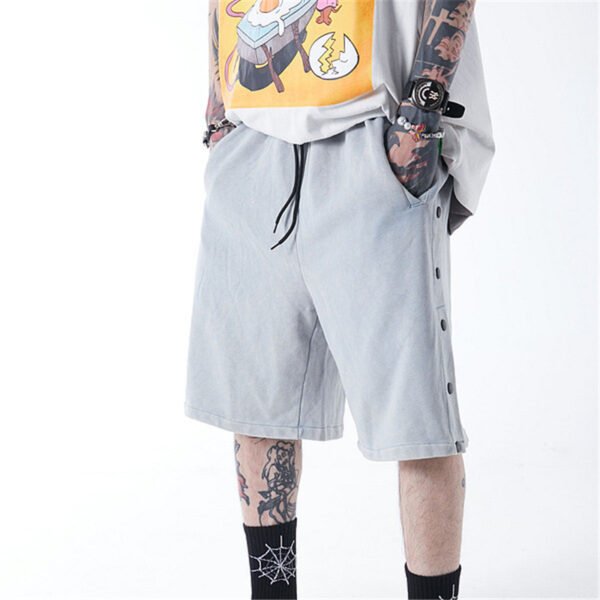


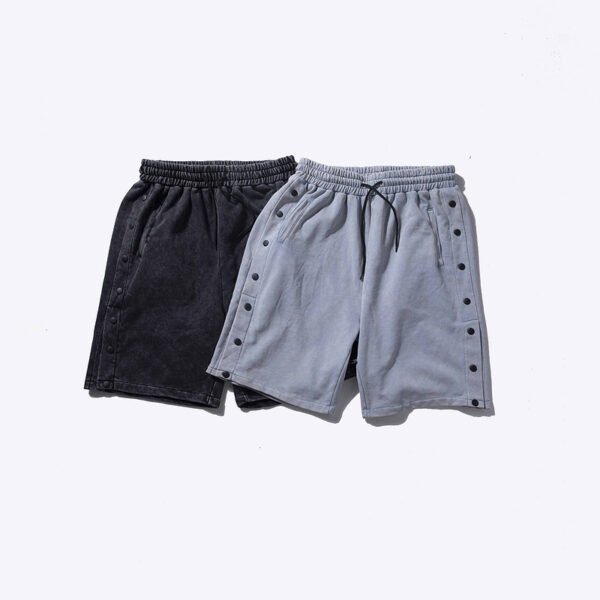


This short program is built around color-block seam accuracy: relaxed proportions still need disciplined alignment when a light acid-wash surface softens visual boundaries. The supplied image shows a centered drawcord, balanced pockets, and level hems, giving buyers practical checkpoints for development approval.
Why Seam Accuracy Matters on a Washed Short
A relaxed short has fewer visual distractions than a tailored garment, so uneven seams can become immediately noticeable. On this design, the center drawcord, pocket openings, side seams, and hem lines create a simple geometry that must remain balanced after washing.
Acid-wash variation complicates inspection because tonal shifts can make one panel appear wider or darker than another. The development target is therefore consistent physical alignment first, with wash placement reviewed separately so surface character does not hide construction drift.
Reading the Supplied Image as a Technical Brief
The main image shows a light gray short with a straight front rise, two angled side pockets, a centered drawcord, and broad leg openings. These observations support a relaxed casual block, while the visible symmetry establishes the most useful first-pass approval references.
The image also suggests a clean lower edge without contrasting trim or visible color inserts. For production, buyers should define seam positions, pocket angles, hem turnback, and tolerance ranges in the technical pack rather than relying on appearance alone.
Construction Controls for the Seam Map
VeeWen's development review should lock the center front, waistband casing, pocket bag entry, side seam, inseam, and hem as connected reference points. A clear seam map helps pattern and sewing teams preserve relationships when grading across sizes.
The key trade-off is ease versus visual discipline. Extra room supports the intended relaxed fit, but excessive allowance can shift pockets or distort hems. The approved pattern should protect movement while keeping paired details visually level on the finished garment.
Managing Wash Before Final Approval
The source wording identifies an acid-wash direction, while the image shows a pale, irregular tonal surface. Wash development should therefore evaluate both shade character and dimensional change, because laundering can affect seam appearance, pocket shape, drawcord position, and hem balance.
A stronger wash may create more expressive contrast but can reduce repeatability between production lots. Buyers should approve a shade panel or sample standard alongside the construction sample, separating acceptable color variation from unacceptable seam displacement before bulk release.
How This Enters VeeWen's Workflow
VeeWen can translate this argument into a focused product-development sequence: establish the seam map, build the relaxed block, place pocket and waistband reference points, then review the washed sample for post-process alignment.
The useful checkpoint is not a generic approval label. It is a side-by-side inspection of paired pockets, centered drawcord exit, side-seam continuity, inseam relationship, and hem level after the intended finish is applied.
Buyer Approval Checkpoint
Before approval, request a sample measured flat and viewed frontally, with the waistband relaxed and the drawcord positioned naturally. Confirm that the pocket openings mirror one another and that the lower edges remain visually level across the size set.
Approve the program when construction tolerances remain acceptable after wash review, not merely when the color looks attractive. Record the approved shade, seam map, measurement points, and grading assumptions so later production decisions remain traceable.
Buyer Questions
What is the primary development risk for this short?
The main risk is seam displacement becoming visible against a tonal wash, especially around paired pockets, centered drawcord placement, side seams, and hem alignment.
Is the fabric composition confirmed for development?
The supplied source title states 100% cotton, but VeeWen should confirm the final fabric construction, weight, shrinkage behavior, and approved wash standard before bulk production.
What should the first sample prove?
The first sample should prove relaxed fit balance, pocket symmetry, drawcord centering, hem level, and whether the intended wash changes those relationships.
What is the minimum order quantity?
The commercial minimum is MOQ: 100 pieces per style, with final specifications and production conditions confirmed during quotation and development review.
Approve the Seam Map Before Wash Bulk
Send your measurement chart, wash reference, and pocket geometry to VeeWen for development review. We will organize the approval around seam relationships, post-wash appearance, and MOQ: 100 pieces per style.


Reviews
There are no reviews yet.