


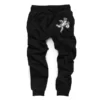


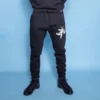
This custom black chenille graphic jogger program treats the lower garment as the balance point for a coordinated hooded set. The supplied image shows relaxed volume, a drawcord waist, gathered cuffs, and a raised thigh graphic, while the assigned axis requires the unseen upper garment to be resolved before approval.
The Jogger Sets the Set's Lower Balance
The supplied image presents a relaxed black jogger with soft folds through the seat, thigh, and lower leg. That volume gives the outfit visual weight below the waist, so an accompanying hood cannot become excessively large without making the complete silhouette feel top-heavy.
The first fitting review should photograph the jogger with the intended companion upper garment. Evaluate shoulder width, hood drop, neckline opening, and body length against the jogger's relaxed leg volume, because the assigned axis concerns proportion across the set rather than one isolated piece.
Hood Volume Needs a Clear Reference
No hooded garment is visible in the supplied evidence, so hood volume remains an approval variable rather than a confirmed product feature. The jogger still provides a useful reference: its generous lower shape supports a hood with presence, but not uncontrolled bulk.
VeeWen should establish hood height, front opening, overlap, and stand relationship from a companion technical sketch or sample. The buyer can then judge whether the hood frames the face cleanly and sits naturally over the jogger's relaxed proportions without pulling the neckline backward.
Neckline Pull Reveals Balance Problems
Neckline pull is often visible when hood weight, seam angles, or collar tension are mismatched. Although the supplied image focuses on the jogger, the visible drawcord waist and gathered cuffs show a garment designed for adjustable containment, making equivalent control important at the upper opening.
During fitting, inspect the companion neckline at rest, while turning the head, and with the hood raised. Record whether the collar lifts, spreads, or drags the shoulder line, then adjust hood attachment, neckline circumference, and seam support before approving coordinated production.
The Raised Graphic Needs a Stable Base
The light raised graphic on the upper front thigh is the jogger's clearest decorative interruption. Its position should remain readable across movement without landing directly on a major fold, pocket opening, or high-friction zone that could change the graphic's outline.
Graphic scale and placement should be reviewed with the final leg block, not a generic trouser template. If the thigh grows through grading, the motif may need a controlled positional adjustment so it remains intentional while the jogger preserves comfortable ease and natural drape.
VeeWen Workflow Resolves the Missing Link
For this program, VeeWen's development workflow should begin by separating confirmed lower-garment evidence from the unconfirmed hooded-set requirements. The jogger block, waistband control, cuff depth, and graphic position can be documented first, while the buyer supplies the companion upper reference.
A coordinated fitting gate then measures hood volume and neckline pull alongside the approved jogger. This sequence lets the pattern team adjust attachment and collar behavior against real lower-body proportions before the style proceeds toward the MOQ: 100 pieces per style.
Approval Depends on the Complete Outfit
The key decision is not whether the jogger looks convincing alone; the image already establishes a clear relaxed lower half. The buyer must decide whether the proposed upper garment matches that volume, keeps the neckline stable, and allows the raised thigh graphic to remain the visual focal.
Approve after reviewing the complete set in standing and moving poses, including hood-up and hood-down positions. Confirm waistband adjustability, cuff recovery, graphic registration, hood scale, and neckline behavior, while keeping fiber content, GSM, and performance claims open until verified.
Buyer Questions
Why does a jogger page address hood volume and neckline pull?
The assigned manufacturing axis defines a coordinated-set relationship, but the supplied image shows only the jogger, so the companion hooded garment requires buyer confirmation.
What does the jogger image establish confidently?
It establishes a black relaxed silhouette, visible drawcord waist, gathered ankle cuffs, soft volume, and one contrasting raised graphic on the upper front thigh.
How should the companion neckline be tested?
Review it at rest, during head movement, and with the hood raised, checking collar lift, shoulder drag, opening spread, and attachment stability before approval.
What is the minimum order for this style?
The commercial minimum is MOQ: 100 pieces per style, with final production conditions dependent on the approved technical specification and order confirmation.
Confirm the Coordinated Hooded Set
Share the companion upper reference and target size range so VeeWen can balance hood volume, neckline pull, jogger proportions, and graphic placement at the fitting gate.


Reviews
There are no reviews yet.