

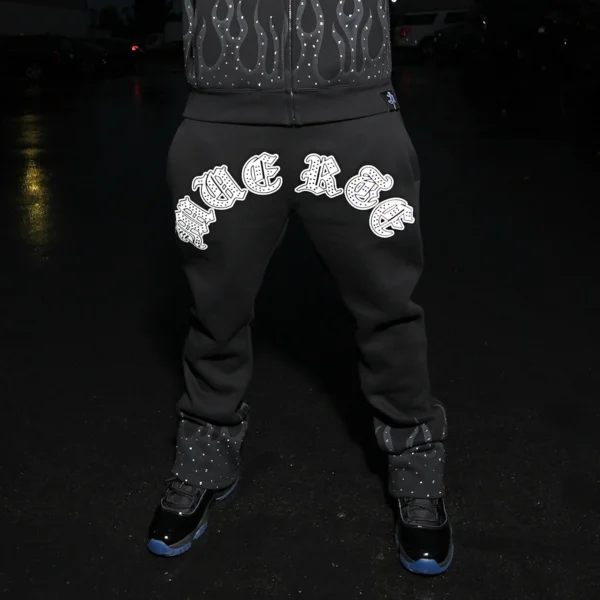


This custom flared sweatpant concept depends on controlling two interacting effects: the raised or embellished surface and the way seams settle around it. The supplied image presents a black lower garment with directional flame language, so texture consistency and seam lay should be approved as one system.
Why Texture and Puckering Interact
A surface treatment adds localized thickness or stiffness to the base fabric. When that fabric is sewn, pressed, stretched, or washed, the added resistance can prevent seams from settling evenly. On a flared sweatpant, small distortions become more visible as the leg widens toward the opening.
Seam puckering is therefore not only a sewing issue. It can be amplified by print build, stones, flocking, or other relief processes placed near stitch lines. The correct development question is whether the finished surface and seam allowance work together after the intended care sequence.
Reading the Supplied Visual Evidence
The source wording identifies flame and stone treatments, while the supplied image presents a black coordinated lower garment in a dark, directional styling environment. That contrast makes the flame concept read as movement across the lower body, even though technical treatment details remain unverified.
The visible styling also suggests that the lower garment is intended to operate with coordinated upper-body graphics. For development, the trouser surface should remain legible without overpowering the outfit, and its seams should preserve a clean silhouette when viewed from front and side.
Production Mechanism to Control
VeeWen should map every textured or embellished area against the pattern pieces and seam lines before cutting. Keeping heavier surface zones away from critical joining points can reduce resistance, while controlled placement near selected panels may create deliberate visual framing without compromising seam flexibility.
The sample should then be sewn, finished, and evaluated in motion. Check side seams, inseams, hems, pocket openings, and flare transitions for rippling. A flat appearance on the table is insufficient because puckering may emerge only when the garment hangs or stretches.
Trade-Offs for the Buyer
A stronger surface effect can make the flames more tactile and distinctive, but it may increase stiffness, weight, handling complexity, or discomfort at bending points. A subtler treatment improves mobility and seam stability, yet may reduce the visual impact suggested by the source direction.
Flare width introduces another compromise. A generous opening strengthens the statement and movement, while a narrower opening is easier to balance with surface detail and everyday styling. The buyer should select the intended wear context before locking texture density and hem proportions.
VeeWen Development Checkpoint
VeeWen's product-development workflow should connect artwork mapping, pattern engineering, sewing trials, and finishing review in one approval sequence. The key checkpoint is a complete garment showing the actual surface treatment near real seams, not an isolated decoration swatch judged without construction.
During review, the buyer should compare front, side, and seated views while checking seam lay and flare symmetry. Any texture relocation, density reduction, or reinforcement decision should be recorded on the specification sheet so later grading preserves the approved visual mechanism.
Bulk Approval Questions
Before bulk approval, confirm the treatment method, attachment or adhesion route, acceptable surface variation, seam tolerance, care guidance, and leg-opening measurements. The review should include handling and movement because raised details can change comfort and appearance after repeated flexing.
The final decision is whether the garment delivers directional flame impact while maintaining smooth, symmetrical seams. Approve only when texture, construction, and flare proportions remain coherent together, since a striking surface cannot compensate for puckered seams or restricted movement.
Buyer Questions
Why must seam puckering be checked after surface treatment?
Texture can add stiffness or thickness, changing how fabric feeds through seams and settles afterward. Final evaluation must use the completed garment.
Should flame details cross major seams?
Only if the design requires it and the sample proves stable alignment, comfortable movement, and acceptable puckering after finishing.
What views should buyers approve?
Review front, side, back, and seated views, then check movement so flare symmetry and seam behavior remain consistent throughout wear.
What is the commercial minimum for this style?
The commercial minimum is MOQ: 100 pieces per style, with final quantities tied to approved specifications and production planning.
Approve Texture With Seam Control
Share the intended flame artwork, flare measurements, and surface-treatment direction with VeeWen for a complete sewn sample and seam-behavior review before production confirmation.



Reviews
There are no reviews yet.